Search Header Logo
RATE OF REACTION

RATE OF REACTION

Assessment

Presentation

Chemistry

11th Grade

Medium

Created by

SITI Moe

Used 7+ times

FREE Resource

18 Slides • 34 Questions

1

RATE OF REACTION

by SITI Moe

media

2

media
media
media

3

​Example of reaction

4

​Example of reaction

5

​Example of reaction

6

​Example of reaction

7

​Example of reaction

8

Multiple Choice

Choose the correct answer for the fast reaction

1

fermentation of glucose solution

2

photosynthesis

3

iron rusting

4

combustion

9

Multiple Choice

What is the best answer for slow reaction

1

reaction between acid and alkali

2

Iron rusting

3

combustion

4

double decomposition

10

Multiple Choice

Which of the following reactions occurs at the highest rate?

1

Photosynthesis

2

Rusting of iron

3

Combustion of magnesium in oxygen

11

Open Ended

What do you understand by the rate of reaction?

12

media

13

Multiple Select

Which of the following is/are the unit(s) for rate of reaction?

1

cm3s1cm^3s^{-1}

2

cm2s1cm^2s^{-1}

3

cm s1cm\ s^{-1}

4

kg min1kg\ \min^{-1}

5

mol s1mol\ s^{-1}

14

Multiple Choice

Which of the following has the lowest rate of reaction?

1

Combustion of ethanol

2

Fermentation of glucose

3

Oxidation of magnesium

4

Precipitation of silver chloride

15

Multiple Choice

Which reactions has the highest rate of reaction?

1

Rusting of water pipe

2

Photosynthesis in green plant

3

Burning of a small piece of charcoal in the air

4

Formation of stalactites and stalagmites

16

Multiple Choice

Which process has the highest rate of reaction?

1

Rusting

2

Respiration

3

Combustion

4

Photosynthesis

17

Multiple Choice

What is the meaning of the rate of reaction?

1

Decrease in amount of product

2

Decrease in amount of product against time

3

Increase in amount of products against time

4

Increase in amount of reactants against time

18

Multiple Choice

Which unit is correct for the rate of reaction?

1

g mol-1

2

g min-1

3

mol dm-3

4

kJ mol-1

19

Multiple Choice

The following equation shows the reaction between calcium carbonate, CaCO3 and hydrochloric acid, HCl:


CaCO3(aq) + 2HCl(aq) → CaCl2(aq) + CO2 (g)­­ + H2O(l)


Which of the following is the suitable method to determine the rate of reaction?

1

Change in the temperature of the solution with time

2

Change in the volume of carbon dioxide gas with time

3

Change in the mass of water with time

4

Change in the concentration of hydrochloric acid with time

20

Determining rate of reaction must be made based on the changes that are observable and can be measured in a certain period of time. What are these changes?

media
  • Formation of precipitate

21

media
media
  • ​Decrease in mass of reactant

  • Increase in volume of gases

22

Multiple Choice

Question image
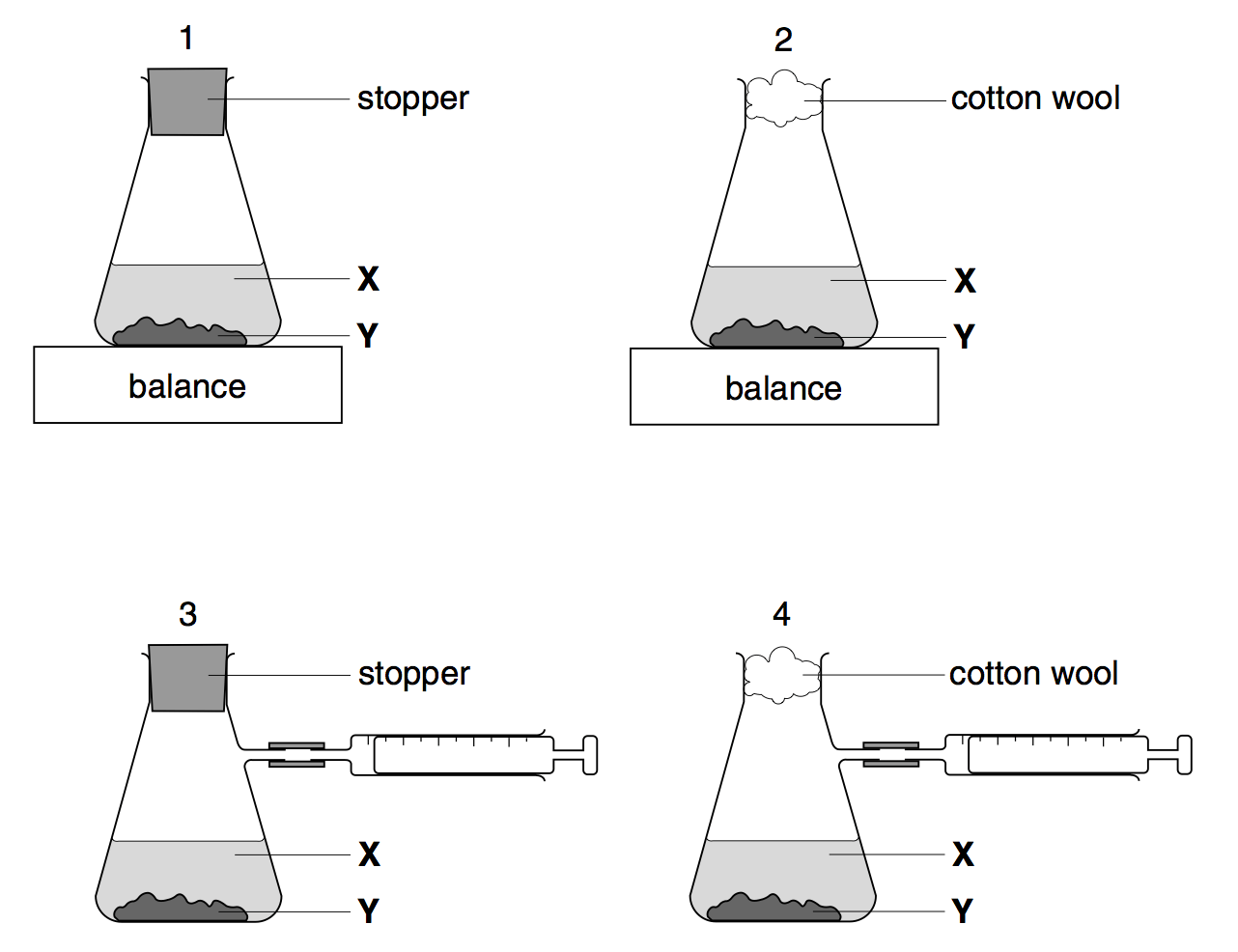
A liquid X reacts with solid Y to form a gas.
Which two diagrams show suitable methods for investigating the speed of the reaction? 
1
1 and 3
2
1 and 4
3
2 and 3
4
2 and 4

23

Multiple Select

This method can use to collect gas produced ...

1

using a gas syringe system

2

downwards water displacement

3

using digital balance

24

Multiple Choice

The following equation represents the reaction between calcium carbonate, CaCO3 and hydrochloric acid, HCl.

CaCO3 + 2HCl --> CaCl2 + CO2 + H2O

Which changes can be used to determine the rate of reaction?

I : mass of calcium carbonate per unit time

II : Volume of carbon dioxide released per unit time

III : Colour of solution per unit time

IV : Mass of precipitate produced per unit time

1

I and II

2

I and III

3

II and IV

4

III and IV

25

Multiple Choice

The following equation shows the reaction between calcium carbonate, CaCO3 and hydrochloric acid, HCl:


CaCO3(aq) + 2HCl(aq) → CaCl2(aq) + CO2 (g)­­ + H2O(l)


Which of the following is the suitable method to determine the rate of reaction?

1

Change in the temperature of the solution with time

2

Change in the volume of carbon dioxide gas with time

3

Change in the mass of water with time

4

Change in the concentration of hydrochloric acid with time

26

Multiple Choice

Question image

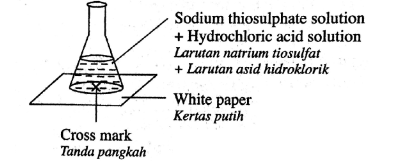
Diagram shows the apparatus set up for an experiment to determine the rate of reaction.

Which of the following techniques is the most suitable to determine the rate of reaction?

1

Record the time as soon as precipitate is formed

2

Record the time taken to obtain the maximum temperature

3

Record the times as soon as the cross mark cannot be seen

4

Record the times taken for the change of the pH value until a fixed pH value is obtained

27

Multiple Choice

The reaction between zinc, Zn and hydrochloric acid, HCl is represented by the following equation.

Zn + 2HCl --> ZnCl2 + H2

A student wants to determine the rate of reaction in a school laboratory. Which of the following methods is the most suitable?

1

Determine the change in temperature of the solution with time

2

Determine the change in the concentration of zinc chloride with time

3

Determine the volume of hydrogen gas given off with time

4

Determine the change in the concentration of hydrochloric acid with time

28

​Determining the time for reaction with reference to some observable and measurable changes.

media

A) Reaction between zinc, Zn and sulphuric acid, H2SO4

29

Multiple Select

Question image

State the observable change? 

1

Change in electrical conductivity

2

Increase in the volume of gases

3

Change in pH Value

4

Change in pressure

30

Open Ended

Question image

How would you know the reaction completed?

31

​Determining the time for reaction with reference to some observable and measurable changes.

B) Reaction between nitric acid, HNO3 and marble chips, CaCO3

media

32

Multiple Select

Question image

State the observable change? 

1

Change in electrical conductivity

2

Decrease of the mass of the reactant

3

Increase in the volume of gases

4

Change in pH Value

5

Change in pressure

33

Multiple Select

Question image

State is the products obtain from this reaction?

1

Salt

2

water

3

hydrogen gas

4

carbon dioxide gas

34

Open Ended

Question image

How do you know that the reaction completed?

35

​Determining the time for reaction with reference to some observable and measurable changes.

c) Reaction between potassium iodide solution, KI and lead(II) nitrate solution, Pb(NO3)2

media

36

Multiple Select

Question image

State the observable change? 

1

Change in electrical conductivity

2

Decrease of the mass of the reactant

3

Increase in the volume of gases

4

Formation of precipitate

5

Change in pressure

37

Multiple Select

Question image

What is the colour of precipitate form

1

Brown

2

White

3

Yellow

38

  • ​Average Rate of Reaction

  • Instantaneous Rate of Reaction

Type of Rate Of Reaction

39

media

40

media

41

media

42

Multiple Choice

Question image

Table 4 shows the total volume of gas evolved at different intervals for the dissociation of hydrogen peroxide.


What is the average rate of reaction in the second minute?

1

14.0 cm3 min-1

2

16.0 cm3 min-1

3

18.0 cm3 min-1

4

28.0 cm3 min-1

43

Multiple Choice

Question image

Table 4 shows the total volume of gas evolved at different intervals for the dissociation of hydrogen peroxide.


What is the average rate of reaction in the second minute?

1

14.0 cm3 min-1

2

16.0 cm3 min-1

3

18.0 cm3 min-1

4

28.0 cm3 min-1

44

Multiple Choice

Question image

Table 7 shows the volume of carbon dioxide gas collected in an experiment for the reaction between excess calcium carbonate and hydrochloric acid.

What is the average rate of reaction for the experiment?

1

0.12 cm3 s-1

2

0.18 cm3 s-1

3

0.22 cm3 s-1

4

0.37 cm3 s-1

45

Multiple Choice

Question image

Table 19 shows the volume of gas collect for each minute for one reaction.

what is the rate of reaction for the first 4 minute of this reaction?

1

0.017 cm3 s-1

2

0.111 cm3 s-1

3

0.133 cm3 s-1

4

0.150 cm3 s-1

46

Multiple Choice

In a reaction between magnesium carbonate and sulphuric acid, the following volume of carbon dioxide is collected for the 10 minutes period of reaction, with each reading taken every minute interval. 0 minute: 0  cm3cm^3   1 minute: 25  cm3cm^{3^{ }}   2 minute: 40  cm3cm^3   3 minute: 51  cm3cm^3   4 minute: 58  cm3cm^3   5 minute: 63  cm3cm^3   6 minute: 63  cm3cm^3   7 minute: 63  cm3cm^3   Calculate the rate of reaction from the 2 minute to 5 minute.

1

12.50  cm3min1cm^{3^{ }}\min^{-1}  

2

7.67 cm3 min1cm^3\ \min^{-1}  

3

12.60  cm3min1cm^3\min^{-1}  

4

20.00  cm3min1cm^3\min^{-1}  

47

media

The instantaneous rate of reaction is the rate of reaction at a particular point of time. It is determined from the experimental data by plotting a graph

media

48

Multiple Choice

Question image

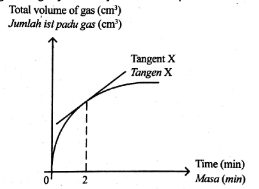
Diagram shows a graph to study the effect of total surface area on the rate of reaction.

What is represented by gradient tangent X?

1

Average rate of reaction in the first 2 minutes

2

Average rate of reaction in the 2nd minute

3

Overall average rate of reaction

4

Rate of reaction at the 2nd minute

49

Multiple Choice

Question image

Diagram 4 shows the graph of volume of carbon dioxide gas against time when 5 g of marble chips is added to

50 cm3 of 0.2 mol dm-3 hydrochloric acid.


At what time the rate of reaction the highest?

1

t1

2

t2

3

t3

4

t4

50

Multiple Choice

Question image

Which of the curves indicates the slowest reaction?

1

A

2

B

3

C

51

Multiple Choice

Question image

Which of the curves indicates the fastest reaction?

1

A

2

B

3

C

52

Multiple Choice

The equation represents the reaction between sodium carbonate and hydrochloric acid.

Na2CO3 + 2 HCl → 2 NaCl + H2O + CO2


The mass of the beaker and its contents is plotted against time.

Which graph represents what happens when sodium carbonate reacts with an excess of dilute hydrochloric acid?

1
2
3
4

RATE OF REACTION

by SITI Moe

media

Show answer

Auto Play

Slide 1 / 52

SLIDE