
SCH3U: Unit #2 Review

Presentation
•
Chemistry
•
11th Grade
•
Practice Problem
•
Medium

Zeenat Shahidullah
Used 2+ times
FREE Resource
19 Slides • 27 Questions
1
Matter, Chemical trends, & Chemical Bonding
2
Multiple Choice

Does the following reaction violate Dalton’s Atomic Theory?
TRUE
FALSE
3
Daltons theory states that atoms cannot be created or destroyed
4
Multiple Choice
Isotopes of the same element differ in what property?
Proton
Electron
Neutron
Ice
5
Multiple Choice
Isotopes of the same element are similar by which property?
Proton
Electron
Neutron
Ice
6
Some elements contain isotopes:
Isotopes of the same element has the same amount of protons and electron but differ in the neutron amount. Which also increases of decreases the atomic mass
7
Fill in the Blanks
Identify the ion with a 1+ charge, atomic number 55, and mass number 133:
Type answer...
8
Cesium :
Atomic #: 55
Atomic Mass: 132.9
Charge: 1+
9
Draw
Draw the correct Bohr Diagram for: Argon
10

11
Multiple Choice
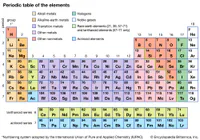
Periods tell us which characteristic?
Valence electrons
Amount of shells
Amount of protons
Amount of neutrons
12
Multiple Choice
Groups tell us which characteristic?
Valence electrons
Amount of shells
Amount of protons
Amount of neutrons
13
Periods tell us the amount of shells for the given element
Groups tell us the amount of valence electrons for the given element
14
Multiple Choice
Non-metals are good conductors of electricity?
TRUE
FALSE
15
Metals: shiny, malleable, good conductors of heat and electricity
Non-metals: dull, poor conductors of heat and electricity
Metalloids: conduct heat and electricity moderately well, possessing some properties of metal and non-metals
16
Multiple Select
Which groups are the MOST reactive (select all that applies)
Alkali metal
Alkali earth metals
Noble gasses
Transition metals
Halogens
Transition metals
Halogens
17
Halogens and Alkali metals are the most reactive because they are only one electron away from satisfying the octet rule:
Halogens: need to gain 1 electron
Alkali Metals: need to lose 1 electron
18
Multiple Choice
What group does Nitrogen belong to?
Alkali metals
Alkali earth metals
Pnictogens
Chalcogens
19

20
Multiple Choice
In an Ionization reaction is there a release of energy or absorption of energy?
Release energy
Absorption of energy
21

22
Multiple Choice
Does a cation gain protons to form a positive charge or does it lose electrons?
Gains protons
Loses electrons
23
Cations: Lose electrons to become more positive
Anions: Gain electrons to become negative
24
Multiple Select
Which of the following atoms would be expected to form negative ions in binary ionic compounds (select all that apply):
P
Mg
Cl
Cs
25
Multiple Select
What is the charge of: Lead (select all that applies)
2+
3+
4+
5+
26

27
Multiple Choice
Why is it incorrect to say NaCl is a molecular compound?
NaCl is made from an anion and cation
NaCl is made from a non-metal and metal
NaCl is a crystal
All of the above
28
NaCl is an ion:
Na is a metal with a charge of 1+ (CATION)
Cl is a non metal with a char 1- (ANION)
Forms a crystal (SALT)
29
Multiple Choice
Is this molecule ionic or covalent: NO
ionic
covalent
30
Covalent because the compound is made from two non-metals and if you calculate the electronegativity it will form covalent bonds
31
Draw
Draw the Lewis Dot Diagram for Se
32

33
Draw
Draw the correct Lewis dot diagram for the ion: As
RMR: to show the charge required to make it a full octet
34

35
Draw
Write Lewis structures for the following: ClNO
36

37
Multiple Choice
Which atom in each pair is more electronegative: Si or N
Si
N
38

Si: 1.8
N: 3.0
39
Multiple Choice
Identify the more polar bond in each of the following pairs of bonds:
SH
OH
40
SH: 2.5-2.1 = 0.4
OH: 3.5 -2.1 = 1.4
41
Multiple Choice
Identify if this compound has ionic, polar covalent, or non-polar covalent bonds: BH
Non-polar
Polar
Ionic
42
Multiple Choice
Name the following compound: CsCl
Cesium chlorine
Cesium chloride
Calcium chloride
Cesium Calcide
43
Multiple Choice
Name the following compound: S3O5
Sulfur oxide
Trisulfur oxide
Trisulfur pentaoxide
Sulfur pentaoxide
44
Fill in the Blanks
Write the formulas of the following compound: aluminum bromide
Type answer...
45
Multiple Choice
Write the correct chemical name for the following compounds: FeCl2
Iron Chloride
Iron Chloride (II)
Iron (II) Chloride
46
Multiple Choice
What is the correct name for Calcium nitrate?
CaNO₃
Ca(NO₃)₂
Ca(NO)₂
Matter, Chemical trends, & Chemical Bonding
Show answer
Auto Play
Slide 1 / 46
SLIDE
Similar Resources on Wayground

40 questions
PPT laju reaksi
Presentation
•
11th Grade
39 questions
TYPES OF REACTIONS.
Presentation
•
11th Grade
45 questions
Clase de P. Periódicas
Presentation
•
11th Grade
38 questions
Nomenclatura de compuestos binarios
Presentation
•
11th Grade
40 questions
manufactured of substances in industry
Presentation
•
10th - 11th Grade
40 questions
Concordância verbal
Presentation
•
KG
40 questions
Chemical and Physical changes
Presentation
•
10th - 12th Grade
44 questions
Molarity, Dilutions, & Gas Laws
Presentation
•
11th Grade
Popular Resources on Wayground
10 questions
Safety Day 2026 – Student Review

Quiz
•
9th Grade
21 questions
Continents and Oceans
Quiz
•
6th Grade
20 questions
Parts of Speech
Quiz
•
5th Grade
16 questions
Subject & Predicate
Quiz
•
5th Grade
25 questions
Multiplication Facts
Quiz
•
5th Grade
12 questions
Map Skills
Quiz
•
3rd Grade
22 questions
Continents and Oceans
Quiz
•
5th Grade
15 questions
Rounding Decimals
Quiz
•
5th Grade
Discover more resources for Chemistry
20 questions
electron configurations and orbital notation
Quiz
•
9th - 12th Grade
20 questions
Periodic Table Trends
Quiz
•
11th Grade
50 questions
Unit 3: Atomic Assault Summative Review
Quiz
•
11th Grade
20 questions
Physical or Chemical Change/Phases
Quiz
•
8th Grade - University
15 questions
Periodicity Module Exam Practice Quiz
Quiz
•
9th - 12th Grade
15 questions
Electron Configurations and Orbital Notation
Quiz
•
11th Grade
8 questions
Label Energy Diagram
Quiz
•
9th - 12th Grade
20 questions
Naming Covalent Compounds
Quiz
•
11th Grade