

Newton's Laws

Presentation
•
Science, Physics
•
4th Grade - University
•
Medium

Erin Hannan
Used 71+ times
FREE Resource
9 Slides • 6 Questions
1
Newton's Laws of Motion
Year 10
2
What we will cover
definitions of the 3 laws
real life examples
sample questions
3
Balanced and Unbalanced Forces
A force is a push, pull, or twist - that results in the changing shape or movement of an object
Forces can be balanced or unbalanced. Unbalanced forces will result in motion or a change in direction or speed.
Measured in Newtons (N)

4
1st Law
An object at rest will stay at rest and an object in motion will stay in motion, unless acted upon by an unbalanced force

Another name for this law is inertia.
Inertia = the resistance of any object (with mass) to change its velocity.
Example: if a bus stops suddenly, you lurch forward, even though the bus is no longer in motion
5


Examples:
Ball rolling on the ground (friction will eventually stop it)
Brakes being applied in a car
Fan continuing to move even after it is powered off
An object skating on ice

6
2nd Law
The acceleration of an object is proportional to the magnitude of the net force, and is inversely proportional to the mass of the object.
OR
Force = mass x acceleration
This makes logical sense, because the more mass an object has, the more force required to move it. Or, the more an object accelerates, the more force required to move it.

7
Example question:
How much force is required to accelerate a 2kg mass at 3m/s2?
force = mass x acceleration
force = 2 x 3
force = 6 N
How much force is required to accelerate a 10kg mass at 3m/s2?
Force = 10 x 3
force = 30 N
8
Newton's 3rd Law
For every action there is an equal and opposite reaction.
Every force is in a pair:
a swimmer propelling themselves through the water with their hands. The hands and the water are exerting an equal but opposite force direction on each other.
This does not mean they are balanced (and therefore cancel each other out), they are acting on different objects.

9


10
Multiple Choice

11
Multiple Choice
A lamp sitting on a table is demonstrating Newton's ___ Law.
1st
2nd
3rd
4th
12
Multiple Choice
Newton's 3rd Law states that for ever action there is an equal and opposite ________.
reaction
satisfaction
fraction
transaction
13
Multiple Choice
A ______ is a push or pull on an object.
force
speed
acceleration
velocity
14
Multiple Choice
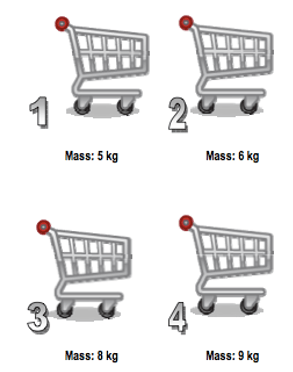
15
Multiple Choice
Your 2500 kg car experiences a net force of 5000 N. How fast will it accelerate?
20 m/s2
0.5 m/s2
2 m/s2
120 N
Newton's Laws of Motion
Year 10
Show answer
Auto Play
Slide 1 / 15
SLIDE
Similar Resources on Wayground

14 questions
Future Passive
Presentation
•
KG - University
13 questions
Speed v. Velocity
Presentation
•
8th Grade
12 questions
Volume
Presentation
•
4th Grade - University
10 questions
SIMPLE PAST
Presentation
•
KG - University
11 questions
What you know?
Presentation
•
KG
10 questions
UNIT 2 REVIEW
Presentation
•
5th Grade - University
14 questions
Weathering and Erosion
Presentation
•
KG - University
9 questions
Pronouns
Presentation
•
KG - Professional Dev...
Popular Resources on Wayground
6 questions
PRIDE Always and Everywhere
Presentation
•
12th Grade
20 questions
Lab Safety Quiz

Quiz
•
6th Grade
26 questions
KOR Review Kahoot Questions
Quiz
•
8th Grade
21 questions
Continents and Oceans
Quiz
•
6th Grade
12 questions
Unit Zero lesson 2 cafeteria
Presentation
•
9th - 12th Grade
20 questions
Parts of Speech
Quiz
•
5th Grade
10 questions
Riddles Riddles fun Riddles
Quiz
•
6th - 12th Grade
16 questions
Subject & Predicate
Quiz
•
5th Grade
Discover more resources for Science
20 questions
Lab Safety Quiz
Quiz
•
6th Grade
20 questions
Lab Safety
Quiz
•
5th - 8th Grade
10 questions
Scientific Method (The scientific method)

Interactive video
•
9th Grade
20 questions
Mixtures and Solutions Practice
Quiz
•
5th Grade
20 questions
Scientific Method and Variables
Quiz
•
8th Grade
20 questions
Scientific method and variables
Quiz
•
8th Grade
27 questions
Counting Atoms - Subscripts
Quiz
•
8th Grade
10 questions
6.6D - Relative Density Review
Quiz
•
6th Grade