PhySci Final Review 1: Motion
Presentation
•
Science, Chemistry, Physics
•
9th Grade
•
Medium
William Jared Lovering
Used 8+ times
FREE Resource
42 Slides • 33 Questions
1
PhySci Review for Final
By William Lovering
2
3
4
The Metric System
The metric system was designed as a way to standardize measurement and make conversions easier.
Before metrics units of measure many units were based off of body parts and so they commonly changed.
Standards were placed in city centers to compare to and often could be changed to short change peasants.
5
6
7
8
9
10
11
12
13
14
15
16
17
18
19
20
21
22
23
24
25
26
27
28
29
30
31
32
33
34
35
36
Newton's First Law
An object in motion tends to stay in motion unless acted upon by an unbalanced force.
An object at rest tends to stay at rest unless acted upon my an unbalanced force.
The first law is often called the law of inertia.
Inertia means that an object usually resist a change in motion. The more mass an object has, the more inertia it has. For example, a train has more inertia than feather.
37
38
39
Newton's Second Law
F= m * a
m=F/a
a = F/m
The more mass an object has, the more force is needed to accelerate it. The more force you apply, the more it will accelerate. There are a lot of applications of Newton's Second Law.
40
41
42
43
Multiple Choice
44
Multiple Choice
A mass of 27.4 grams would be an example of
qualitative data
quantitative data
45
Multiple Choice
Which of the following units would NOT be used to measure distance?
meters
centimeters
millimeters
kilograms
46
Multiple Choice
What is the mass (in grams) pictured on this triple beam balance?
3.5
206.5
200
263.5
47
Multiple Choice
Which of the following would best represent the volume of the liquid in this graduated cylinder?
20.6
25.8
25
0.6
48
Multiple Choice
49
Multiple Choice
50
Multiple Choice
51
Multiple Choice
52
Multiple Choice
An old lady rolls down a hill at 3 meters/second. The hill is 36 meters long. How many seconds does it take the old lady to reach the bottom of the hill?
39 seconds
12 seconds
15 seconds
33 seconds
53
Multiple Choice
What is the average speed of a cheetah that sprints 100 m in 4 s?
25 m/s
0.04 m/s
25 s
104 m/s
54
Multiple Choice
What is a difference between distance and displacement
Distance is measured in seconds and displacement is measured in meters
Distance is always shorter than displacement
Displacement can be equal to zero if the object ends in the place it began in
Distance can be equal to infinite when only a small distance has been travelled
55
Multiple Choice
This occurs when an object speeds up, slows down, or changes direction.
Speed
Velocity
Acceleration
56
Multiple Choice
In each of the following cases, determine where the car has no acceleration?
A car speeds up after a stoplight turns green.
A car slows down as it approaches a red light
A car with the cruise control set at 80 km/h going down a straight highway
A car turning a curve at a constant speed
57
Multiple Choice
The SI unit for acceleration is
mph
ft/sec
m/s2
m/s
58
Multiple Choice
59
Multiple Choice
An object and rest will stay at rest and an object in motion will stay in motion unless acted on by a force, is which one of Newton's Laws of Motion?
4th Law of Motion
1st Law of Motion
3rd Law of Motion
2nd Law of Motion
60
Multiple Choice
61
Multiple Choice
62
Multiple Choice
63
Multiple Select
A push or pull on an object, causing it to move, stop, or change direction.
motion
gravity
force
inertia
64
Multiple Select
A force that slows down an object when it rubs against another object.
gravity
velocity
inertia
friction
65
Multiple Select
An object's resistance to any change in motion.
inertia
velocity
speed
friction
66
Multiple Choice
Equal forces that do not cause a change in an objects motion
Unbalance force
Push or a pull
Balanced force
Average speed
67
Multiple Choice
68
Multiple Choice
If a force of 50 Newton's was applied to an object with a mass of 0.5 kilograms, what will the object's acceleration be?
10 m/s2
0.1 m/s2
100 m/s2
1 m/s2
69
Multiple Choice
70
Multiple Choice
71
Multiple Choice
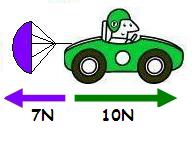
What is the net force?
17N Left
3 N, right
10N Right
3N Left
72
Multiple Choice
73
Multiple Choice
What is the acceleration of an object that has a mass of 5 g and is hit with a force of 10 N?
50 m/s2
2 m/s2
15 m/s2
5 m/s2
74
Multiple Choice
75
Multiple Choice
While driving down the road, a firefly strikes the windshield of a bus and makes a quite obvious mess in front of the face of the driver. The firefly hit the bus and the bus hits the firefly. Which of the two forces is greater: the force on the firefly or the force on the bus?
Firefly
Bus
Equal Forces
PhySci Review for Final
By William Lovering
Show answer
Auto Play
Slide 1 / 75
SLIDE

Similar Resources on Wayground
65 questions
Waves Properties
Presentation
•
9th Grade
68 questions
Byzantine Empire
Presentation
•
9th Grade
71 questions
HHE 2.2 Energy Transfers
Presentation
•
8th Grade
74 questions
Y10 Lesson 1.5 Forces in Motion
Presentation
•
9th Grade
70 questions
Chapter 10 Earthquakes and Volcanoes
Presentation
•
8th Grade
67 questions
Grade 10: Mirrors and Lenses
Presentation
•
10th Grade
71 questions
1st 6 Weeks Test Review
Presentation
•
9th Grade
69 questions
Pehchaan Kaun
Presentation
•
KG
Popular Resources on Wayground
20 questions
STAAR Review Quiz #3
Quiz
•
8th Grade
20 questions
Equivalent Fractions
Quiz
•
3rd Grade
6 questions
Marshmallow Farm Quiz
Quiz
•
2nd - 5th Grade
20 questions
Main Idea and Details
Quiz
•
5th Grade
20 questions
Context Clues
Quiz
•
6th Grade
20 questions
Inferences
Quiz
•
4th Grade
19 questions
Classifying Quadrilaterals
Quiz
•
3rd Grade
12 questions
What makes Nebraska's government unique?
Quiz
•
4th - 5th Grade
Discover more resources for Science
46 questions
Unit 4 Geosphere Test Review
Quiz
•
9th - 12th Grade
25 questions
Naming Ionic and Covalent Compounds
Quiz
•
9th Grade
20 questions
Human Impact on the Environment Review #2
Quiz
•
9th Grade
16 questions
Ecosystem Stability
Quiz
•
9th Grade
20 questions
Mendelian Genetics Review
Quiz
•
9th Grade
12 questions
Unit 6 Quiz #3 (Life Cycles of Stars)
Quiz
•
9th Grade
34 questions
Human Impact on Ecosystems Quiz
Quiz
•
9th Grade
10 questions
Exploring Alfred Wegener's Continental Drift Theory
Interactive video
•
6th - 10th Grade