Search Header Logo
Atoms, Periodic Table, Ions and Bonding

Atoms, Periodic Table, Ions and Bonding

Assessment

Presentation

•

Science

•

9th Grade

•

Hard

•
NGSS
HS-PS1-1, MS-PS1-1, MS-PS2-3

+3

Standards-aligned

Created by

Kate NICHOLLS

Used 7+ times

FREE Resource

1 Slide • 25 Questions

1

Atoms, Periodic Table, Ions and Bonding

By Kate NICHOLLS

2

Multiple Choice

Subatomic particle with a negative charge, has very little mass compared to other particles

1

Proton

2

Neutron

3

Electron

4

Alpha Particle

3

Multiple Choice

Subatomic particle with positive charge identifies the atom

1

Proton

2

Neutron

3

Electron

4

Alpha Particle

4

Multiple Choice

Atomic mass is equal to the number of protons plus _______.

1

Protons

2

Neutrons

3

Electrons

4

Alpha particles

5

Multiple Choice

An atom with high ionization energy has 7 valence electrons, when this atom gains an electron, it becomes a __________ ion.

1

Positive

2

Negative

3

Neutral

4

Covalent

6

Multiple Choice

_________ give away electrons to become positive ions and __________ steal electrons to become negative ions.

1

Metals, metals

2

Nonmetals, nonmetals

3

Nonmetals, metals

4

Metals, nonmetals

7

Multiple Select

Which combination of elements form ionic bonds? Select all that apply.

1

metal and nonmetal

2

nonmetal and nonmetal

3

two of the same elements

4

two elements with electronegativity difference > 1.7

8

Multiple Choice

What part of the atom does bonding involve?

1

protons

2

neutrons

3

all electrons

4

valence electrons

9

Multiple Choice

How many valence electrons do MOST atoms need to be stable?

1

6

2

8

3

3

4

5

10

Multiple Choice

Which of the following is the correct ionic formula for calcium sulfide?

1

Ca2S2

2

CaS

3

S2Ca2

4

SCa

11

Multiple Choice

Name the compound from it's formula: BaI2

1

Iodine barium

2

Iodine bariumide

3

Barium iodine

4

Barium iodide

12

Multiple Choice

What is the charge for each iron atom (Fe) in Fe2O3:

1
+2
2
+3
3
+1
4
-2

13

Multiple Choice

How many valence electrons does Calcium have?

1

1

2

2

3

3

4

4

5

5

14

Multiple Choice

How many valence electrons does Sulfur have?

1

4

2

5

3

6

4

7

5

8

15

Multiple Choice

Question image
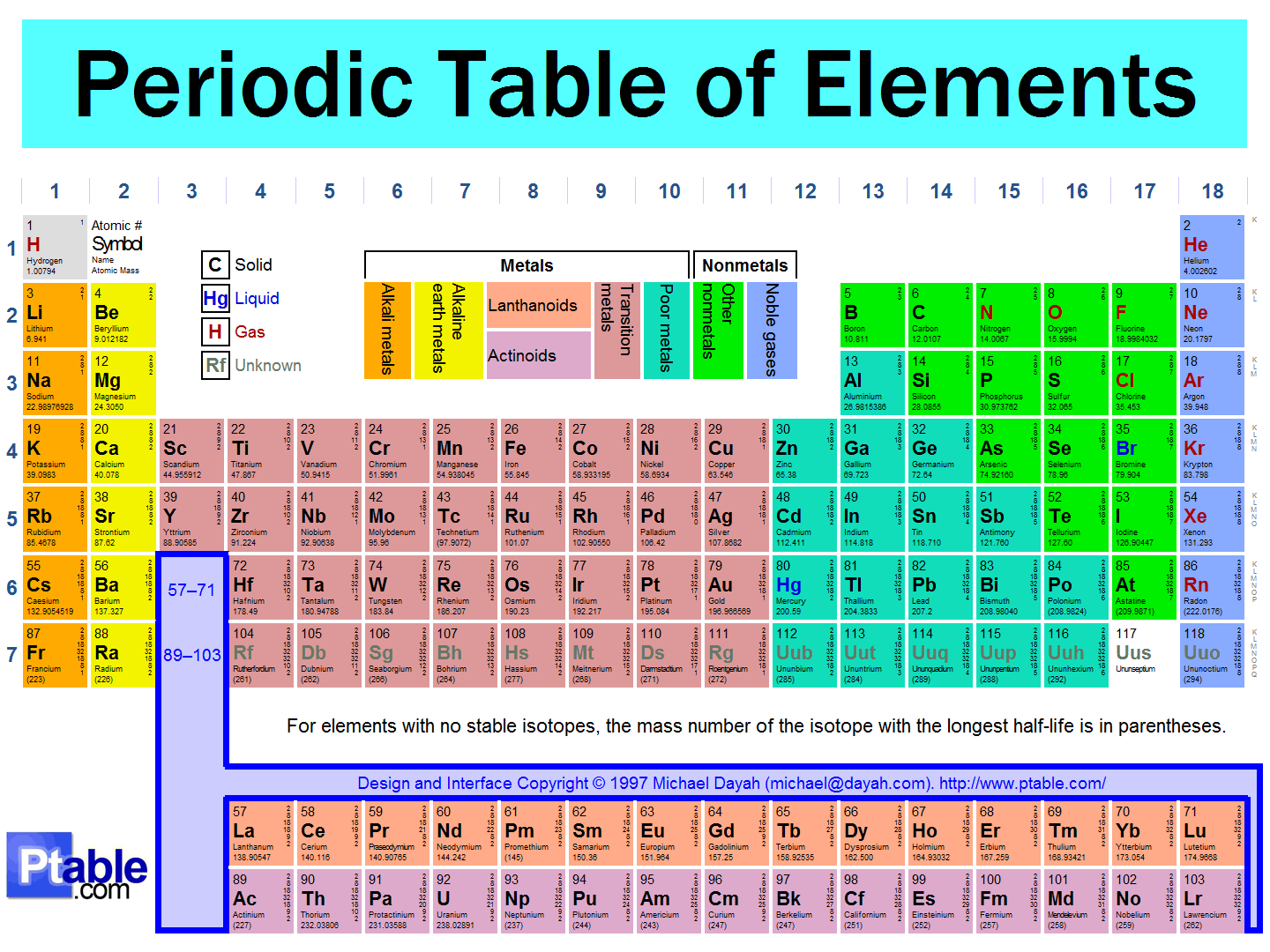
The horizontal row on the periodic table is called a
1
group
2
family
3
period
4
atomic number

16

Multiple Choice

Magnesium Hydroxide is an ionic compound made up from Mg2+ and OH- ions. Which is its correct formula?

1

MgOH

2

MgOH2

3

Mg(OH)2

4

MgO

17

Multiple Choice

Question image
This is a correct dot diagram for fluorine (F)
1
true
2
false

18

Multiple Choice

Which type of ion results from the loss of electrons and has a positive charge?

1

cation

2

anion

19

Multiple Choice

Which of the following groups on the Periodic Table will only form ions with positive charges?

1

Group 2

2

Group 15

3

Group 17

4

Group 18

20

Multiple Choice

A compound is

1

anything that has mass

2

any element that cannot be broken down into a simpler substance.

3

a substance consisting of two or more different elements in a fixed ratio

4

any element on the periodic table

21

Multiple Choice

What is a group?

1

There are seven in the periodic table, with each one beginning at the far left.

2

A horizontal row of the periodic table.

3

A vertical column on the periodic table

4

Begins when a new principal energy level begins filling with electrons.

22

Multiple Select

Metals (select all that apply)

1

are found on the right side of the periodic table.

2

are found on the left side of the periodic table.

3

are good conductors of heat and electricity.

4

are brittle.

5

are malleable and ductile.

23

Multiple Choice

Question image

Which element is found in group 2, period 6?

1

Oxygen (O)

2

Barium (Ba)

3

Selenium (Se)

4

Carbon (C)

24

Multiple Choice

Which is an alkali metal?
1
Magnesium
2
Iron
3
Sodium
4
Europium

25

Multiple Choice

If an atom had the same properties as fluorine (F), it would probably be located in
1
period 1.
2
period 2.
3
group 2.
4
group 17.

26

Multiple Choice

Atoms with similar properties are most likely located...
1
in the same period.
2
in the same group.
3
in different periods.
4
to the right and left of each other.

Atoms, Periodic Table, Ions and Bonding

By Kate NICHOLLS

Show answer

Auto Play

Slide 1 / 26

SLIDE