

Vector Quantities CXC

Presentation
•
Mathematics
•
10th Grade
•
Medium

r Henderson
Used 2+ times
FREE Resource
18 Slides • 23 Questions
1
At the end of this session students will be able to :
distinguish between scalar and vectors and give examples of each
state that vectors can be represented using an arrow .

2
Scalar : has magnitude only | Vector: has magnitude and direction |
|---|---|
distance | displacement |
speed | velocity |
time | acceleration |
energy | force |
3
Scalars | Vectors |
|---|---|
Physical quantities have magnitude only but no direction | Physical quantities have magnitude and direction |
These quantities are completely described by : 1 a number 2 a suitable unit | These quantities are completely described by 1 a number 2 a suitable unit 3 a direction |
These quantities are added, subtracted , multiplied and divided by simple arithmetic rules | These quantities cannot be added ,subtracted, multiplied and divided by simple arithmetic rules. |
| |
4

The tail is the starting position.
The head is the ending position.
The magnitude represents how long or large the vector is.
For example, a vector representing 100 should be twice as long as a vector representing 50.
How To Draw a Vector
5
Multiple Choice
Another word for "size" is...
magnification
magnetism
magnitude
magnanimity
6
Multiple Choice
Wind blowing at 20 mph. Vector or scalar?
7
Multiple Select
Select the scalar quantities.
velocity
distance
energy
acceleration
speed
8
Multiple Choice
A deer running 15 meters per second due west. Vector or scalar?
9
Multiple Choice
10
Multiple Choice
11
Multiple Choice
12

13

14

15

16
Multiple Choice
17
Multiple Choice

18
Multiple Choice
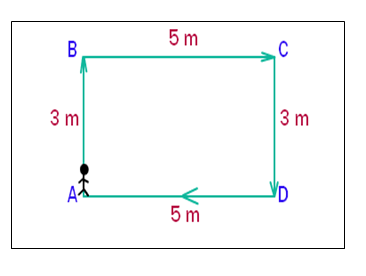
Michael walks in the following order: from Point A, to Point B, and finally to Point C. Which is true?
Distance and displacement are EQUAL
Distance is less than displacement
Displacement is less than distance.
19
Multiple Choice
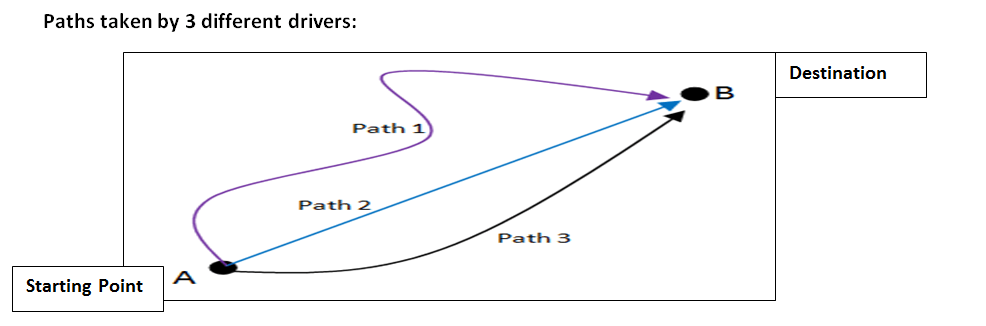
Which driver has an equal distance and displacement at B?
1
2
3
20
Multiple Choice
An example of scalar magnitude:
velocity
mass
acceleration
force
21
Multiple Choice
22
Multiple Choice
23
Multiple Choice
The students are arguing over the differences between speed and velocity. One student says, “Speed is a vector because it describes how fast an object traveling. Velocity is a scalar because it tells how fast and what direction an object is traveling.” Which of the following statements is correct?
The students' understanding of all four terms (speed, velocity, scalar, and vector) is correct.
The students' understanding of all four terms (speed, velocity, scalar, and vector) is incorrect.
The students' understanding of speed and velocity is incorrect but their
understanding of scalar and vector is correct.
The students’ understanding of speed and velocity is correct but their understanding of scalar and vector is incorrect.
24
Multiple Choice
25
Multiple Choice
26
Multiple Choice
You slowly walked 10 km West and then quickly ran 10 km North. During each part of the journey, the ______________ was the same.
displacement
distance
time
velocity
27
Multiple Choice
An example of scalar magnitude:
velocity
mass
acceleration
force
28
Multiple Select
Two cars are travelling at 10 m/s, in different directions. Select the sentences that are true.
Their speeds are the same.
Their speeds are different.
Their velocities are the same.
Their velocities are different.
29
At the end of this session students will be able to :
calculate the resultant of vectors which are parallel, anti-parallel and perpendicular;
30
In this class we will focus on calculating the resultant of vectors that are :
parallel
antiparallel
perpendicular


31
Multiple Choice

What's the sum of the vectors?
50 N -->
50 N <--
350 N -->
350 N <--
32
Multiple Choice

What's the sum of the vectors
13N -->
13 N <--
113 N -->
113 N <--
33
34
35
Choose a scale and indicate it on a sheet of paper. The best choice of scale is one that will result in a diagram that is as large as possible, yet fits on the sheet of paper.
Pick a starting location and draw the first vector to scale in the indicated direction. Label the magnitude and direction of the scale on the diagram (e.g., SCALE: 1 cm = 20 m).
Starting from where the head of the first vector ends, draw the second vector to scale in the indicated direction. Label the magnitude and direction of this vector on the diagram.
Repeat steps 2 and 3 for all vectors that are to be added
Draw the resultant from the tail of the first vector to the head of the last vector. Label this vector as Resultant or simply R.
Using a ruler, measure the length of the resultant and determine its magnitude by converting to real units using the scale
36
Find the Resultant Vector, R, of two vectors, 15 N east and 10 N at an angle of 45° from the horizontal.


37
At the end of this session students will be able to :
explain that a single vector is equivalent to two other vectors at right angles.
38
Sometimes a single vector needs to be changed into an equivalent set of two component vectors that are at right angles to each other
Any vector can be “resolved” into two component vectors at right angles
Components: two vectors at right angles that add up to a given vector
Resolution: the process of determining the components of a vector The perpendicular components of a vector are independent of each other.
39
Vector V represents a vector quantity First, horizontal and vertical lines are drawn from the tail of the vector Second, a rectangle is drawn that encloses the vector V.
The sides of the rectangle are the desired components, vector.

40
Find the Resultant Vector, R, of two vectors, 15 N east and 10 N at an angle of 45° from the horizontal.
41
Draw
Find the Resultant Vector, R, of two vectors, 15 N east and 10 N at an angle of 45° from the horizontal.
At the end of this session students will be able to :
distinguish between scalar and vectors and give examples of each
state that vectors can be represented using an arrow .
Show answer
Auto Play
Slide 1 / 41
SLIDE
Similar Resources on Wayground

38 questions
Factoring
Presentation
•
10th Grade
36 questions
Rounding 4/24
Presentation
•
10th Grade
37 questions
Types of Plate Boundaries
Presentation
•
10th Grade
34 questions
Lesson 2: Expressions & Linear Equations/Inequalities
Presentation
•
10th Grade
35 questions
Modeling Linear Relationships : Slope
Presentation
•
9th Grade
36 questions
Sectors Arc Length
Presentation
•
10th Grade
35 questions
Similar Triangles
Presentation
•
10th Grade
36 questions
The Brain
Presentation
•
10th Grade
Popular Resources on Wayground
10 questions
How much do you know about our Portrait of an Eagle?

Quiz
•
10th Grade
10 questions
Fast Food Slogans
Quiz
•
6th - 8th Grade
21 questions
Continents and Oceans
Quiz
•
6th Grade
20 questions
Parts of Speech
Quiz
•
5th Grade
16 questions
Subject & Predicate
Quiz
•
5th Grade
25 questions
Multiplication Facts
Quiz
•
5th Grade
12 questions
Map Skills
Quiz
•
3rd Grade
22 questions
Continents and Oceans
Quiz
•
5th Grade
Discover more resources for Mathematics
10 questions
Identifying equations
Quiz
•
KG - University
12 questions
Identify Rigid Transformations
Quiz
•
8th - 12th Grade
9 questions
Proving lines are parallel using angles
Quiz
•
9th - 11th Grade
10 questions
Midpoint Formula
Quiz
•
10th Grade
12 questions
Parallel Lines Cut by a Transversal
Quiz
•
10th Grade
15 questions
Triangle Sum Theorem and Exterior Angle Theorem
Quiz
•
10th Grade
15 questions
2.3 (b) Domain & Range Lesson Check
Quiz
•
9th - 12th Grade
20 questions
Classifying Real Numbers
Quiz
•
6th - 12th Grade