Plate Tectonics
Presentation
•
Science
•
KG
•
Medium
Kim Wilson
Used 88+ times
FREE Resource
0 Slides • 49 Questions
1
Multiple Choice
the place where two plates meet
cross section
pattern
surface
plate boundary
2
Multiple Choice
Earth's outermost layer of hard, solid rock that is underneath the soil, vegetation, and water
plate
mantle
outer layer or crust
surface
3
Multiple Choice
one of the very large sections of hard, solid rock that make up Earth's outer layer
cross section
mantle
trench
plate
4
Multiple Choice
a sudden shaking of Earth's surface
earthquake
pattern
tornado
storm
5
Multiple Choice
the layer of soft, solid rock underneath Earth's plates
plate boundary
plate
mantle
outer layer
6
Multiple Choice
an underwater mountain range formed when two plates move apart (Divergent)
trench
rift
mid-ocean ridge
earthquake
7
Multiple Choice
a long, deep indentation in the ocean floor formed when two plates move together
rift
pattern
mantle
trench
8
Multiple Choice
any of the many processes in which gas, lava, and ash are pushed out on the surface of the earth.
earthquake
volcanic activity
rifting
tornado
9
Multiple Choice
the slow pulling apart of land that is caused by plate movement
rifting
moving
spacing
converging
10
Multiple Choice
Divergent Boundary
Convergent Boundary
Transform Boundary
Subduction
11
Multiple Choice
America
Super Earth
Pangea
Eurasia
12
Multiple Choice
Convergent Boundary
Divergent Boundary
Transform Boundary
Subduction
13
Multiple Choice
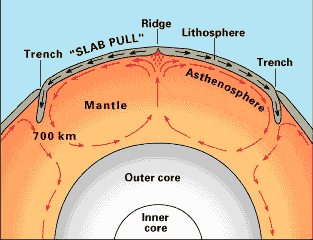
The lithosphere is ismade of dense solid meal whle the asthenosphere is made of liquid molten metal
The lithosphere is a mixture of gasses while the asthenosphere is made of solid rock
The lithosphere is molten rock that moves while the asthenosphere is ridid and thin
The lithosphere is made of solid rock while the asthenosphere is more flexible hot rock that moves.
14
Multiple Choice
Rifts
Mountains
Ocean Ridges
Radiation
15
Multiple Choice
_______________ Currents within the mantle cause the earth's plates to move and shift. molten material rises and falls due to density, heat, and gravity
Convection
Radiation
Conduction
Wind
16
Multiple Choice
Convection Currents
Conduction
Mountains
Rifts and ocean ridges
17
Multiple Choice
Earthquake
Volcano
Convection Current
Gravitational Pull
18
Multiple Choice
Earth's plates meet at ____________.
plate tectonics
plate boundaries
continental drift
oceans
19
Multiple Choice
Breaks in the crust called __________ form where plates meet.
mountains
rift valleys
faults
trenches
20
Multiple Choice
Plates slide past each other at _________________ boundaries.
divergent
convergent
transform
universal
21
Multiple Choice
What is the motion of Earth's plates like?
fast and in stages
slow and in stages
fast and constant
slow and constant
22
Multiple Choice
Rocky Mountains
Mariana Trench
Mid Atlantic ridge
23
Multiple Choice
submarine zone
divergence zone
subduction zone
lower zone
24
Multiple Choice
In some areas of the world, like California and Japan, earthquakes are a common occurrence. How can this best be explained?
The strong ocean currents are undermining both areas causing earthquakes.
Both areas are located near the edge of the Pacific Ocean, the unstable sand causes earthquakes.
Both areas are subjected to strong ocean wind and waves that causes earthquakes.
Both areas are on the boundary of active plates, the motion of the plates causes earthquakes.
25
Multiple Choice
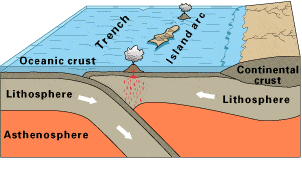
Observe this diagram of a plate boundary. One statement BEST describes what is happening. It is that
the oceanic crust is melting.
the denser ceanic crust is subducting under the less dense oceanic crust
volcanic islands are forming.
the tectonic plates are moving away from each other.
26
Multiple Choice
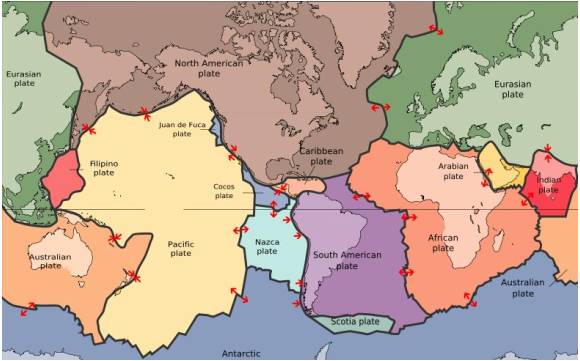
The map in the picture shows tectonic plate boundaries. This map would be useful in predicting the location of future
droughts
hurricanes
earthquakes
tornadoes
27
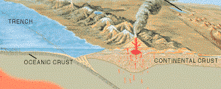
Multiple Choice
diverging tectonic plates
erosion of the land by the ocean
converging tectonic plates
deposition of sediments by the ocean
28
Multiple Choice
continental and oceanic
ocean and basin
lower and upper
thick and thin
29
Multiple Choice
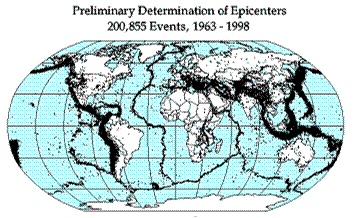
Earthquake epicenters (center of where the earthquakes started) were mapped for a 35 year period in the diagram above. The black dots indicate these epicenters. The black dots appear along what feature on Earth?
hot spots
plate boundaries
rift zones
sea floor spreading
30
Multiple Choice
What is the source of energy that drives plate movement?
the subducton of the sea floor
the different densities of the oceanic and crustal plates
convection currents in the asthenosphere
the friction force between the plates that move past each other
31
Multiple Choice
death ring
fire zone
ring of fire
zone of fire
32
Multiple Choice
The Theory of Plate Tectonics says that:
Large solid pieces of Earth called Plates make up which layer of the Earth?
The crust
The atmosphere
The inner core
The mantle
33
Multiple Choice
What is the effect of plates moving?
volcanoes
earthquakes
tornadoes
both volcanoes and earthquakes
34
Multiple Select
What is true about the Earth's outer layer?
it is made of hard, solid rock
it is made of soft, solid rock
it is broken in plates
it is broken in mantle
it is moving at a slow rate
35
Multiple Choice
The plates of the Earth moved
suddenly.
gradually.
36
Multiple Select
Which terms describe this plate boundary?
convergent
divergent
mid ocean ridge
trench
sinking
37
Multiple Choice
What patterns can you see on this map?
Earthquakes happen in similar places.
Earthquakes and volcanoes happen in similar places on plate boundaries.
Volcanoes happen in similar places.
Volcanoes and earthquakes happen in this order: volcano, earthquake, volcano, earthquake, and so on.
38
Multiple Choice
What happens when two plates are moving toward each other?
The plates hit each other and break into pieces making sand.
One plate goes underneath the other plate into the soft rock below.
The plates push against each other, making the edges bend upward.
One plate goes underneath the other plate into the ocean below.
39
Multiple Choice
Where will geologists find hard, solid rock?
neither under continents or oceans, because there is sand and water under both.
neither under continents or oceans, because there is water under both places.
only under the continents, but not under the oceans.
under both continents and oceans, because Earth's outer layer is made of hard, solid rock.
40
Multiple Choice
The Lystrosaurus fossils can be found in India and South America, which are parts of different plates. This is a land animal that can not swim. What could explain how these fossils got so far apart?
The plates slowly moved apart as soft solid rock from underneath got added to the edges of the plates over millions of years.
The plates floated away from each other.
The plates slowly moved apart as new plates from underneath got added between them over millions of years.
The plates were sometimes pushed far apart by earthquakes and soft solid rock from underneath got added to the edges of the plates.
41
Multiple Choice
What happens when two plates move apart?
a new plate from underneath fills in the gap created by the plates moving apart
sand and dirt fill in the gap created by the plates moving apart
water fills in the gap created by the plates moving apart
soft, solid rock from underneath the plates rises up and hardens, adding solid rock to the edges of both plates.
42
Multiple Choice
Harry Hess
Galileo
Alfred Wegener
Newton
43
Multiple Choice
Convergent boundary
Transform Boundary
Divergent Boundary
44
Multiple Choice
Pangaea.
Wegener.
Panthalassa.
Euraisa.
45
Multiple Choice
When subduction happens, which plate will go under the other plate?
the denser one
the less dense one
the one with magma
the one with mountains
46
Multiple Choice
When two plates converge on land, they form_______.
mountains
rivers
valleys
lakes
47
Multiple Select
These two things are often seen at tectonic plate boundaries.
volcanos
earthquakes
erosion
hurricanes
48
Multiple Choice
Earthquakes occur near faults because _________.
One plate pushes the other plate up.
A portion of the plate gets stuck then suddenly loosens then moves.
49
Multiple Choice
Where are the tectonic plates located?
Lithosphere
Aesthenosphere
Biosphere
Atmosphere
the place where two plates meet
cross section
pattern
surface
plate boundary
Show answer
Auto Play
Slide 1 / 49
MULTIPLE CHOICE

Similar Resources on Wayground
43 questions
Earth's Biomes
Presentation
•
7th Grade
41 questions
Earthquakes Notes w/ videos
Presentation
•
9th - 12th Grade
45 questions
Lewis Dot Structures
Presentation
•
7th - 8th Grade
45 questions
social emotional learning
Presentation
•
6th Grade
45 questions
moon phases
Presentation
•
8th Grade
46 questions
Minerals & Mining
Presentation
•
9th Grade - University
46 questions
Anatomical Direction, Planes & Cavities
Presentation
•
8th - 12th Grade
46 questions
APT Test Review
Presentation
•
6th - 8th Grade
Popular Resources on Wayground
6 questions
Secondary Safety Quiz
Presentation
•
9th - 12th Grade
10 questions
MyPath Diagnostic Overview
Presentation
•
6th - 8th Grade
20 questions
Lab Safety Quiz
Quiz
•
6th Grade
21 questions
Continents and Oceans
Quiz
•
6th Grade
20 questions
Adding and Subtracting Decimals
Quiz
•
5th Grade
20 questions
Parts of Speech
Quiz
•
5th Grade
16 questions
Subject & Predicate
Quiz
•
5th Grade
21 questions
Lab Safety
Quiz
•
10th Grade
Discover more resources for Science
20 questions
Place Value
Quiz
•
KG - 3rd Grade
16 questions
Lab Equipment
Quiz
•
KG
20 questions
Community helpers
Quiz
•
KG - 3rd Grade
15 questions
Subject and Predicate
Quiz
•
KG - 3rd Grade
12 questions
Nouns and Verbs
Quiz
•
KG - 2nd Grade
10 questions
Four Types of Sentences
Quiz
•
KG - 12th Grade
12 questions
Globes and maps
Presentation
•
KG
15 questions
Digraph Practice
Quiz
•
KG