Search Header Logo
CYCLE 2 SUB LESSON

CYCLE 2 SUB LESSON

Assessment

Presentation

Science

6th Grade

Hard

NGSS
MS-PS1-1, MS-PS1-2

Standards-aligned

Created by

Vasilios Savopoulos

FREE Resource

20 Slides • 35 Questions

1

Review: Density, Pure Sub and Mixture

*This actually WILL BE GRADED

media

2

media
media

​The amount of matter in an object or substance

​​Mass

​The amount of gravitational pull on an object based upon it's mass

​​Weight

​The amount of space that matter takes up

​​Volume

​The amount of mass in a given volume

D = M/V​

​​Density

media
media

Review these definitions

3

Multiple Choice

What is matter?

1

Anything that takes up space.

2

Anything that has mass.

3

Anything that takes up space and has mass.

4

Anything that you can measure.

4

Multiple Choice

What is mass?

1

The amount of a space a substance takes up.

2

The amount of matter in a substance.

3

The amount of substance packed into a given space.

4

The mass of a substance divided by the space it takes up.

5

Multiple Choice

What is volume?

1

The amount of a space a substance takes up.

2

The amount of matter in a substance.

3

The amount of substance packed into a given space.

4

The mass of a substance divided by the space it takes up.

6

media

Rectangular objects - calculate volume by using the formula:​

Volume = Length x Width x Height.​

Volume is measured in different ways depending on what shape the object has.

Let's practice using this formula on the next slide.

7

Multiple Choice

Calculate the volume of a block that is 5 m long, 6 m wide, and 2 m high.

1

10 m3

2

30 m2

3

60 m3

4

120 m3

8

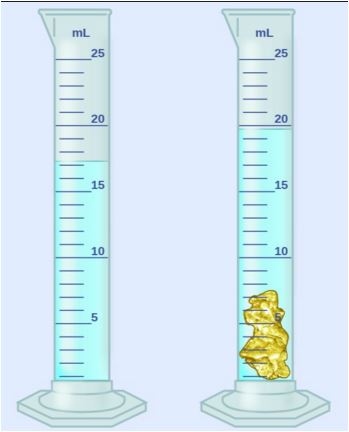
One way would be to put the object in liquid that is inside a graduated cylinder. The liquid in the cylinder will rise the same amount as the volume of the object.

Subtract the final liquid volume reading from the starting volume reading to find the volume of the object.​

Science tool definition: A graduated cylinder is a tall narrow cylinder with markings used to measure volume of liquids!

So, then, how do you measure the volume of an irregular shaped object?

media

This is called the DISPLACEMENT METHOD

9

media
  • Tool to help you remember your formulas

  • ​D= M/V

  • M= D x V

  • V= M/D ​

Density- Mass- Volume Triangle

10

Multiple Choice

What is the formula for calculating density?

1

density = mass x volume

2

density = mass / volume

3

density = mass + volume

4

density = mass - volume

11

Multiple Choice

What is the density of a liquid that has a volume of 50 mL and a mass of 4 g?

1

50ml divided by 4g= 12.5 g/mL

2

50mL x 4g= 200 g/mL

3

4g divided by 50 mL= 0.08 g/mL

4

not enough information to find the answer

12

Multiple Choice

Question image
Jack has a rock. The rock has a mass of 14g and a volume of 2cm3. What is the density of the rock?
1

7 mL

2

7 g/cm3

3

28 g/cm3

4

1/7 g/cm3

13

Multiple Choice

If I cut a block of gold in half, what happens to its density?

1

Density is cut in half.

2

Density stays the same.

3

Density doubles.

4

Density cannot be determined.

14

Multiple Choice

If an object has a density of 3.6 g/mL and you put it into water, will it sink or float?  
1

sink

2

float

15

  • Different parts are visible.

  • uneven distribution of parts

  • least mixed of all mixtures

  • Easiest mixture to separate​

Heterogeneous

  • appears the same throughout.

  • can NOT see different parts

  • very well mixed

  • MOST are Solutions (a substance dissolved in another)​

Homogeneous

​Mixtures: Same or Different?

Mixtures are classified as Homogeneous or Heterogeneous.

16

Multiple Choice

Question image
An irregularly shaped stone was lowered into a graduated cylinder holding a volume of water equal to 200 ml. The height of the water rose to 280 ml. If the mass of the stone was 240 g, what was its density?
1

3 g/mL

2

4 g/mL

3

2 g/mL

4

5 g/mL

17

Multiple Choice

Question image
Calculate the density of the cube.
1

2 g/cm3

2

4 g/cm3

3

6 g/cm3

4

8 g/cm3

18

Multiple Choice

Question image
Calculate the density of the cube.
1

2 g/cm3

2

4 g/cm3

3

6 g/cm3

4

8 g/cm3

19

Multiple Choice

Question image
An irregularly shaped piece of gold was lowered into a graduated cylinder holding a volume of water equal to 17 ml. The height of the water rose to 20 ml. If the mass of the gold was 27 g, what was its density?
1

9 g/mL

2

10.5 g/mL

3

6.5 g/mL

4

8 g/mL

20

Multiple Select

Which of the following are Pure Substances?

1

compounds

2

elements

3

mixtures

21

media

Benchmark Review

Pure Substances & Mixtures

22

​Classes of Matter

All matter is classified as a Pure Substance OR a Mixture of substances.

23

  • made up of 2 or MORE different substances PHYSICALLY combined.​

Mixture (of substances)

  • A substance that is chemically uniform throughout the substance.

  • Made of IDENTICAL particles.

  • can be an ELEMENT or a COMPOUND.

I

Pure Substance

​Pure Substances -vs- Mixtures

24

Models of Matter: Elements

A model of an element will have all the same atoms.

(same color, same shape, etc.)

media
media

​or

25

Models of Matter: Compounds

A model of a compound will have identical particles, but each particle is made of more than one color.

​or

media
media

*Notice how the particles in both diagrams are made up of different colors, but all of the particles are identical to each other.

26

Models of Matter: Mixtures

A model of a mixtures will have at least one particle that is NOT identical to the others.

media
media

Mixture

of

Compounds

media

Mixture

of

Elements

Mixture

of

Elements and Compounds

27

Multiple Select

Which of the following diagrams represent an element?

1
2
3
4

28

Multiple Select

Choose the diagrams that represent a compound.

1
2
3
4

29

More on Chemical Symbols

​Elements

​Compounds

  • more than 1 uppercase letter

    • = more than 1 type of atom = COMPOUND

  • Examples:

    • Iron Oxide - FeO

    • Sodium Chloride - NaCl

    • Water - H2O

  • 1 uppercase =

    • 1 type of atom = ELEMENT

  • Examples:

    • Iron - Fe

    • Oxygen - O

    • Hydrogen - H

    • Sodium - Na

30

Multiple Select

Which of the following substances are elements?

1

Ag

2

NaHCO3

3

KF

4

H2

31

Multiple Select

Choose all substances that are elements.

1

Hydrogen

( H )

2

Iron Oxide

(Fe2O3)

3

Baking Powder

4

Silicon

( Si )

32

More about Mixtures...

  • The different substances in a mixture are PHYSICALLY combined.

  • Because they are only PHYSICALLY combined, the different substances keep thier original properties.

  • P​arts of a mixture can be separated by PHYSICAL means.

33

Multiple Select

Which of the following are true of Mixtures?

1

made of identical particles

2

parts physically combined

3

can be homogenous or heterogeneous

4

chemically uniform throughout

34

  • Different parts are visible.

  • uneven distribution of parts

  • least mixed of all mixtures

  • Easiest mixture to separate​

Heterogeneous

  • appears the same throughout.

  • can NOT see different parts

  • very well mixed

  • MOST are Solutions (a substance dissolved in another)​

Homogeneous

​Mixtures: Same or Different?

Mixtures are classified as Homogeneous or Heterogeneous.

35

​Homogeneous

Examples​

​Heterogeneous

Examples​

media
media
media
media
media
media
media
media

36

Multiple Choice

Trail mix is a heterogenous mixture because __.

1

it can be physically separated

2

you can see the different parts

3

the parts are edible

4

it is made of more than 2 different substances

37

Multiple Choice

Which of the pictures represent a heterogenous mixture?

1
2
3
4

38

Multiple Choice

Which of the following mixtures is homogeneous?

1

fruit salad

2

milk

3

chicken noodle soup

4

chocolate chip cookie

39

Multiple Select

Which of the following are Pure Substances?

1

compounds

2

elements

3

mixtures

40

Multiple Select

Which of the following substances are elements?

1

Ag

2

NaHCO3

3

KF

4

H2

41

Multiple Choice

Which of the following substances are compounds?

1

O2

2

Cl2

3

Au

4

HF

42

Multiple Select

Which of the following models are pure substances?

1
2
3
4

43

​What is a Solution?

​A solution is a homogeneous mixture of two or more substances, one of which is usually a liquid.

The major component of solution is known as the solvent and the minor component is known as the solute

  • ​The substance which does the dissolving is the solvent

  • ​The substance being dissolved is the solute

media

44

​Saturated solutions

​A saturated solution is one in which the solvent cannot dissolve any more solute at a particular temperature in the presence of a undissolved solute

media

45

Multiple Choice

What is a Solution?

1

It is a heterogeneous mixture

2

It is a Homogeneous mixture

3

Compose of only solute

4

Compose of only Solvent

46

​What is a suspension?

​A suspension is a heterogeneous mixture in which minute, visible particles of one substance are dispersed in another substance, which is usually a liquid.

media
media
media

47

​What is a colloid?

​A colloid is a heterogeneous mixture of differently sized particles. They do not separate into layers when left to rest.

They are an intermediate between a solutions and a suspension

media
media
media
media

48

Multiple Choice

A type of mixture where the particles are larger than those in a solution but not heavy enough to settle out.

1

Homogeneous mixture

2

Colloid

3

Suspension

4

Compound

49

Multiple Choice

What is a suspension?

1

A mixture of two or more materials that separate on standing.

2

How hard of soft an object is when it hits against another object.

3

A mixture between two or more materials that mix together.

50

Multiple Choice

Question image
Sand floating in water, but most of the sand is settled at the bottom this an example of which type of mixture?
1

A solution

2

A colloid

3

A suspension

4

A compound

51

Multiple Choice

Question image

BLACK PEPPER, GARLIC AND VINEGAR

1

SOL

2

SUS

3

COL

52

Multiple Choice

Question image

Milk

1

Solution

2

Suspension

3

Colloid

53

Multiple Choice

Question image

Maple Syrup

1

Solution

2

Suspension

3

Colloid

54

Multiple Choice

Question image

Oil in Water

1

Solution

2

Suspension

3

Colloid

55

Multiple Choice

Question image

Seltzer Water

1

Solution

2

Suspension

3

Colloid

Review: Density, Pure Sub and Mixture

*This actually WILL BE GRADED

media

Show answer

Auto Play

Slide 1 / 55

SLIDE