Search Header Logo
ITB_1st Semester Exam Practice

ITB_1st Semester Exam Practice

Assessment

Presentation

•

Biology

•

9th - 12th Grade

•

Medium

Created by

Chiquita Gaylor

Used 1+ times

FREE Resource

5 Slides • 64 Questions

1

The information in these slides are questions similar to what we have covered during the course of this semester and will be covered on your Semester Exam.

​

Practicing for 1st Semester Exam

media

2

Characteristics of Life

Remember there are 8 characteristics that help determine the presence or absence of life.

1.Cellular Organization 2. Metabolism

3. Growth and Development 4. Reproduction

5. Homeostasis 6. Response to Stimuli

7.Adaptation to Evolution 8.Heredity

3

Multiple Choice

Question image
A _____ is something in the environment that causes an organism to respond.
1

stimulus

2

response

3

cause

4

effect

4

Multiple Choice

Question image
Which of these is not true about all organisms?
1

all living things have many cells

2

all living things need water

3

all living things respond to stimuli

4

all living things reproduce

5

Multiple Choice

Question image
When a baby kitten becomes an adult cat, this is an example of...
1

energy metabolism

2

growth and development

3

response to stimuli

4

having cells

6

Multiple Choice

Question image
Your body shivers when you are cold. This is because of the concept of...
1

homeostasis

2

heredity

3

energy metabolism

4

cellular organization

7

Multiple Choice

Living things are made up of units called

1

DNA

2

Cells

3

Homeostasis

4

Seeds

8

Multiple Choice

If an organism is made entirely of one cell it is called...

1

Multicellular

2

Prokaryotic

3

Unicellular

4

Eukaryotic

9

Multiple Choice

Living things are based on a universal genetic

code. What molecule is responsible for that code?

1

RNA

2

Lipid

3

Protein

4

DNA

10

Multiple Choice

The combination of chemical reactions through

which an organism builds up or breaks down

materials as it carries out its life processes is called ...

1

absorption

2

metabolism

3

digestion

4

consumption

11

Multiple Choice

Maintaining a stable internal

environment is called

1

homeostasis

2

equilibrium

3

balance

4

evenness

12

The Cell and Its History

​Cell are grouped based on the presence or absence of structures

13

Multiple Choice

Which type of cell has no nucleus?
1

Eukaryote

2

Prokaryote

3

Animal

4

Plant

14

Multiple Choice

Are prokaryotes multicellular or unicellular? 
1

Multicellular

2

Unicellular

15

Multiple Choice

Question image
Which type of cell?
1

Prokaryote

2

Eukaryote

3

Mixed

16

Multiple Choice

Has cytoplasm
1

Prokaryote

2

Eukaryote

3

both

4

yes

17

Multiple Choice

Has ribosomes
1

Prokaryote

2

Eukaryote

3

both

4

nihn

18

Multiple Choice

Plants and animal cells are examples of ___ cells 
1

prokaryotic cells 

2

eukaryotic cells 

19

Multiple Choice

The control center of the cell; contains DNA

1

mitochondria

2

nucleus

3

ribosomes

4

ER

5

Golgi Bodies

20

Multiple Choice

Where cellular respiration takes place to make energy for the cell

1

nucleus

2

mitochondria

3

Golgi Bodies

4

ER

5

lysosomes

21

Multiple Choice

Captures energy from the sun to make food in a plant cell

1

lysosomes

2

vacuoles

3

Golgi bodies

4

ribosomes

5

Chloroplasts

22

Multiple Choice

Transports materials throughout the cell, like a winding road

1

Golgi Bodies

2

cell membrane

3

ER

4

ribosomes

5

cytoskeleton

23

Multiple Choice

Stores materials in the cell like a closet

1

vacuoles

2

lysosomes

3

Golgi bodies

4

ribosomes

5

mitochondria

24

Multiple Choice

Produces proteins for the cell

1

ribosomes

2

lysosomes

3

vacuoles

4

mitochondria

5

chloroplasts

25

Multiple Choice

Helps remove wastes and damaged cell parts

1

vacuoles

2

chloroplasts

3

ribosomes

4

mitochondria

5

lysosomes

26

Multiple Choice

Which statement was NOT included in cell theory?

1

All living things are composed of cells.

2

Living cells come only from other living cells.

3

Each cell contains a cell membrane, cytoplasm, nucleus, mitochondria, and endoplasmic reticulum.

4

Cells are the smallest structure of living things that can perform the functions necessary for life.

27

Multiple Choice

Which instrument is credited for helping scientists develop cell theory?

1
2
3
4

28

Multiple Choice

Who discovered and named cells while looking at cork?

1

Captain Hook

2

Robert Hooke

3

Matthais Schleiden

4

Rudolf Virchow

29

Multiple Choice

What was Schleiden convinced of?

1

All plants are made of cells

2

All animals are made of cells

3

All cells are prokaryotic

4

None of the above

30

Multiple Choice

Who discovered that all cells come from other living cells and had research that lead to the last major principle of cell theory?

1

Matthias Schleiden

2

Theodore Schwann

3

Robert Hooke

4

Rudolf Virchow

31

Cellular Transport

32

Multiple Choice

Which of the following is the BEST definition for passive transport?

1

Movement of substances through a cell membrane from a high to low concentration without the use of energy

2

Movement of substances through a cell membrane from a low to high concentration requiring the use of energy

3

Movement of substances through a cell membrane from a low to high concentration without the use of energy

4

Movement of substance through a cell membrane from a high to low concentration requiring the use of energy

33

Multiple Choice

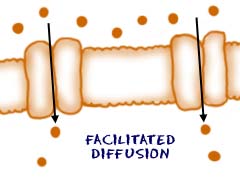
_____________ occurs when a substance is too large to flow through a cell membrane and it uses a protein "door".

1

Diffusion

2

Osmosis

3

Exocytosis

4

Facilitated Diffusion

34

Multiple Choice

Select the correct definition for "Osmosis":

1

A molecule is too large to pass through a cell membrane and therefore uses a transport protein

2

The movement of substances from a low to high concentration; cell energy is used

3

The movement of water from a high to low concentration through a selectively permeable membrane

4

The movement of substances from a high to low concentration

35

Multiple Choice

Which of the following transport methods moves substances from a low to high concentration?

1

Active Transport

2

Facilitated Diffusion

3

Osmosis

4

Passive Transport

36

Multiple Choice

Question image
1

Passive Transport

2

Active Transport

37

Multiple Choice

Question image
The cell below is in a _________ solution.
1

Hypotonic

2

Hypertonic

3

Isotonic

38

Multiple Choice

Question image
The cell below is in a _____________ solution.
1

Hypertonic

2

Hypotonic

3

Isotonic

39

Multiple Choice

A cell in an isotonic solution will
1

swell

2

shrink

3

stay the same size

4

impossible to tell

40

Types of Reproduction

41

Multiple Choice

Question image

The diagram below represents events that occur during Sexual Reproduction. The stages labeled A, B, and C are necessary to ensure that the offspring will inherit

1

half of their genetic material from each parent

2

double the amount of genetic material from each parent

3

double the amount of chromosomes from one parent

42

Multiple Choice

What are the two reasons for reproduction?

1

Survival of the species AND passing on genetic material to offspring

2

Survival of the species AND maintaining homeostasis

3

Survival of individual organisms AND passing on genetic material to offspring

43

Multiple Choice

What is an advantage of Asexual Reproduction?

1

Asexual reproduction is a slower type of reproduction

2

Asexual reproduction can save energy and happen faster

3

Asexual reproduction increases the risk of extinction

44

Multiple Choice

Which type of reproduction requires 2 parent cells combining to create a new cell (offspring)?

1

sexual

2

asexual

3

both

45

Multiple Choice

Which of the following is an advantage to sexual reproduction?

1

Rapid reproduction of a large amount of offspring

2

More genetic mutations occur

3

genetic variation

4

offspring are identical to parents

46

Multiple Choice

Question image

Hydras use a type of asexual reproduction in which they grow genetically identical offspring on the side of their body. This is an example of what type of asexual reproduction?

1

vegetative propogation

2

cloning

3

binary fision

4

budding

47

Multiple Choice

Occurs when an animal's offspring grows from a piece of its parent.

1

binary fission

2

budding

3

regeneration

4

vegetative propagation

48

Multiple Choice

Sexual reproduction requires ______ parent(s) and asexual reproduction requires ______ parent(s).

1

one, one

2

two, two

3

two, one

4

one, two

49

Multiple Choice

What is the correct name for a sex cell?

1

DNA

2

Gamete

3

Ovary

4

Chromosomes

50

Multiple Choice

The correct sequence of mitosis:

1

metaphase, anaphase, telophase, prophase

2

prophase, metaphase, anaphase, telophase

3

prophase, anaphase, metaphase, telophase

4

telophase, metaphase, prophase, anaphase

51

Multiple Choice

During which cycle can you identify chromosomes

1

G1 phase

2

G2 phase

3

S phase

4

M phase

52

Multiple Choice

Identical halves of a chromosome are called?

1

Cousins

2

Chromatids

3

Centromere

4

Centrosome

53

Multiple Choice

Chromosomes are visible and spindle fibers start to appear

1

prophase

2

metaphase

3

telophase

4

anaphase

54

Multiple Choice

Sister Chromatids separate from each other

1

prophase

2

telophase

3

anaphase

4

metaphase

55

Multiple Choice

Chromosomes line along the center of the cell

1

anaphase

2

prophase

3

metaphase

4

telophase

56

Multiple Choice

There are 2 nucli in one cell

1

telophase

2

prophase

3

anaphase

4

metaphase

57

Multiple Choice

Having only one copy of each chromsome

1

haploid

2

diploid

3

triploid

4

octoploid

58

Multiple Choice

The division of the cytoplasm is called?

1

anaphase

2

mitosis

3

cytokineses

4

G0

59

Multiple Choice

Non dividing state of the cell cycle

1

Interphase

2

Mitosis

3

Telophase

4

Cytokinesis

60

Multiple Choice

Uncontrolled growth can result in:

1

G0 phase

2

S phase

3

Replication

4

Cancer

61

Multiple Choice

Responsible for making sure that the cell is ready to divide

1

G1 checkpoint

2

G2 checkpoint

3

M checkpoint

4

G0 checkpoint

62

Multiple Choice

Cells of organism must replicate for ?

1

growth

2

repair of damaged tissue

3

replacement of dying cells.

4

All of the above

63

Multiple Choice

Involves 1 cell division (PMAT once)

1

Mitosis

2

Meiosis

3

Mitosis & Meiosis

64

Multiple Choice

Results in 2 identical daughter cells

1

Mitosis

2

Meiosis

3

Mitosis & Meiosis

65

Multiple Choice

Daughter cells are genetically identical

1

Mitosis

2

Meiosis

3

Mitosis & Meiosis

66

Multiple Choice

In humans, produces cells with 46 chromosomes

1

Mitosis

2

Meiosis

3

Mitosis & Meiosis

67

Multiple Choice

Question image

This diagram represents:

1

Mitosis

2

Meiosis

3

Mitosis & Meiosis

68

Multiple Choice

Results in 4 different (non-identical) daughter cells

1

Mitosis

2

Meiosis

3

Mitosis & Meiosis

69

Multiple Choice

Question image

This diagram represents

1

Mitosis

2

Meiosis

3

Mitosis & Meiosis

The information in these slides are questions similar to what we have covered during the course of this semester and will be covered on your Semester Exam.

​

Practicing for 1st Semester Exam

media

Show answer

Auto Play

Slide 1 / 69

SLIDE