

Phloem 9.2

Presentation
•
Biology
•
12th Grade
•
Medium

Claudia Escobar
Used 2+ times
FREE Resource
12 Slides • 34 Questions
1

2
Multiple Choice
I. adhesion
II. cohesion
III. evaporation
IV. active transport
I and II only
I, II and III only
I, and III only
I, II, III and IV
3
Multiple Choice
4
Multiple Choice
Tracheids
Sieve Tubes
Companion cells
Cambium cells
5
Multiple Choice
What is a halophyte?
Aquatic Plant
Heat tolerant Plant
Salt tolerant plant
Cold tolerant plant
6
Multiple Choice
Water molecules bonding to each other due to the hydrophobic nature of water.
Water molecules bonded to other other surfaces due to the transparency of water.
Water molecules sticking to each other due to the polarity of water.
Water molecules sticking to other surfaces due to the polarity of water.
7
Multiple Choice
reduced roots
hairy stomata
many stomata
thin cuticle
8
Multiple Choice
I. To get rid of excess CO2
II. To allow transpiration
III. To exchange gases with the environment
9
Multiple Choice
stem
roots
leaves
all of the above
10
Multiple Choice
What is the function of root hair?
it is a place to store the food and gas
it increases surface area to absorb more water
11
Multiple Choice
Which of these is TRUE?
Xylem carries water and dissolved minerals up the plant
Phloem carries water and dissolved minerals up the plant
Stomata carry water and dissolved minerals up the plant
12
Multiple Choice
Why is transpiration an inevitable consequence of gas exchange in the leaf?
Water creates a hypertonic environment in the leaf, but hypotonic environment everywhere else in the plant
When stomata open, only molecules containing oxygen may enter or leave the leaf
When stomata open for carbon dioxide absorption, water vapor leaves simultaneously
When stomata open for oxygen absorption, water vapor leaves simultaneously
13
Multiple Choice
When photosynthesis takes place during the day, stomata will...
open
close
14
Multiple Choice
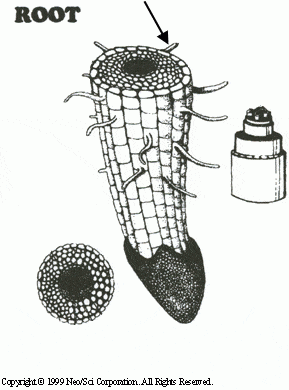
What is the name of the part of the root that allows water and minerals to enter?
epidermis
root hairs
phloem
phyla
15
Multiple Choice
Water and minerals move in which direction within the plant
Upward
Down
16
Multiple Choice
What part of the leaf prevents water loss?
Spongy mesophyll
Palisade mesophyll
Waxy cuticle
Xylem
17
Multiple Choice
Within a leaf, chloroplasts are found in abundance within the
Waxy cuticle
Guard cells
Xylem tissue
Palisade mesophyll
18
Multiple Choice
Which of the following is not an adaptation of a xerophyte?
Reduced leaves
Rolled leaves
Stomata in pits
Salt excretion
19
Multiple Choice
Within a stem, the vascular bundle is made up of
pith and cortex
guard cells
xylem and phloem
mesophyll cells
20
Multiple Choice
Guard cells are responsible for
protecting the roots from water loss
producing glucose for plant growth and metabolism
controlling the opening and closing of the stomata
producing xylem
21
Fill in the Blanks
Biting an Halophyte will give you a
Type answer...
22

Structure and function are correlated in the phloem of plants
23

Phloem Structure
Structure-function relationships of phloem sieve tubes
Companion Cell
Sieve Cell
Phloem comprise of sieve elements and companion cells
• Sieve elements
have no nuclei (to maximise space) and have thick and rigid cell walls (to withstand pressure)
connect to form a tube with porous plates at their transverse ends (allows material flow)
• Companion cells
possess a highly folded membrane to maximize SA:Vol ratio (more material exchange)
24


Active transport is used to load organic compounds into phloem sieve tubes at the source
Companion cells support phloem transport by:
•Providing metabolic support for sieve elements
•Facilitate loading and unloading at source (leaves) and sink (roots)
•Via interconnecting plasmodesmata (symplastic)
•By actively pumping materials from within the cell wall space of the companion cells (apoplastic)
Companion Cells
Companion cells move materials in two ways:

25

Phloem versus Xylem
Transports organic
molecules
End walls (sieve plates)
exist between cells
Two-way movement
(bidirectional)
PHLOEM
Cells are living but need
support (companion cells)
Transports water
and minerals
No end walls between cells
(continuous tube)
One-way movement
(unidirectional)
Outer cells are not living
(xylem vessel is hollow)
XYLEM
26
Multiple Select
The main types of phloem cells are listed below. Check the boxes that apply.
sieve tube elements
tracheids
companion cells
phloem parenchyma
phloem fibres
27
Fill in the Blanks
Another name for organic substances transported by the phloem is
Type answer...
28
Multiple Select
The organelles not present in the sieve tube elements - check all that apply.
mitochondria
nucleus
Golgi body
ribosomes
endoplasmic reticulum
29
Fill in the Blanks
The end wall of a sieve tube element is called a
Type answer...
30

Active Translocation
Plants transport organic compounds from sources to sinks
Translocation is the movement of organic compounds (e.g. sugars, amino acids) also called assimilates from sources to sinks
The source is where the organic compounds are synthesized – this is the photosynthetic tissues (leaves)
The sink is where the compounds are delivered for use or storage – this includes roots, fruits, and seeds
Organic compounds are transported from sources to sinks via a vascular tube system called the phloem
Sugars are principally transported as sucrose (disaccharide), because it is soluble but metabolically inert
The nutrient-rich, viscous fluid of the phloem is called plant sap
Source
Sink
PHLOEM
31
Fill in the Blanks
The phloem transports organic substances produced during
Type answer...
32
Fill in the Blanks
Another name for organic substances transported by the phloem is
Type answer...
33
Fill in the Blanks
State the term for the process of transporting carbohydrates in the phloem.
Type answer...
34
Fill in the Blanks
State the term for the location where compounds are delivered to for use or storage.
Type answer...
35

Source: Phloem Loading
High concentrations of solutes in the phloem at the source lead to water uptake by osmosis
Apoplastic loading is an active process that occurs
against a concentration gradient (and needs ATP)
•Protons are pumped out of phloem cells
•They passively return via a co-transport protein
which facilitates the joint movement of solutes
The build up of solutes in the phloem creates a
hypertonic solution that draws water via osmosis
H+
H+
S
S
ATP
H+
APOPLAST
PHLOEM
Active loading creates high
concentrations of solutes in
the phloem (hypertonicity)
36
Multiple Choice
Identify the source
Potato tuber
Fruit
Leaf
Seed
37
Multiple Choice
Identify the process used to load organic compounds into phloem sieve tubes at the source.
Endocytosis
Facilitated diffusion
Osmosis
Active transport
38

Phloem: Mass Flow
Incompressibility of water allows transport along hydrostatic pressure gradients
High concentrations of solute in the phloem draws water from the xylem (osmosis)
•The incompressibility of water causes the sap volume and pressure to increase
•High sap pressure at the source causes sap to move to the sink via mass flow
SOURCE
SINK
Xylem
Phloem
39
Multiple Choice
An increase in solute concentration in a phloem sieve tube causes water to be drawn in by what process?
Osmosis
Endocytosis
Facilitated diffusion
Simple diffusion
40
Multiple Choice
The active transport of solutes (such as sucrose) into the phloem by companion cells in the source makes the sap solution which of the following?
Isotonic
Hypotonic
Hypertonic
Dilute
41

Raised hydrostatic pressure causes the contents of the phloem to flow towards sinks
Sink: Phloem Unloading
Organic molecules are actively unloaded at sinks
•This lowers solute concentration in the phloem,
causing water to return to the xylem (osmosis)
•The drop in sap pressure maintains a pressure
gradient relative to the source (allows mass flow)
Direction of mass flow can be reversed according to
need (e.g. growing regions need nutrients from sinks)
Solutes
+ ATP
Metabolites
ATP
ATP
Storage
Metabolism
42

Summary: Phloem Transport
Translocation of sucrose
Transpiration of water
Source
(leaf cell)
Sink
(root cell)
Companion Cells
Active Translocation:
• Source produces
organic nutrients
• Loaded to phloem
• Water from xylem
raises sap pressure
• Mass flow (phloem)
• Unloaded at sink
43
Multiple Choice
Identify the source
Potato tuber
Fruit
Leaf
Seed
44
Multiple Choice
Sugars are principally transported in what form?
Glucose
Fructose
Sucrose
Starch
45


Translocation Rate
Analysis of data from experiments measuring phloem transport using aphid stylets and radioactive CO2
Translocation rates can be measured using
aphid stylets and radioactive carbon dioxide
• Aphids are insects that feed on sap in
phloem via a stylet (protruding mouthpiece)
• Plants incorporate radioactive CO2 to form
radioactively labeled sugars within the sap
• Severing a stylet allows sap to be collected
Aphid feeding on sap via stylet
46

Measuring Translocation
The rate of translocation can be measured according to the time taken for the
radioactively labeled sugars to be detected at various points along the phloem
Starter
colony
Colony
#1
Colony
#2
Colony
#3
Glass chamber containing radioisotope (14CO2)
Distance (cm)
0
20
40
60
Time (minutes)
0
85
170
220
Analysis of data from experiments measuring phloem transport using aphid stylets and radioactive CO2
Show answer
Auto Play
Slide 1 / 46
SLIDE
Similar Resources on Wayground

41 questions
APB Unit 6.1 - Cell Expression & Regulation #GoBioRams
Presentation
•
11th - 12th Grade
40 questions
Concordância verbal
Presentation
•
KG
40 questions
Wednesday 1004
Presentation
•
12th Grade
39 questions
Studying Human Populations
Presentation
•
12th Grade
40 questions
Mendelian Genetics and Punnett Squares
Presentation
•
12th Grade
40 questions
Median Genetics
Presentation
•
12th Grade
40 questions
Mendelian Inheritance
Presentation
•
12th Grade
43 questions
Skeletal System
Presentation
•
12th Grade
Popular Resources on Wayground
10 questions
Safety Day 2026 – Student Review

Quiz
•
9th Grade
21 questions
Continents and Oceans
Quiz
•
6th Grade
20 questions
Parts of Speech
Quiz
•
5th Grade
16 questions
Subject & Predicate
Quiz
•
5th Grade
25 questions
Multiplication Facts
Quiz
•
5th Grade
12 questions
Map Skills
Quiz
•
3rd Grade
22 questions
Continents and Oceans
Quiz
•
5th Grade
15 questions
Rounding Decimals
Quiz
•
5th Grade
Discover more resources for Biology
20 questions
Cell Transport
Quiz
•
9th - 12th Grade
8 questions
DNA vs. RNA
Presentation
•
9th - 12th Grade
16 questions
Epithelial tissues
Quiz
•
11th - 12th Grade
15 questions
DNA Structure and Replication
Quiz
•
9th - 12th Grade
20 questions
Ecological Succession Review
Quiz
•
9th - 12th Grade
3 questions
Enzymes & Energy
Quiz
•
9th - 12th Grade
38 questions
Mitosis & Meiosis
Quiz
•
9th - 12th Grade
37 questions
DNA/RNA practice part 2
Quiz
•
9th - 12th Grade