Y11 CS Unit 10 T5 Databases and SQL
Presentation
•
Computers
•
11th Grade
•
Practice Problem
•
Easy
Michael Harrington
Used 2+ times
FREE Resource
27 Slides • 26 Questions
1
Objectives
• Be able to create a single-table database including:
• Fields, Records and Validation
• Suggest suitable data types for fields, including:
• Text/Alphanumeric
• Boolean, Character, Integer and Real
• Date/Time
• Understand the purpose of primary keys
• Read, understand and complete SQL including:
• SELECT, FROM, WHERE, ORDER BY, SUM and COUNT
2
3
Databases and SQL
Unit 10 Advanced programming and databases
Starter
• Previously you saw how data could be stored and
accessed using a file
• Where else can data be stored
and accessed?
• Give some examples from
everyday life that use
such a system
4
Fill in the Blanks
Type answer...
5
Fill in the Blanks
6
Fill in the Blanks
7
Fill in the Blanks
8
Databases and SQL
Unit 10 Advanced programming and databases
Starter
• Data can be stored in a structured way in databases
• Examples include:
• Social media content
• Internet shopping sites – for products, prices, descriptions etc.
• School student records
• Tax records
9
Open Ended
Previously you saw how data could be stored and accessed using a file
Where else can data be stored and accessed?
Give 4 examples from everyday life that use such a system
10
Databases and SQL
Unit 10 Advanced programming and databases
The database concept
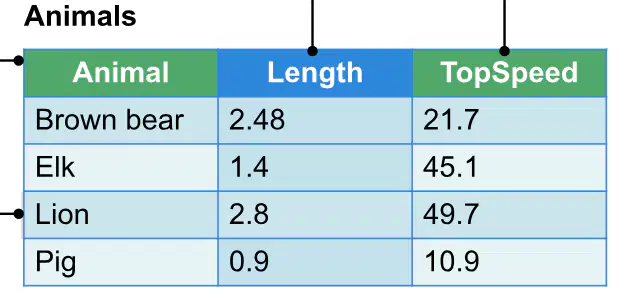
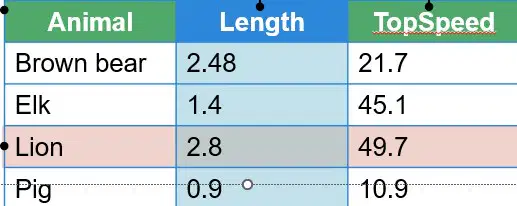
• A database is a structured way to store data so that
it can be retrieved using queries
Animal
Length
TopSpeed
Brown bear
2.48
21.7
Elk
1.4
45.1
Lion
2.8
49.7
Pig
0.9
10.9
Record
Field
Animals
Table
Table name Field name
11
Databases and SQL
Unit 10 Advanced programming and databases
Data types
• A developer is creating a
database for a local shop
which is starting to sell
products online
• What fields do you think
would need to be included
to store the customer
information?
• What data types will
these need to be?
12
Multiple Choice
A database is a structured way to store data so that it can be retrieved using queries
Which is an example of a Table Name?
queries
Brown bear
2.48
Animals
TopSpeed
13
Multiple Choice
A database is a structured way to store data so that it can be retrieved using queries
Which is an example of a Field Name?
Animals
Elk
2.48
Record
Length
14
Multiple Select
A database is a structured way to store data so that it can be retrieved using queries
Which ARE exampleS of a Field value not name?
Elk
Lion
1.4
10.9
21.7
15
Multiple Choice
A database is a structured way to store data so that it can be retrieved using queries
What is a Record?
Brown bear
A row of data in a date base table
A column of data in a table
I dont know
Animal
16
Databases and SQL
Unit 10 Advanced programming and databases
Data types
• Some possible fields the nail salon will need along
with their data type:
• Other data types include ‘character’ and ‘real’
Field names
Data type
FirstName
Text/alphanumeric
LastName
Text/alphanumeric
Mobile
Text/alphanumeric
DateJoined
Date/Time
NumberOfCustomerOrders
Integer
17
Databases and SQL
Unit 10 Advanced programming and databases
Primary keys
• A primary key is a field, where every value stored in
it will be unique
• It identifies the record
• What is the primary key used in the Customers table?
CustomerID
FirstName
LastName
Mobile
DateJoined
NumberOfCustomer
Orders
1
Grace
Evans
07700 900 452
6/10/2020
17
2
Lily
Thomas
07700 900 218
17/07/2020
23
3
Rosie
Scott
07700 900 213
09/05/2021
11
4
Nadia
Rahman
07700 900 892
26/02/2021
8
Customers
18
Match
Match the following Field names with a suitable Data type
Mobile
DateJoined
NumberOfCustomerOrders
Text / alphanumeric
Date /Time
Integer
Text / alphanumeric
Date /Time
Integer
19
Databases and SQL
Unit 10 Advanced programming and databases
Validation
• Validation allows rules to be placed on fields
• One rules is that a mobile number to start with a zero
• The rule for this is:
Like "0*"
• This means the text entered must start with 0 and then have
any other characters after
• What other validation could be carried out on the data?
20
Databases and SQL
Unit 10 Advanced programming and databases
Validation
• Data will need to be the correct data type (type validation)
• A length check can be used for the firstName, Lastname and
mobile number
• The DateJoined may also be validated
A validation to check a date is later than the 1stJan 2020:
>1/1/2020
21
Multiple Choice
What is the primary key used in the
Customers table?
FirstName
CustomerID
Mobile
NumberOfCustomerOrders
KeyID
22
Open Ended
A length check can be used for the firstName, Lastname and mobile number
Use one of these examples to say exactly what this means - explain fully to a non DB person.
23
Databases and SQL
Unit 10 Advanced programming and databases
What is SQL?
• SQL stands for Structured Query Language
• It is a language which allows you to create, query
and add data to databases
• SQL is used within most Database Management Systems,
including MySQL, SQL Server and MS Access
• SQL queries can be used within high level programming
languages such as Python, Visual Basic or C#
24
Fill in the Blanks
25
Databases and SQL
Unit 10 Advanced programming and databases
Writing a query using SQL
• The SQL syntax for querying a database is:
SELECT … (list the fields to be displayed)
FROM … (specify the table name)
WHERE … (list the search criteria)
26
Databases and SQL
Unit 10 Advanced programming and databases
The SELECT statement
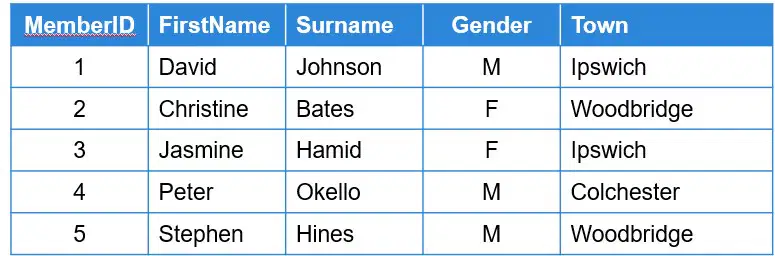
• The table above is named members
• The following SQL statement will select all the records and
fields from the table
SELECT MemberID, FirstName, Surname, Gender, Town
FROM members
MemberID
FirstName
Surname
Gender
Town
1
David
Johnson
M
Ipswich
2
Christine
Bates
F
Woodbridge
3
Jasmine
Hamid
F
Ipswich
4
Peter
Okello
M
Colchester
5
Stephen
Hines
M
Woodbridge
27
Reorder
The following SQL statement will select all the records and fields from the table
when you put THEM in the correct order
SELECT MemberID,
FirstName, Surname, Gender,
Town FROM members
28
Databases and SQL
Unit 10 Advanced programming and databases
Using a wild card
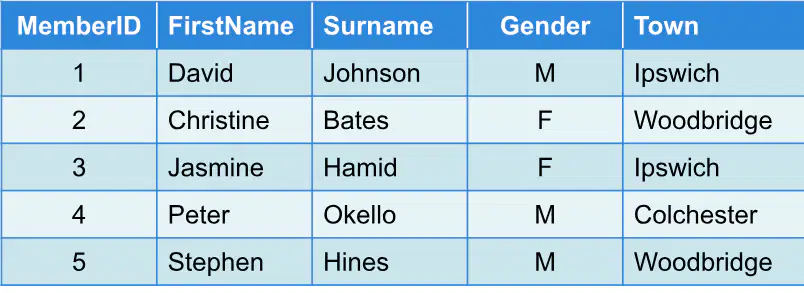
• You can use a “wild card” * to mean “all columns”
SELECT *
FROM members
• You can select specific columns in a query:
SELECT FirstName, Surname
FROM members
MemberID
FirstName
Surname
Gender
Town
1
David
Johnson
M
Ipswich
2
Christine
Bates
F
Woodbridge
3
Jasmine
Hamid
F
Ipswich
4
Peter
Okello
M
Colchester
5
Stephen
Hines
M
Woodbridge
29
Multiple Choice
The WHERE clause is used to select only records satisfying a specified condition:
SELECT Surname , Gender
FROM members
WHERE FirstName = 'Peter’
What is the result of this query?
[ which shows the fields selected, in order and for the correct gender]
30
Databases and SQL
Unit 10 Advanced programming and databases
The WHERE clause
• The WHERE clause is used to select only records
satisfying a specified condition:
SELECT FirstName, Surname
FROM members
WHERE Town = 'Ipswich’
• What is the result of this query?
MemberID
FirstName
Surname
Gender
Town
1
David
Johnson
M
Ipswich
2
Christine
Bates
F
Woodbridge
3
Jasmine
Hamid
F
Ipswich
4
Peter
Okello
M
Colchester
5
Stephen
Hines
M
Woodbridge
31
Databases and SQL
Unit 10 Advanced programming and databases
The WHERE clause
SELECT FirstName, Surname
FROM members
WHERE Town = 'Ipswich’
• Query result:
FirstName
Surname
David
Johnson
Jasmine
Hamid
MemberID
FirstName
Surname
Gender
Town
1
David
Johnson
M
Ipswich
2
Christine
Bates
F
Woodbridge
3
Jasmine
Hamid
F
Ipswich
4
Peter
Okello
M
Colchester
5
Stephen
Hines
M
Woodbridge
32
Databases and SQL
Unit 10 Advanced programming and databases
Operators in the WHERE clause
• You have already used some of these operators
in queries:
= != > < >= <= AND, OR, NOT
• You can use these operators in SQL queries:
SELECT *
FROM members
WHERE Town = 'Colchester' OR Town = ‘Ipswich'
SELECT FirstName, Surname
FROM members
WHERE (Town = 'Colchester' OR Town = ‘Ipswich') AND
Gender = 'F'
33
Databases and SQL
Unit 10 Advanced programming and databases
SELECT queries
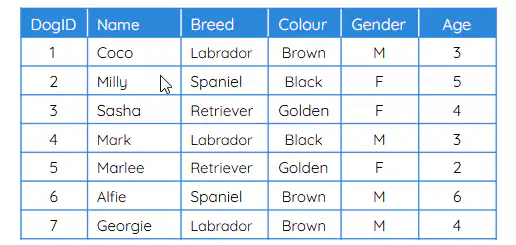
• Look at the following table named ‘Dogs’
• Write SQL queries to find:
• All the names and breeds of female dogs
• All fields for dogs older than four (including those aged four)
DogID
Name
Breed
Colour
Gender
Age
1
Coco
Labrador
Brown
M
3
2
Milly
Spaniel
Black
F
5
3
Sasha
Retriever
Golden
F
4
4
Mark
Labrador
Black
M
3
5
Marlee
Retriever
Golden
F
2
6
Alfie
Spaniel
Brown
M
6
7
Georgie
Labrador
Brown
M
4
34
Databases and SQL
Unit 10 Advanced programming and databases
SELECT queries
• Dogs table
• All the names and breeds of female dogs
• SELECT Name, Breed FROM Dogs WHERE Gender = 'F'
• All fields for dogs older than four (including those
aged four)
• SELECT * FROM Dogs WHERE Age >= 4
DogID
Name
Breed
Colour
Gender
Age
1
Coco
Labrador
Brown
M
3
2
Milly
Spaniel
Black
F
5
3
Sasha
Retriever
Golden
F
4
4
Mark
Labrador
Black
M
3
5
Marlee
Retriever
Golden
F
2
6
Alfie
Spaniel
Brown
M
6
7
Georgie
Labrador
Brown
M
4
35
Open Ended
Write SQL query to find:
All the colours, age and breeds of male dogs
36
Open Ended
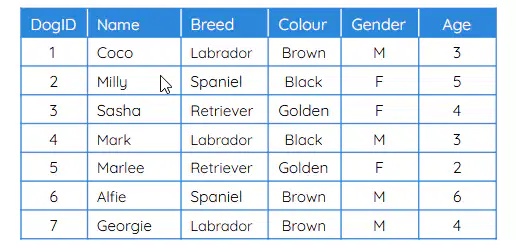
Write SQL query to find:
All the breeds of female dogs age over 5
37
Open Ended
Write SQL query to find:
All the names (just the name) of dogs that are black
Starts like this
SELECT Name
FROM Dogs
38
Databases and SQL
Unit 10 Advanced programming and databases
Sorting: the ORDER BY keyword
• ORDER BY allows a query to sort data by ascending
or descending order
• For ascending order
SELECT * FROM members
ORDER BY Surname ASC
• For descending order
SELECT * FROM members
ORDER BY Surname DESC
39
Databases and SQL
Unit 10 Advanced programming and databases
Sorting
• What will the result be for the following query?
SELECT FirstName, Surname
FROM members
ORDER BY Town ASC
MemberID
FirstName
Surname
Gender
Town
1
David
Johnson
M
Ipswich
2
Christine
Bates
F
Woodbridge
3
Jasmine
Hamid
F
Ipswich
4
Peter
Okello
M
Colchester
5
Stephen
Hines
M
Woodbridge
40
Databases and SQL
Unit 10 Advanced programming and databases
Result of sorting
• Result after execution of the statement:
SELECT FirstName, Surname, Town
FROM members
ORDER BY Town ASC
FirstName
Surname
Town
Peter
Okello
Colchester
David
Johnson
Ipswich
Jasmine
Hamid
Ipswich
Christine
Bates
Woodbridge
Stephen
Hines
Woodbridge
41
Databases and SQL
Unit 10 Advanced programming and databases
SUM and COUNT
• SQL is often used to count records or find the sum of
a particular field
• What do you think the results of the following
queries are?
SELECT COUNT(Quantity)
FROM Receipts
SELECT SUM(Cost)
FROM Receipts
ReceiptID
Product
Quantity
Cost
1
Apples
6
£2.20
2
Cheese
1
£2.50
3
Bread
2
£1.50
4
Pears
6
£1.80
Receipts
42
Databases and SQL
Unit 10 Advanced programming and databases
SUM and COUNT
• What do you think the results of the following
queries are?
SELECT COUNT(Quantity) FROM Receipts
Result:
SELECT SUM(Cost)
FROM Receipts
Result:
ReceiptID
Product
Quantity
Cost
1
Apples
6
£2.20
2
Cheese
1
£2.50
3
Bread
2
£1.50
4
Pears
6
£1.80
Receipts
COUNT(Quantity)
15
SUM(Cost)
£8.00
43
Databases and SQL
Unit 10 Advanced programming and databases
Plenary
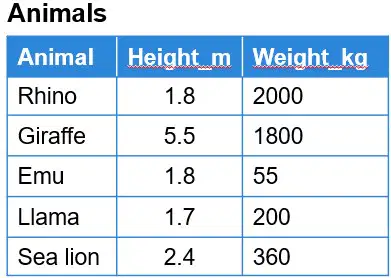
• Look at the table called
Animals on the right
• In pairs create SQL
statements for the following:
• Find all animal names in
alphabetical order
• Find all animal names and weights that are over 1000 kg
• Find all animals, including all fields that are over 2 m
Animal
Height_m
Weight_kg
Rhino
1.8
2000
Giraffe
5.5
1800
Emu
1.8
55
Llama
1.7
200
Sea lion
2.4
360
Animals
44
Databases and SQL
Unit 10 Advanced programming and databases
Animal
Height_m
Weight_kg
Rhino
1.8
2000
Giraffe
5.5
1800
Emu
1.8
55
Llama
1.7
200
Sea lion
2.4
360
Plenary
• All animal names in alphabetical order
SELECT Animal FROM Animals
ORDER BY Animal ASC
• All animal names and weights
that are over 1000 kg
SELECT Animal, Weight_kg FROM
Animals WHERE Weight_kg > 1000
• All animals, including all fields that are over 2 m
SELECT * FROM Animal WHERE Height_m > 2
Animals
45
Multiple Choice
How many records would this output?
SELECT Animal
FROM Animals
ORDER BY Animal ASC
3
5
4
0
6
46
Multiple Choice
How many records would this output?
SELECT Animal, Weight_kg
FROM Animals
WHERE Weight_kg > 2000
3
5
4
0
6
47
Multiple Choice
How many records would this output?
SELECT * FROM Animals
WHERE Height_m < 2
3
5
4
0
6
48
Multiple Choice
How many records would this output?
SELECT * FROM Animals
WHERE Height_m >= 2.4
3
5
4
0
2
49
Multiple Choice
How many records would this output?
SELECT * FROM Animals
WHERE Animals = "S*"
3
5
1
0
2
50
Multiple Choice
How many records would this output?
SELECT * FROM Animals
WHERE Height_m > 1.8
or Weight_kg >= 1800
3
5
1
0
2
51
Multiple Choice
How many records would this output?
SELECT * FROM Animals
WHERE Height_m = 5.5
AND Weight_kg = 1800
3
5
1
0
2
52
Multiple Choice
How many records would this output?
SELECT * FROM Animals
WHERE Height_m = 2000
AND Weight_kg = 1.8
3
5
1
0
2
53
Databases and SQL
Unit 10 Advanced programming and databases
Worksheet 5
• Now complete Worksheet 5
Objectives
• Be able to create a single-table database including:
• Fields, Records and Validation
• Suggest suitable data types for fields, including:
• Text/Alphanumeric
• Boolean, Character, Integer and Real
• Date/Time
• Understand the purpose of primary keys
• Read, understand and complete SQL including:
• SELECT, FROM, WHERE, ORDER BY, SUM and COUNT
Show answer
Auto Play
Slide 1 / 53
SLIDE

Similar Resources on Wayground
44 questions
Unit 8: Waves Review
Presentation
•
11th - 12th Grade
48 questions
WWII/Cold War Review
Presentation
•
11th Grade
49 questions
Exponential Growth and Decay
Presentation
•
10th - 12th Grade
51 questions
Language Review for AASA - Day 1
Presentation
•
KG
48 questions
Generative AI-Deepfake
Presentation
•
10th Grade - University
48 questions
matter
Presentation
•
11th Grade
53 questions
Computer Hardware and Software
Presentation
•
10th Grade
Popular Resources on Wayground
10 questions
Factors 4th grade
Quiz
•
4th Grade
10 questions
Cinco de Mayo Trivia Questions
Interactive video
•
3rd - 5th Grade
13 questions
Cinco de mayo
Interactive video
•
6th - 8th Grade
20 questions
Math Review
Quiz
•
3rd Grade
20 questions
Main Idea and Details
Quiz
•
5th Grade
20 questions
Context Clues
Quiz
•
6th Grade
20 questions
Inferences
Quiz
•
4th Grade
19 questions
Classifying Quadrilaterals
Quiz
•
3rd Grade