3.3 Pressure in gasses
Presentation
•
Science
•
7th Grade
•
Easy
William Katumba
Used 8+ times
FREE Resource
2 Slides • 62 Questions
1
Unit 3;
Recap of 3.1 & 3.2
Complete these questions to test your understanding of lessons 3.1 & 3.2 from yesterday.
2
Multiple Choice
On a distance VS time graph, the distance is always plotted on the
x-axis
y-axis
z-axis
can be on any of them
3
Multiple Choice
On a distance VS time graph, the time is always plotted on the;
x-axis
y-axis
z-axis
can be any of them
4
Multiple Choice
On a distance VS time graph, the slope of the line gives helps you find the ____
distance
time
speed
acceleration
5
Multiple Choice
This distance VS time graph show's an object that is ____ ____
Moving Fast
Moving Slow
6
Multiple Choice
This distance VS time graph show's an object that is ____ ____
Moving at a Fast speed
Moving at a Slow speed
Moving at a Medium speed
7
Multiple Choice
This distance VS time graph show's an object that is ____ ____
Moving Fast
Moving Slow
8
Multiple Choice
This distance VS time graph show's an object that is ____ ____
Speeding Up
Slowing Down
9
Multiple Choice
This distance VS time graph show's an object that is ____ ____
Speeding Up
Slowing Down
10
Multiple Choice
How far will Barkus go in 9 seconds?
9 meters
1 meter
6 meters
10 meters
11
Multiple Choice
S = t/d
S = d/t
S = d x t
S = t x d
12
Multiple Choice
A runner races in the 100 meter dash. It takes her 10 seconds to finish. What is her average speed?
10 m/s
1000 m/s
100 seconds
10 seconds
13
Multiple Choice
Which of the following is the standard unit of distance ?
miles
meters
kilometers
m/s
14
Multiple Choice
Which of the following is the standard unit of time?
seconds
minutes
hours
years
15
Multiple Choice
Which of the following is THE STANDARD unit of speed ?
miles/seconds
miles/hour
m/s
kilometers/hour
16
Multiple Choice
Avery rides her bike 15 miles in 5 hours. Which girl rides her bike faster?
Reese
Avery
17
Multiple Choice
If you are solving for the distance, you would calculate the...
time divided by speed
speed divided by time
speed multiplied by time
distance multiplied by speed
18
Multiple Choice
Based on the UNITS given, which of the following would be a correct answer for finding the SPEED.
S = 4 miles
S = 4 minutes
S = 4 min/miles
S = 4 miles/min
19
Multiple Choice
Which of the following could be a correct answer for solving for the time?
t= 4 kilometers
t = 4 km/hr
t = 4 hr
t = 4hr/km
20
Multiple Choice
Which of the following could be an answer if solving for the distance?
d = 4 seconds
d = 4 meters/second
d = 4 seconds/meters
d = 4 meters
21
Multiple Choice
If Sally is speeding through the parking lot at 18m/hr, and she travels 9 m, how long did it take her?
2 m/hr
0.5 hr
2 m
0.5 m
22
Multiple Choice
The speed of an object at one instant of time is called:
Average Speed
Instantaneous Speed
Velocity
Acceleration
23
Multiple Choice
The speed shown on the speedometer of a car is the
Total speed
Highest speed
Average speed
Instantaneous speed
24
Multiple Choice
The rate at which speed changes is known as;
{How quickly speed changes}
Speed
Velocity
Acceleration
Slope
25
Multiple Choice
Walking at a constant speed
Running fast
Not moving
Walking slow
26
Multiple Choice
Constant Speed
Acceleration
Decceleration
Not moving
27
Multiple Choice
According to the graph what was the average speed?
0 m/s
1.2 m/s
0.8 m/s
12 m/s
28
Multiple Choice
Soccer ball A
Soccer ball B
Their speeds are equal.
29
Multiple Choice
What is the formula for average speed?
Average Speed = Total Time undefined Total Distance
Average Speed = Total Time + Total Distance
Average Speed = Total Distance ÷ Total Time
Average Speed = Total Distance × Total Time
30
Multiple Choice
the speed relative to an observer
average speed
relative speed
regular speed
motion
31
3.3 Pressure in Gases
Use pages 162-163 to complete this lesson;
Lesson objectives;
At the end of this lesson, you should be able to;
Describe the factors that affect gas pressure
Describe how atmospheric pressure changes with height
32
Fill in the Blanks
Type answer...
33
Multiple Select
Today's 3.3 lesson objectives are;
interpret distance-time graphs
describe relative motion
describe the factors that affect gas pressure
describe how atmospheric pressure changes with height
describe how changes in speed cause acceleration
34
Multiple Choice
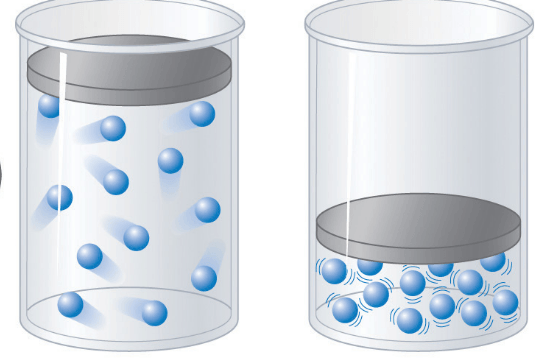
Page 162; Lots of collisions inside the balloon make a ____ gas pressure
low
medium
equal
none of these
35
Fill in the Blanks
Type answer...
36
Multiple Choice
TRUE or FALSE;
Gas pressure is exserted in only specific directions
TRUE
FALSE
37
Multiple Select
Page 162;
What happens when you squash the volume of a gas into a smaller volume? (Select 3 answers)
There will be more molecules because of a higher pressure
There will be more collisions between the molecules and the walls of the container
The pressure increases because there are more collisions
The temperature increases because there are more collisions
38
Multiple Select
Page 162; (Try this at home - HW)
What happens when you blow a balloon and place it inside the fridge to decrease its temperature?
The molecules move more slowly
The pressure goes down
There are fewer collisions
The balloon will collapse
The balloon will keep its shape
39
Multiple Select
Page 163;
What happens when you compress more air into a bicycle tyre as you pump it up!?
There are less molecules in the same space
There are more molecules in the same space
The pressure is bigger
A bigger force is exerted by the gas
There are more gas molecule collisions inside the tyre
40
Fill in the Blanks
Type answer...
41
Multiple Choice
Page 163; The pressure exerted on our bodies by the air around us is known as;
air pressure
gas pressure
pressure
atmospheric pressure
42
Multiple Select
Page 163; How come we do not feel the atmospheric pressure pushing on us from all directions around us?
{Select two answers
It cancels itself out
Its cancelled out by the gasses
Its cancelled out by the pressure of the gases and liquids in your body pushing out
It's balanced by our body's internal pressure
43
Multiple Choice
TRUE or FALSE; Page 163
The atmospheric pressure at sea level is the same as the the atmospheric pressure up a high mountain
TRUE
FALSE
44
Multiple Select
Page 163; (Select 4 answers
Which of these are true about atmospheric pressure?;
Gravity pulls the air particles towards the earth
The particles are closer and there are more collisions near the earth's surface
The pressure is higher at the earth's surface
The temperature is higher closer to the earth's surface
The temperature s lower closer to the earth's surface
45
Fill in the Blanks
Type answer...
46
Multiple Choice
Page 163; What does it mean to say "the gas has a higher density"?
there is more mass of a gas in a certain volume
there is less mass of a gas in a certain volume
there is equal mass of a gas in a certain volume
None of these
47
Multiple Choice
Page 163;
Why do mountaineers often take oxygen tanks when climbing high mountains like Everest?
There is high atmospheric pressure, which leads to low oxygen levels
There is a smaller atmospheric pressure, which leads to low oxygen levels
There is no atmospheric pressure, so they need oxygen tanks to breathe
The tanks contain oxygen gas
48
Multiple Choice
TURE or FALSE; Page 163
Oxygen tanks contain oxygen gas that has been compressed into a smaller volume
TRUE
FALSE
49
Multiple Choice
If a hairspray can is heated, what can be expected of the pressure of the gas inside the can?
The pressure will increase
The pressure will decrease
50
Multiple Choice
In all directions
In no direction
there is no pressure
51
Multiple Choice
We can increase the pressure of a gas by:
Not changing the temperature of the gas
Decreasing the temperature of the gas
Increasing the temperature of the gas
52
Multiple Choice
in an orderly fashion
constantly and randomly
in a circular motion
53
Multiple Choice
True
False
54
Multiple Choice
left
right
they both have the same pressure
55
Multiple Choice
Volume will increase
Volume will decrease
Volume will not change
56
Multiple Choice
The pressure inside the balloon will:
Decrease
Increase
Remain the same
57
Multiple Choice
The pressure of the gas in the balloon in the ice water will be:
Greater than that of the balloon in the boiling water.
Less than that of the balloon in the boiling water.
The same as that of the balloon in the boiling water.
58
Multiple Select
We can increase the pressure of a gas by:
Adding more gas.
Reduce the volume of the container.
Increase the temperature of the gas.
None of the above answers.
59
Multiple Choice
The reason gases can be compressed is because:
The particles are very close together.
The particles are merely vibrating.
The particles are unable to move.
The particles are very far apart.
60
Multiple Choice
At the bottom of the ocean
At the top of Mt Everest
Close to ground on the Scotch oval
In a rockpool on the Great Barrier Reef
61
Multiple Choice
There is too much oxygen in this location.
There is a higher density of air molecules.
There is a low density of air molecules.
The air pressure is greater than at low altitudes.
62
Multiple Choice
When a diver dives deeper into the ocean, he will experience ...................... liquid pressure
greater
less
no
63
Multiple Choice
Pressure rxerted by air on the earth's surface
Pressure
Atmospheric pressure
Heat pressure
64
Multiple Select
What were today's lesson objectives?
{ALL DONE! - DO THE HW ASSIGNMENT ON GOOGLE CLASSROOM}
Describe the factors that affect gas pressure
Describe how atmospheric pressure changes with height
describe what happens to a balloon in a fridge
Calculate speed
Unit 3;
Recap of 3.1 & 3.2
Complete these questions to test your understanding of lessons 3.1 & 3.2 from yesterday.
Show answer
Auto Play
Slide 1 / 64
SLIDE

Similar Resources on Wayground
60 questions
Structure of Cells and Organelles
Presentation
•
7th Grade
64 questions
Invasive & Endangered Species
Presentation
•
7th Grade
56 questions
Earth's History
Presentation
•
8th Grade
59 questions
SS6H1a/b Influences on Latin America
Presentation
•
6th Grade
57 questions
Energy Transformations
Presentation
•
6th - 8th Grade
60 questions
Electromagnetic Waves
Presentation
•
8th Grade
56 questions
Grade 7 Ecology Unit HW
Presentation
•
7th Grade
Popular Resources on Wayground
20 questions
"What is the question asking??" Grades 3-5
Quiz
•
1st - 5th Grade
20 questions
“What is the question asking??” Grades 6-8
Quiz
•
6th - 8th Grade
10 questions
Fire Safety Quiz
Quiz
•
12th Grade
20 questions
Equivalent Fractions
Quiz
•
3rd Grade
34 questions
STAAR Review 6th - 8th grade Reading Part 1
Quiz
•
6th - 8th Grade
20 questions
“What is the question asking??” English I-II
Quiz
•
9th - 12th Grade
20 questions
Main Idea and Details
Quiz
•
5th Grade
47 questions
8th Grade Reading STAAR Ultimate Review!
Quiz
•
8th Grade
Discover more resources for Science
19 questions
Introduction to Properties of Waves
Presentation
•
6th - 8th Grade
16 questions
Interactions within Ecosystems
Presentation
•
6th - 8th Grade
20 questions
genetics, punnett squares, heredity
Quiz
•
7th Grade
16 questions
Photosynthesis and Cellular Respiration Review
Quiz
•
7th Grade
20 questions
Abiotic & Biotic Factors
Quiz
•
7th Grade
18 questions
Conduction Convection Radiation
Quiz
•
7th Grade
20 questions
Asexual/Sexual Reproduction
Quiz
•
7th Grade
5 questions
Natural Selection
Interactive video
•
7th Grade