
7.1 Notes
Presentation
•
Science
•
6th - 8th Grade
•
Easy
+11
Standards-aligned
Landon Ahlers
Used 3+ times
FREE Resource
18 Slides • 22 Questions
1
7.1 (slides 1-35)
2
Things to know before we start:
•The world is full of
energy
•Everything that you do
or see requires or is a
product of energy
•Without energy, living
things could not
survive.
3
Energy and Work
•Work is the transfer of energy from one
object to another
•Energy is the ability to do work or the
ability to cause a change
•Whenever work is done, energy is
transformed or transferred
•Ex. Whenever you stretch a slingshot back,
you do work and you transfer energy from
your body to the elastic band.
4
Multiple Choice
Energy can't be .....
transformed.
made or destroyed.
converted.
harnessed or produced.
5
Multiple Choice
kinetic energy
potential energy
mechanical energy
electromagnetic energy.
6
Energy and Work
•Energy is measured in joules (J).
•Because energy is a measure of the
ability to do work, energy and work are
expressed in the same unit.
•Work requires an object to change its
motion; however, energy can be
present in an object when nothing is
happening at all.
7
Multiple Choice
Thermal
Chemical
Sound
Nuclear
8
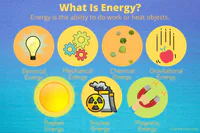
Types of Energy
•Mechanical Energy (kinetic & potential)
•Thermal Energy
•Chemical Energy
•Electromagnetic Energy
•Nuclear Energy
•Light Energy
•Sound Energy
•Electrical Energy
•Magnetism
9
Multiple Choice
What type of energy is being used when riding a bicycle?
mechanical
light
thermal
sound
10
Mechanical Energy
•Mechanical energy is the sum of
kinetic and potential energy in an
object that is used to do work.
•In other words, it is energy in an
object due to its motion or position,
or both.
11
Multiple Choice
Identify the energy form.
sound
radiant
gravitational
mechanical
12
Kinetic and Potential Energy
•Kinetic energy is the energy that
a moving object possesses.
•Ex. A hammer pushing in a
nail
•Potential energy is stored energy
due to position.
•Ex. Dynamite before it
explodes
•Has the potential to do work
13
Multiple Choice
What energy comes from splitting the nucleus of an atom?
nuclear
mechanical
thermal
radiant
14
15
Multiple Choice
Identify the energy form.
sound
chemical
nuclear
mechanical
16
Fill in the Blanks
Type answer...
17
Multiple Choice
Identify the energy form.
chemical
nuclear
radiant
sound
18
Fill in the Blanks
Type answer...
19
Multiple Choice
Energy that comes from humans digesting their food.
gravitational
sound
chemical
nuclear
20
Potential Energy
•Gravitational potential energy:
•Energy that is stored by objects
that are above Earth’s surface
•Elastic potential energy:
•Energy stored by an object that
can stretch or shrink
21
Heat/Thermal Energy
•Results from the motion of
molecules
•Anything that produces
heat is said to have heat
energy.
•Ex. Rubbing your hands
together
•Ex. A heater
•Specific heat is the amount
of heat it takes to increase
the temperature by 1 degree
celsius
• Temperature
– Measure of the
average kinetic
energy of the
particles
22
Multiple Choice
Identify the energy form.
thermal
nuclear
gravitational
chemical
23
ENERGY
TRANSFORMATIONS
24
Multiple Choice
What energy is demonstrated when a driver honks a car horn to warn other drivers?
nuclear
gravitational
sound
mechanical
25
Chemical Energy
•The energy required to
bond atoms together.
•When you break these
bonds, the energy is
released.
•Ex. Digestion
•Ex. When a car burns
gasoline
26
Multiple Choice
What kind of energy?
Thermal
Electrical
Mechanical
Light
27
Electromagnetic Energy
•Energy that comes from
space (waves)
•Ex. The sun’s rays
producing light, X-rays,
and UV rays.
•Ex. Asphalt on a hot
summer day is hotter
where the light shines.
•We will talk about this
more during Unit 8
28
Multiple Choice
Thermal
Chemical
Electrical
Sound
29
Nuclear Energy
•This energy is derived
from the forces that holds
atoms together
•2 types of Nuclear Energy
•Fission - atoms breaking
apart
•Fusion - atoms coming
together
•Happens in stars
30
Multiple Choice
kinetic
electrical
potential
chemical
31
Electrical Energy
•Moving electrons through a wire
•Ex. Outlets, tv’s, lights,
lightning
32
Multiple Choice
What kind of energy does this device use?
Chemical
Electrical
Radiant
Mechanical
33
Sound Energy
•Energy that is transferred via
sound waves
•Ex. Music, noise
34
Multiple Choice
What type of energy is seen here?
chemical energy
radiant energy
mechanical energy
atomic energy
35
Light Energy
•Anything that produces light
•Ex. Lightning, sparklers, fireworks
36
Multiple Choice
Energy stored in chemical bonds like food fuel, and batteries
Sound Energy
Nuclear Energy
Chemical Energy
Light Energy
37
Magnetism
•The attraction or repulsion of
an object due to its magnetic
field.
•Ex. Electromagnet, bar
magnet
38
Multiple Choice
What is sound energy?
An example of PE, because energy is stored in sound
An example of KE, because energy is carried through vibrating waves
An example of PE, because energy stored in an atom
An example of KE, because energy travels through electromagnetic waves
39
Match
Match the types of Energy.
Gravitational Energy
Elastic Energy
Chemical Energy
Nuclear Energy
Stored in an object above ground.
Stored in an object that can be stretched or compressed.
Stored within bonds of atoms.
Stored within the nucleus of atoms.
Stored in an object above ground.
Stored in an object that can be stretched or compressed.
Stored within bonds of atoms.
Stored within the nucleus of atoms.
40
Match
Match the types of Energy.
Thermal Energy
Sound Energy
Electromagnetic Energy
Electrical Energy
Motion of particles
Motion of vibrating waves
Motion of electromagnetic waves
Motion of electrons through a wire
Motion of particles
Motion of vibrating waves
Motion of electromagnetic waves
Motion of electrons through a wire
7.1 (slides 1-35)
Show answer
Auto Play
Slide 1 / 40
SLIDE

Similar Resources on Wayground
37 questions
Heating Metal Practice
Presentation
•
7th Grade
35 questions
Endothermic and Exothermic
Presentation
•
6th - 8th Grade
32 questions
Unit 5 Topic 3 and 4
Presentation
•
6th - 8th Grade
35 questions
Electric Current
Presentation
•
7th - 8th Grade
35 questions
Unit 2 Oceans Review 7th Grade Science
Presentation
•
7th Grade
33 questions
3rd 3wk review
Presentation
•
6th - 8th Grade
31 questions
Atmosphere, Clouds, Water Cycle
Presentation
•
6th - 8th Grade
Popular Resources on Wayground
15 questions
Grade 3 Simulation Assessment 1
Quiz
•
3rd Grade
22 questions
HCS Grade 4 Simulation Assessment_1 2526sy
Quiz
•
4th Grade
16 questions
Grade 3 Simulation Assessment 2
Quiz
•
3rd Grade
19 questions
HCS Grade 5 Simulation Assessment_1 2526sy
Quiz
•
5th Grade
17 questions
HCS Grade 4 Simulation Assessment_2 2526sy
Quiz
•
4th Grade
20 questions
Equivalent Fractions
Quiz
•
3rd Grade
24 questions
HCS Grade 5 Simulation Assessment_2 2526sy
Quiz
•
5th Grade
20 questions
Math Review
Quiz
•
3rd Grade
Discover more resources for Science
20 questions
8th Grade Science STAAR Review
Quiz
•
8th Grade
16 questions
Interactions within Ecosystems
Presentation
•
6th - 8th Grade
20 questions
Earth Day
Quiz
•
3rd - 12th Grade
20 questions
Rocks and The Rock Cycle
Quiz
•
6th Grade
20 questions
genetics, punnett squares, heredity
Quiz
•
7th Grade
16 questions
Photosynthesis and Cellular Respiration Review
Quiz
•
7th Grade
20 questions
Abiotic & Biotic Factors
Quiz
•
7th Grade
52 questions
iLearn Science Review
Quiz
•
6th Grade