
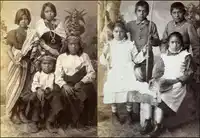
native Americans

Presentation
•
English
•
8th Grade
•
Easy
+14
Standards-aligned

TRICIA MOULTON
Used 26+ times
FREE Resource
6 Slides • 11 Questions
1

Lesson Objective
Analyze primary and secondary sources to explain the
impact of different types of schools on Native
American children and communities.
2
Multiple Choice
What was the true purpose of the Indian Boarding Schools?
The teach Native Americans how to farm and work in a factory
To "civilize" Native Americans
To give willing Native Americans a chance to learn English
To teach Native Americans how to preserve their cultural heritage
3


Independent Work
Tom Torlino,
1882-1885
BEFORE
AFTER
4
Multiple Choice
In 1887 the Americans sent many Indian children in boarding schools away from their mothers in order to ...
teach them English
make them Christians
cut them off their customs and language
all of the above
5
Multiple Choice
Indian children in boarding schools ...
had to wear uniforms and keep their hair short
enjoyed their education and life there
could keep their Indian names
could see their families very often
6
Multiple Choice
Which of these things is traditional in Native American tribes?
wearing braids
taking trains
speaking English
writing stories
7


Independent Work
Boarding Schools - Struggling with Cultural Repression
Beginning in the late nineteenth century, many American Indian children
attended government- or church-operated boarding schools. Families were
often forced to send their children to these schools, where they were forbidden
to speak their Native languages. Indian boarding schools were founded to
eliminate traditional American Indian ways of life and replace them with
mainstream American culture. The first boarding schools were set up either by
the government or Christian missionaries. At boarding schools, Indian children
were separated from their families and cultural ways for long periods,
sometimes four or more years. The children were forced to cut their hair and
give up their traditional clothing. They had to give up their meaningful Native
names and take English ones.
8
Multiple Choice
A Primary Source is from...
A third party person writing about an event
Someone who witnessed the event(s)
9


Independent Work
Boarding Schools - Struggling with Cultural Repression
They were not only taught to speak English, but were punished for speaking
their own languages. Their own traditional religious practices were forcibly
replaced with Christianity. They were taught that their cultures were inferior.
Some teachers ridiculed and made fun of the students’ traditions. These
lessons humiliated the students and taught them to be ashamed of being
American Indian. The boarding schools had a bad effect on the self-esteem of
Indian students and on the well being of Native languages and cultures. Indian
boarding schools usually imitated military life. Children were forced to cut their
hair, wear uniforms, and march in formations. Rules were very strict and
discipline was often harsh when rules were broken.
10
Multiple Choice

Many White Americans didn't understand Native American culture, so they sent the children to.....
concentration camps
to be slaves
boarding schools
11
Multiple Choice
education
Wounded Knee
discovery of gold in the Black Hills
12
Multiple Choice
Battle of Little Bighorn
Carlisle Indian Industrial boarding school
Sioux
13
Citizenship
The issue of American Indian birthright citizenship wouldn’t be settled until 1924 when the Indian Citizenship Act conferred citizenship on all American Indians. At the time, 125,000 of an estimated population of 300,000 American Indians weren’t citizens.
14
Multiple Choice
citizenship
Carlisle Indian Industrial boarding school
Sioux
15

Side Effects of Discrimination
●According to the U.S. Commission on Civil Rights, Native
Americans continue to experience higher rates of poverty, poor
educational achievement, substandard housing, and diseas
●Elements of acculturation - mission and boarding schools,
weakening parental influence, and dislocation from native lands -
undermine tribal unity and have removed many safeguards
against suicide that Native American culture might ordinarily
provide.
●There are very few evidence-based programs that are adapted
for American Indian and Alaska Native cultures.
16
Multiple Choice
Assimilation into American culture
Nativism
Americanization
Discrimination
17
Multiple Choice
What word means: "To fit in"
Assimilation
Acculturation
Urban
Suburban
Lesson Objective
Analyze primary and secondary sources to explain the
impact of different types of schools on Native
American children and communities.
Show answer
Auto Play
Slide 1 / 17
SLIDE
Similar Resources on Wayground

11 questions
Parts of Speech
Presentation
•
8th Grade
14 questions
Verbals: Gerunds and Participles
Presentation
•
8th Grade
11 questions
Setting, Conflict, and Irony in "The Lottery"
Presentation
•
8th Grade
12 questions
Taste of Revising
Presentation
•
7th Grade
12 questions
Determine the Figurative Meaning of Words and Phrases
Presentation
•
7th Grade
11 questions
Identify an Author's Point of View (RI.7.6)
Presentation
•
7th Grade
11 questions
01.10 | Tone VS Mood Review
Presentation
•
7th Grade
12 questions
Characterization Notes
Presentation
•
8th Grade
Popular Resources on Wayground
10 questions
How much do you know about our Portrait of an Eagle?

Quiz
•
10th Grade
10 questions
Fast Food Slogans
Quiz
•
6th - 8th Grade
21 questions
Continents and Oceans
Quiz
•
6th Grade
20 questions
Parts of Speech
Quiz
•
5th Grade
16 questions
Subject & Predicate
Quiz
•
5th Grade
25 questions
Multiplication Facts
Quiz
•
5th Grade
12 questions
Map Skills
Quiz
•
3rd Grade
22 questions
Continents and Oceans
Quiz
•
5th Grade
Discover more resources for English
25 questions
Making Inferences
Quiz
•
6th - 8th Grade
20 questions
Figurative Language Review
Quiz
•
8th Grade
30 questions
Central Idea practice Grade 7-8
Quiz
•
6th - 8th Grade
12 questions
Final Figurative Language Review
Presentation
•
6th - 8th Grade
20 questions
Sentences, Fragments, and Run-ons
Quiz
•
8th Grade
20 questions
TEXTUAL EVIDENCE & INFERENCES
Quiz
•
6th - 8th Grade
11 questions
Objective Summary Review
Quiz
•
6th - 8th Grade
17 questions
Plot
Quiz
•
8th Grade