AP Review: Regression
Presentation
•
Mathematics
•
9th - 12th Grade
•
Practice Problem
•
Hard
+2
Standards-aligned
Monika Christoff
Used 1+ times
FREE Resource
7 Slides • 9 Questions
1
Chapter 3: Regression
2
Positive/Negative or No Association
Direction
Address any points that have high residuals or would be influential points
Unusual Points
Linear vs. Non Linear
Form
Weak, moderate or strong
Strength
CONTEXT
3
Multiple Select
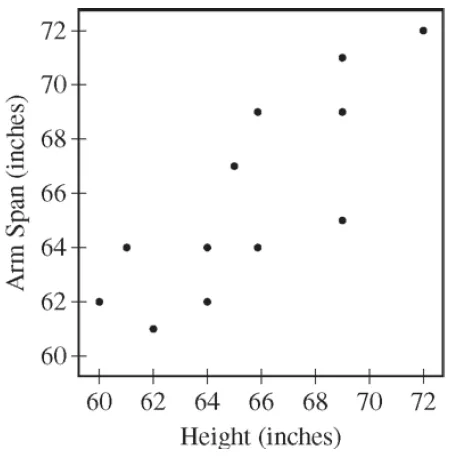
A student measured the height and arm spans, rounded to the nearest inch, of each person in a random sample of 12 seniors at a high school. A scatterplot of arm span vs height for 12 seniors are shown.
Describe the relationship.
There is a moderately strong, positive, linear relationship between height and arm span
There is a moderately weak, positive, linear relationship between height and arm span
There is a moderately strong, positive, non-linear association between hieght and arm span
There is a moderately weak, positive, linear association between height and arm span
4
Multiple Choice
Which of the above scatterplots suggests a strong correlation?
Plot A indicates a stronger correlation as the linear pattern extends further
Plot B indicates a stronger correlation as there is less open space
The scatterplots suggest that the correlation is the same
Without seeing a computer regression printout, one cannot know which plot suggests a stronger correlation
5
The amount by which the predicted value of y changes when x increases by 1 unit
Slope of regression line
Predicted value of y when x = 0
Y-intercept of regression line
the percent of the variability in the response variable (y ) that is accounted for by the least square regression line
Coefficient of determination (r2)
measures the direction and strength of association for linear relationships only!
Correlation coefficient (r)
Slope of regression line (b1) = r * (sy/sx)
6
More facts about correlation
correlation does not measure form
correlation only describes linear relationship
correlation does not imply causation
correlation is not a resistant measure of strength
both variables must be quantative
if you switch x and y correlation will stay same
you can change units of measurement and correlation will stay same (there are no units of measurement for correlation)
7
Multiple Choice
A newspaper in Germany reported that the more semesters needed to complete an academic progam at the university, the greater the starting salary in the first year of the job. The number of semesters is the explanatory variable and the starting salary (in 1000 Euros) is the response variable.
The table shows the computer output from a liner regression analysis on the data.
Identify the slope of the least squares regression line and interpret the slope in context.
The slope is 34.018 and it represents a change starting salary of 34,018 Euros for every additional one semester.
The slope is 1.1594 and it represents a change starting salary of 1,159 Euros for every additional one semester.
The slope is 4.455 and it represents a change of 4.45 semesters for every additional one Euro.
I and
8
Multiple Choice
What is the correlation coefficient and interpret it's value.
It is 0.335 and it represents 33.5% of the variability in the salary changes were accounted for by the least squares regression line.
It is 0.578 and it represents 57.9% of the variability in the salary changes were accounted for by the least squares regression line.
It is 0.335 and it represents that the relationship between semesters and salary is a positive and relatively weak linear relationship.
It is 0.578 and it represents that the relationship between semesters and salary is a positive and moderate linear relationship.
9
Multiple Choice
The correlation between two scores X and Y equals 0.8. If both the X scores and the Y scores are converted to z-scores, then the correlation between the z-scores for X and the z-scores for Y would be
-0.8
-0.2
0
0.8
10
The difference between the actual value of y and the value of y predicted by the regression line.
Residual
11
Multiple Choice
Jamal is researching the characteristics of a card that might be useful in predicting the fuel consumption rate (FCR). The length of a car is one explanatory variable that can be used to predict FCR. A computer output from a linear regression is shown. For a point that represents one car length of 175 inches and an FCR of 5.88. Calculate and interpret the residual for the car relative to the least squares regression line.
4.92
The actual FCR is 4.92 gallons/100 miles greater than the predicted value.
0.96
The actual FCR is 0.96 gallons/100 miles greater than the predicted value.
-0.96
The actual FCR is 0.96 gallons/100 miles less than the predicted value.
-4.92
The actual FCR is 0.96 gallons/100 miles greater than the predicted value.
12
Points that have much larger or much smaller x values than the other points in the data set
High leverage
A point that does not follow the pattern of the data and has a large residual
Outlier
A point that, if removed, substantially changes the slope, y intercept, correlation and coefficient of determination, or standard deviation of the residuals.
Influential point
13
Multiple Choice
Which of the following statements about residuals are true?
I. The mean of the residuals is always zero
II. The sum of the residuals is always zero
III. Influential points have large residuals
I only
I and II
I and III
I, II and III
14
Open Ended
A simple random sample of 9 students was selected from a large university. Each of these students reported a number of hours he or she had allocated to studying and the number of hours allocated to work each week. The least squares regression line was hours studied = 8.107 + 0.4919 hours worked with an r2 value of 47.6%. A point P was removed from the data and a second linear regression was performed, the computer output is shown. Does point P exercise a large influence on the regression line? Explain.
15
Apply logs to both variables.
Transforming Power Models
Apply log to just the y.
Transforming Exponential Models.
16
Multiple Choice
Two measures x and y were taken on 18 subjects. THe first of two regressions, Regression I, yielded y^= 24.5 + 16.1x and had the top residual plot.
The second Regression, Regression II, yielded ^log(y)=1.6 +0.51 log(x) and had the second residual plot. Which of the following conclusions is best supported by the evidence above?
There is a linear relationship between x and y, and Regression I yields a better fit.
There is a linear relationship between x and y, and Regression II yields a better fit.
There is a nonlinear relationship between x and y and Regression I yields a better fit.
There is a nonlinear relationship between x and y and Regression II yields a better fit.
Chapter 3: Regression
Show answer
Auto Play
Slide 1 / 16
SLIDE

Similar Resources on Wayground
14 questions
Simplifying Rational Expressions
Presentation
•
9th - 12th Grade
13 questions
Multiplying Polynomials
Presentation
•
8th - 12th Grade
10 questions
Writing an equation from a graph
Presentation
•
9th - 12th Grade
12 questions
Graphing Linear Inequalities Review
Presentation
•
9th - 12th Grade
12 questions
Standard Deviation
Presentation
•
9th - 12th Grade
12 questions
Linear Equations/ One Step
Presentation
•
9th - 12th Grade
9 questions
Y = MX + B Review
Presentation
•
9th - 12th Grade
14 questions
Trapezoids and Kites
Presentation
•
9th - 12th Grade
Popular Resources on Wayground
20 questions
"What is the question asking??" Grades 3-5
Quiz
•
1st - 5th Grade
20 questions
“What is the question asking??” Grades 6-8
Quiz
•
6th - 8th Grade
10 questions
Fire Safety Quiz
Quiz
•
12th Grade
20 questions
Equivalent Fractions
Quiz
•
3rd Grade
34 questions
STAAR Review 6th - 8th grade Reading Part 1
Quiz
•
6th - 8th Grade
20 questions
“What is the question asking??” English I-II
Quiz
•
9th - 12th Grade
20 questions
Main Idea and Details
Quiz
•
5th Grade
47 questions
8th Grade Reading STAAR Ultimate Review!
Quiz
•
8th Grade
Discover more resources for Mathematics
20 questions
Graphing Inequalities on a Number Line
Quiz
•
6th - 9th Grade
46 questions
Linear and Exponential Function Key Features
Quiz
•
9th Grade
18 questions
CHS PSAT Prep
Quiz
•
9th Grade
21 questions
Factoring Trinomials (a=1)
Quiz
•
9th Grade
15 questions
Combine Like Terms and Distributive Property
Quiz
•
8th - 9th Grade
44 questions
Vocabulary Algebra I
Quiz
•
9th Grade
20 questions
Function or Not a Function
Quiz
•
8th - 9th Grade
18 questions
Linear vs Exponential Functions
Quiz
•
9th Grade