Chemistry STAAR review 2023
Presentation
•
Science
•
8th Grade
•
Medium
+1
Standards-aligned
Joseph F Mcguinness
Used 17+ times
FREE Resource
10 Slides • 45 Questions
1
Do now:
→ Join quizizz
→ Read warm-up questions below:
What is an element?
Where do we find information on the elements?
2
Multiple Choice
What is an element?
A substance that is made up of one type of atom and can't be reduced to simpler substances.
A substance made of two or more different atoms chemically bonded to one another. They can only be destroyed by chemical processes.
A material containing two or more elements or compounds that are in close contact and are mixed in any proportion. They can be separated by physical means.
3
Multiple Choice
Where can you find examples of Elements?
Dictionary
Periodic Table of Compounds
Periodic Table of Elements
Your Neighbor
4
ELEMENTS AND THE PERIODIC TABLE ARE BROKEN UP INTO THREE TYPES
5
Multiple Choice
The blue elements (left side) are called
metals
nonmetals
metalloids
noble gases
6
Multiple Choice
The yellow elements (right side) are called
metals
nonmetals
metalloids
noble gases
7
Multiple Choice
metals
nonmetals
metalloids
noble gases
8
Physical Properties of Metals
Luster - Shines, reflects light
Great Conductivity - How well electricity and heat travels through the element
Malleable - Can be beaten into different shapes without breaking
Ductile - Turned into wires
Solid at room temperature - Except for Mercury
9
Multiple Choice
Luster
how an object reflects light
can be hammered into a shape
transfers heat and/or electricity
10
Multiple Choice
Malleability
how an object reflects light
can be hammered into a shape
transfers heat and/or electricity
11
Multiple Select
Check off all properties of metal you can observe in this image of US coins.
Luster
Malleable
Conductivity
Ductile
Solid at room temperature
12
Multiple Choice
Conductivity
how an object reflects light
can be hammered into a shape
transfers heat and/or electricity
13
Multiple Choice
Manganese is shiny, conducts heat and electricity, and can be hammered into thin sheets. What is is?
Nonmetal
Metal
Metalloid
None of the above
14
Properties of Nonmetals
Essentially, they are the opposite of metals
Dull, not shiny
Brittle when solid
Some are gasses
NOT malleable, conductive, or ductile
15
Multiple Choice
Neon is colorless, a poor conductor of heat and is not able to be stretched. How would it be classified?
Nonmetal
Metalloid
Metal
None of the above
16
Multiple Select
Check off all of the nonmetal physical properties you can observe in this image of sulfur.
Dull appearance
Brittle solid
Gaseous
Not malleable
17
Properties of Metalloids
Properties are between metals and nonmetals
Can have a metallic luster, or be dull
Conductive, but less than metals
Solid at room temperature, but more brittle than metals
Usually malleable and ductile
18
Multiple Choice
Metal
Nonmetal
Metalloid
19
Multiple Choice
Titanium
Selenium
Potassium
Polonium
20
THE PERIODIC TABLE IS ALSO ORGANIZED BY GROUPS, PERIODS, AND MORE
WATCH THE VIDEO TO REMEMBER
21
Multiple Choice
period
group
cluster
unit
22
Multiple Choice
Horizontal Rows
Vertical Columns
23
Multiple Choice
Horizontal Rows
Vertical Columns
24
Multiple Select
Elements in the same group have : (2 correct answers)
Similar chemical properties
Similar names
Same number of outer (valence) electrons)
The same number of protons
25
Multiple Choice
How many periods are on the periodic table?
5
6
7
8
26
Multiple Choice
Same group
Same period
27
Multiple Choice
Compound formulas have ____ capital letter(s).
1
2
3
more than 1
28
Multiple Choice
Element symbols have _____ capital letter(s).
1
2
3
4
29
The electron configuration of Group 8 elements completely fill the valence shell
The filled valence shell makes Group 8 element very stable (NON-REACTIVE). They are called "noble gases".
All elements want to have Noble Gas Electron Configuration.
30
Multiple Choice
Helium
Argon
Nitrogen
Krypton
31
Multiple Choice
The reason that Noble Gases do not react is because
Their outer electron shell is filled
Their inner electron shell is filled
They are able to bond to fill their outer shell
None of the above, Noble Gases are highly reactive
32
Multiple Select
select the (ONE) property of noble gases that apply
non reactive
low ionization energy
high boiling point
can never conduct electricity
33
Elements are Made of Atoms
34
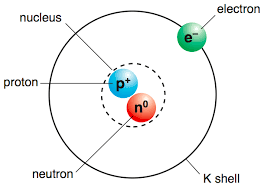
Draw
Draw where the three subatomic particles go
35
Multiple Choice
protons, neutrons, and isotopes
neutrons, isotopes, and electrons
positives, negatives, and electrons
protons, neutrons, and electrons
36
Multiple Choice
Neutrons only
Electrons only
Protons and Neutrons
Protons and Electrons
37
Multiple Choice
What two particles are in the nucleus of an atom?
protons and electrons
electrons and neutrons
protons and neutrons
38
Multiple Choice
nucleus
electron cloud
core
center
39
Multiple Choice
Protons, Neutrons, Electrons
Protons only
Protons and Electrons
Protons and Neutrons
40
Multiple Choice
Proton
Ion
Neutron
Electron
41
Multiple Choice
electrons
positrons
neutrons
protons
42
The periodic table provides the number of Protons, Electrons, and Neutrons for each element
43
Multiple Choice
The atomic number is the number of ____ in the nucleus. It's the element's "identification"!
electrons
neutrons
protons
44
Multiple Choice
What particle(s) make up the mass number?
electrons
neutrons
protons
protons and neutrons
45
Multiple Choice
What is the mass number of Phosphorous (P)?
15
30
31
16
46
Dropdown
E=
N=
47
Draw
Draw the Bohr Model for Lithium
48
VALENCE ELECTRONS
49
Multiple Choice
This is a Bohr Diagram of Aluminum. How many valence electrons does Aluminum have?
3
4
5
50
Multiple Choice
How many valence electrons does Lithium (Li) have?
8
1
5
2
51
Multiple Choice
How many valence electrons does Tin (Sn) have?
8
7
5
4
52
Multiple Choice
How many valence electrons does Bromine (Br) have?
5
6
7
8
53
Multiple Choice
an electron that is found in the outermost shell of an atom.
an electron found in the innermost shell of an atom.
an electron found in the middle shell.
54
Multiple Choice
Which element is this?
Nickel
Neon
Sodium
Nitrogen
55
Multiple Choice
How many valence electrons?
2
3
4
5
Do now:
→ Join quizizz
→ Read warm-up questions below:
What is an element?
Where do we find information on the elements?
Show answer
Auto Play
Slide 1 / 55
SLIDE

Similar Resources on Wayground
51 questions
Organization in the Biosphere
Lesson
•
8th Grade
55 questions
Earth Science Review Lesson
Lesson
•
8th Grade
55 questions
Science TCAP Practice
Lesson
•
8th Grade
50 questions
Plate Tectonics Review
Lesson
•
7th Grade
50 questions
Biomes and Ecosystems
Lesson
•
7th Grade
51 questions
Unit 1 Weather Review
Lesson
•
7th Grade
49 questions
Evolution / Diversity of Life
Lesson
•
8th Grade
52 questions
PMA 1 Review Space Lesson
Lesson
•
8th Grade
Popular Resources on Wayground
15 questions
Fractions on a Number Line
Quiz
•
3rd Grade
14 questions
Boundaries & Healthy Relationships
Lesson
•
6th - 8th Grade
13 questions
SMS Cafeteria Expectations Quiz
Quiz
•
6th - 8th Grade
20 questions
Equivalent Fractions
Quiz
•
3rd Grade
25 questions
Multiplication Facts
Quiz
•
5th Grade
12 questions
SMS Restroom Expectations Quiz
Quiz
•
6th - 8th Grade
20 questions
Main Idea and Details
Quiz
•
5th Grade
10 questions
Pi Day Trivia!
Quiz
•
6th - 9th Grade
Discover more resources for Science
20 questions
Cell Organelles and Functions
Quiz
•
6th - 8th Grade
10 questions
Exploring the Layers of the Earth
Interactive video
•
6th - 10th Grade
21 questions
Waves and Wave Properties
Quiz
•
6th - 8th Grade
20 questions
Newton's Laws of Motion
Quiz
•
8th Grade
20 questions
Heredity Punnett square review
Quiz
•
8th Grade
13 questions
Plate Tectonics and Earth's Structure
Lesson
•
6th - 8th Grade
16 questions
Pedigree
Quiz
•
8th Grade
10 questions
Exploring Heat Transfer: Conduction, Convection, and Radiation
Interactive video
•
6th - 8th Grade