
Search Header Logo
Saturn

Saturn

Assessment

Presentation

Science

9th Grade

Easy

NGSS
MS-ESS1-3, MS-PS1-1, MS-ESS2-5

+3

Standards-aligned

Created by

Staff.William Chenausky

Used 1+ times

FREE Resource

34 Slides • 16 Questions

1

media

Saturn

2

Rules:

This is due by Wednesday.

You must read all slides.

Review all videos.

and examine all images.

3

media

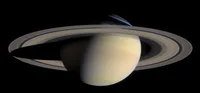
The Planet Saturn

• Saturn – the 2nd largest planet and the 6th planet

from the sun. Some say Saturn is the Jewel of the
solar system.
– Lowest density – would float
– Much like Jupiter

• Made up of mostly Hydrogen and Helium.
• Bands, clouds, storms, magnetic field strength is high.

• Saturn's rings span up to 175,000 miles.

4

media

The Planet Saturn

• There are 83 are moons that are named. (9 moons

await naming-provisional)

• There are 7 major rings around Saturn. (Labeled

A-G)

• Saturn spins very fast as one day on Saturn is 10.7

Earth hours.

• There have been 5 missions to Saturn.
• The current mission is the spacecraft Cassini.
• Saturn’s volume is 755 times greater than that of

Earth.

5

Open Ended

Question image

Go to NASA's website and write down 5 facts about Saturn that you did not know before. https://solarsystem.nasa.gov/planets/saturn/overview/

6

media
media

The Planet Saturn

• Cassini was designed to explore the

Saturnian system from orbit: the planet and
its atmosphere, rings and magnetosphere,
and its moons, particularly Titan and the icy
satellites.

7

Multiple Choice

Question image
Which spacecraft has been orbiting Saturn since 2004, and mapped the surface of Titan?
1

Cassini

2

Huygens

3

Magellan

4

Rosetta

8

media

The Planet Saturn

• The Grand Finale

In 2016, the Cassini spacecraft began a
daring set of orbits.

• Cassini will probe the water-rich plume of the

active geysers on the planet's intriguing moon
Enceladus, and then will hop the rings and
dive between the planet and its innermost
ring 22 times.”

9

Multiple Choice

Question image
Saturn's atmosphere, hundreds of kilometers deep, is composed mostly of _____
1

hydrogen

2

methane

3

ammonia

4

helium

10

Multiple Choice

Question image
Saturn's density is about _____ that of water
1

1/2

2

2/3

3

3/4

4

4/5

11

Multiple Choice

Question image
Saturn spins really quickly, completing a day in just _____
1

three hours

2

five and a half hours

3

eight  hours

4

ten and a half hours

12

Multiple Choice

Question image
In 2010, what was seen in Saturn’s northern hemisphere?
1

a huge storm

2

a meteor impact

3

volcanic activity

4

distinct bands

13

Multiple Choice

Question image
Saturn's rings are composed of _____
1

solid rock

2

Just water ice

3

gas and dust

4

methane gas

5

Water Ice and Rock and dust

14

Multiple Choice

Question image
On average, what is the thickness of Saturn's rings?
1

about ten millimeters thick

2

about ten centimeters thick

3

about ten meters thick

4

about ten kilometers thick

15

Multiple Choice

Question image
Saturn's rings are given lettered names in order of _____
1

their thickness

2

their width

3

their distance from the planet

4

their discovery

16

Multiple Choice

Question image
Enceladus erupts water from a series of cracks nicknamed _____
1

Huygens striations

2

Cassini Divisions

3

bands and belts

4

tiger stripes

17

Multiple Choice

Question image
Which moon pictured here belongs to Saturn and is unique because it has ice geysers or plumes at it's south pole?
1

Titan

2

Enceladus

3

Hyperion

4

Iapetus

18

media

19

media

20

media

21

media

22

media

23

Multiple Choice

Question image
On Saturn, where is the huge, hexagonal vortex located?
1

on the equator

2

the location changes

3

the north pole

4

the south pole

24

media

25

media

26

media

Moons of Saturn

Saturn’s Moons – 53 at most recent count.

~with 9 Provisional.
– Titan – larger than the Planet Mercury, is the

2nd largest moon in solar system.

• Has a thick atmosphere.
• Appears to have feature caused by flowing

liquids like streams.

• Could have some water in the atmosphere.
Possibly the most earth-like moon in the solar

system.

27

media

28

media

29

media

30

media

Titan

• Titan's atmosphere is mostly nitrogen (about 95

percent) and methane (about 5 percent), with
small amounts of other carbon-rich compounds.

High in the atmosphere, methane and nitrogen

molecules are split apart by the sun's ultraviolet
light and high-energy particles accelerated by
Saturn's magnetic field; the products of this
splitting recombine to form a variety of organic
molecules.

31

media

Moons of Saturn

• These organic molecules contain carbon and

hydrogen, and often include nitrogen, oxygen
and other elements important to life on Earth.

32

media

33

media

34

media
media

35

media

36

Multiple Choice

Question image
Which of Saturn's moons is bigger than Mercury?
1

Titan

2

Tethys

3

Mimas

4

Enceladus

37

Multiple Choice

Question image
What liquid has been found, residing in lakes, on Titan’s north and south poles?
1

water

2

methane

3

ammonia

4

hydrogen

38

media

Tethys

• Tethys [pronounced TEE-this] is a small moon

662 miles in diameter and is Saturn's 5thlargest
moon.

• This cold, airless and heavily scarred body is

very similar to sister moons Dione and Rhea.

Tethys' density is 0.97 times that of liquid

water, which suggests that Tethys is
composed almost entirely of water ice
plus a small amount of rock.

39

media

Tethys

• Tethys has gravitationally locked two

smaller moons into its own subsystem
-- Telesto and Calypso.

40

media

41

media
media

42

Audio Response

This is a mandatory verbal response. You must go to NASA's website and read about the moon Tethys. Verbally describe 3-5 interesting facts about that moon? Be sure to include if Tethys (a moon) has moons. Record your 45 second to 1 minute response. You have 10 minutes to complete this assignment.

https://solarsystem.nasa.gov/moons/saturn-moons/tethys/in-depth/

audio
Open Audio Recorder

43

media

44

media

Enceladus

• Enceladus is Saturn's sixth largest moon, and

is only 157 miles radius, but it's one of the
most scientifically compelling bodies in our
solar system.

• Hydrothermal vents spew water vapor and ice

particles from an under-ice ocean beneath the
icy crust of Enceladus.

45

media
media

46

media

Enceladus

• Scientific measurements suggests a large sea

about 6 miles deep beneath the southern
polar region, under an ice shell about 19 to
25 miles thick.

47

media

48

media

49

media

NASA's Cassinispacecraft zoomed by Saturn's icy moon Enceladus on
October 14, 2015, capturing this stunning image of the moon's north pole.

50

Open Ended

Question image

Finally, go to NASA's website, again, and research some information as to what does NASA want to learn about Enceladus? What are some things scientists would like to learn? Write down your long answer. https://solarsystem.nasa.gov/moons/saturn-moons/enceladus/in-depth/

media

Saturn

Show answer

Auto Play

Slide 1 / 50

SLIDE
