

Mixtures and Solutions 2

Presentation
•
Science
•
8th Grade
•
Medium
+9
Standards-aligned

Derrick Thompson
Used 15+ times
FREE Resource
16 Slides • 7 Questions
1
Diluted Solutions Vs Concentrated Solutions
A dilute solution has a small proportion of solute when compared with a concentrated solution.
Experience Chemistry | Lesson 5.4.2

2
solute = what is being dissolved (Ex: Lemonade powder)
solvent = what is doing the dissolving (Ex: Water)
solution = the result (Ex: Lemonade)
soluble = CAN dissolve in water
insoluble = CANNOT dissolve in water
3
Match

Identify a solute, the solvent, and the solution in a carbonated drink (like soda).
Carbon Dioxide (dissolved in the drink)
Water
The Carbonated Drink
Solute
Solvent
Solution
Solute
Solvent
Solution
4

5

6
7
Solubility
Solubility is determined based on a substance ability to dissolve. A substance such as sand is considered to be insoluble (-unable to dissolve) because when sand and water is mixed, the solute sand, settles at the bottom. Sugar on the other hand, when mixed in water is considered to be soluble (-capable of being dissolved) because when sugar is mixed in water it dissolves evenly amongst the solvent.
8
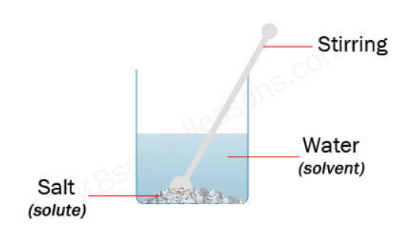
Stirring or agitating a solution increases the amount of solute/solvent interactions mechanically.
Increasing solute/solvent interactions increases rate of dissolution.
This is why you stir the Kool-aid when you add it to the water.
9
Concentration in solutions

10
Concentration refers to the amount of solute dissolved in a volume of solvent.
The more solute that is dissolved in a solvent, the more concentrated the solution is.
A solution that is not very concentrated is a dilute solution.

11
Multiple Choice
If you want to make a solution more concentrated, you should add more
solute
solvent
love
12

13
Multiple Choice

Which of the following solutions is the most diluted?
A solution of 5 grams of salt with a volume of 100 mL.
A solution of 10 grams of salt with a volume of 1000 mL.
A solution of 20 grams of salt with a volume of 1000 mL.
A solution of 50 grams of salt with a volume of 1000 mL.
14
A saturated solution is a solution in which no more solute can dissolve.
At the saturation point, all of the solute is dissolved, but adding more solute will leave some undissolved.

15
Multiple Choice
A ________ is a solution in which no more solute can dissolve.
saturated solution
unsaturated solution
supersaturated solution
16
A supersaturated solution is a solution that contains more solute than a saturated solution.
Usually, this results in undissolved material that tends to crystallize.

17
The amount of solute that will dissolve in a solvent is its solubility. Solubility depends on the solvent.

18
Multiple Choice

In which way is solubility different than concentration?
Unlike concentration, solubility does not depend on the amount of solvent.
Solubility can change based on temperature and pressure, but concentration can only change due to the total volume of solution.
Solubility is a measurement of how much solute can possibly dissolve, but concentration is a measurement of how much solute is dissolved.
Unlike concentration, solubility depends on the amount of solute dissolved in the total solution.
19
Multiple Choice

Solubility is the ability of a solute to dissolve into a solution. Which of the following statements is true about solubility?
More solute can dissolve in a solution if its solubility is high.
More solute can dissolve in a solution if its solubility is low.
Less solute can dissolve in a solution if its solubility is high.
The amount of solute that can dissolve depends on the solvent, not solubility.
20
Temperature
Pressure
Rate of stirring/mixing
Size of solute particles
21
Separating Mixtures-Physical Means
There are many ways to separate mixtures into their components, and what you do depends on your ultimate goal
Physical methods
Decanting
Centrifuging
Filtration
Evaporation


22
Separating Mixtures- other methods
Chromatography separates components of a mixture based on how quickly different molecules dissolved in a mobile phase solvent move along a solid plane
Distillation separates mixtures based on evaporation point


23
Multiple Choice
What does it mean to be "Soluble" ?
Capable of being a solid.
To have soul.
Capable of being dissolved.
To sink.
Diluted Solutions Vs Concentrated Solutions
A dilute solution has a small proportion of solute when compared with a concentrated solution.
Experience Chemistry | Lesson 5.4.2
Show answer
Auto Play
Slide 1 / 23
SLIDE
Similar Resources on Wayground

18 questions
Ionic Compounds
Presentation
•
8th Grade
18 questions
chemistry review
Presentation
•
8th Grade
20 questions
Critical Thinking & Problem Solving
Presentation
•
8th Grade
20 questions
Solving Systems with Elimination Day 1
Presentation
•
8th Grade
17 questions
Properties and Changes Remediation
Presentation
•
8th Grade
20 questions
Heterogeneous and Homogeneous Mixtures Lesson
Presentation
•
8th Grade
21 questions
Exponent Properties Review
Presentation
•
8th Grade
21 questions
Multistep Equations with Variables on Both Sides
Presentation
•
8th Grade
Popular Resources on Wayground
10 questions
How much do you know about our Portrait of an Eagle?

Quiz
•
10th Grade
10 questions
Fast Food Slogans
Quiz
•
6th - 8th Grade
21 questions
Continents and Oceans
Quiz
•
6th Grade
20 questions
Parts of Speech
Quiz
•
5th Grade
16 questions
Subject & Predicate
Quiz
•
5th Grade
25 questions
Multiplication Facts
Quiz
•
5th Grade
12 questions
Map Skills
Quiz
•
3rd Grade
22 questions
Continents and Oceans
Quiz
•
5th Grade
Discover more resources for Science
20 questions
Scientific Method and Variables
Quiz
•
8th Grade
20 questions
Scientific method and variables
Quiz
•
8th Grade
27 questions
Counting Atoms - Subscripts
Quiz
•
8th Grade
20 questions
Claim, Evidence and Reasoning (CER)
Quiz
•
6th - 8th Grade
18 questions
Counting Atoms
Quiz
•
7th - 8th Grade
20 questions
Elements, Compounds and Mixtures
Quiz
•
8th Grade
10 questions
Exploring Chemical and Physical Changes

Interactive video
•
6th - 10th Grade
10 questions
Decoding the Periodic Table of Elements
Interactive video
•
6th - 10th Grade