
Punnet Squares Gr12 GED
Presentation
•
Science
•
12th Grade
•
Easy
Alexei Gardner
Used 4+ times
FREE Resource
9 Slides • 92 Questions
1
Multiple Choice
In the punnett square below, what belongs in the missing square
tt
Tt
Bb
TT
2
Open Ended
In a particular kind of mouse grey fur is dominant to brown fur. A cross between a heterozygous mouse and a brown mouse would produce what potential offspring?
3
Multiple Select
In a particular kind of mouse grey fur (G) is dominant to brown fur (g). In order to determine the potential offspring for a cross between a heterozygous mouse and a brown mouse list the gametes from the grey mouse and the gametes from the brown mouse . Check all that apply
Grey mouse produces gametes that have G allele
Grey mouse produces gametes that have g allele
Brown mouse produces gametes that have G allele
Brown mouse produces gametes that have g allele
Grey mouse produces only the G allele gametes
4
Multiple Choice
What does a punnet square show us?
The age of the offspring
The chance of a genotype (trait) showing up in offspring
Numbers
Blue eyes
5
Monohybrid Crosses (Punnet Squares)
6
Multiple Choice
Genotypes are:
Green
Dominant only
Recessive only
traits that appear in offspring
7
Why is it important for you to know about Punnett squares?
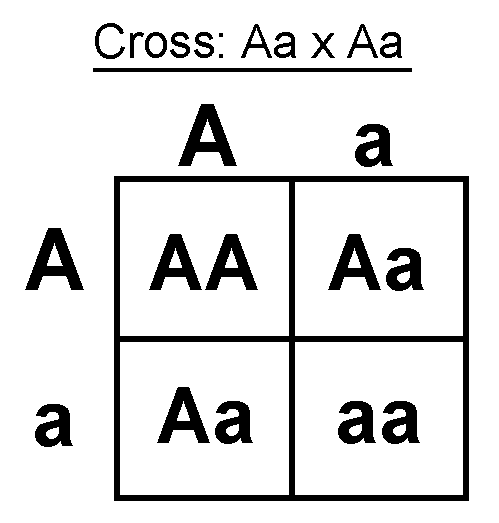
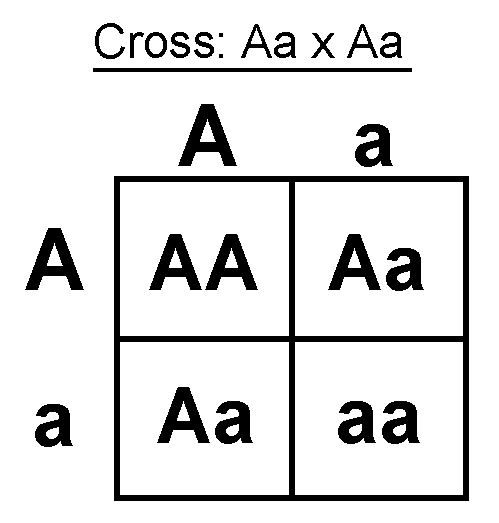
The answer is that they can be used as predictive tools when considering having children. Let us assume, for instance, that both you and your mate are carriers for a particularly unpleasant genetically inherited disease such as cystic fibrosis . Of course, you are worried about whether your children will be healthy and normal. For this example, let us define "A" as being the dominant normal allele and "a" as the recessive abnormal one that is responsible for cystic fibrosis. As carriers, you and your mate are both heterozygous (Aa). This disease only afflicts those who are homozygous recessive (aa). The Punnett square allows the prediction of having a child with the disease (aa).
8
Fill in the Blanks
Type answer...
9
The answer to the last question is here (the program may not have corrected you for incorrect capitalization)
Aa x Aa
Use this for the next question
10
Multiple Choice
What is the next step in completing this problem?
Fill in the boxes in the punnett square with potential offspring
Determine the gametes and put them on the outside of the punnett square
Determine the potential outcome by listing genotypic and phenotypic ratios
11
12
Multiple Choice
What is the next step in completing this problem?
Fill in the boxes in the punnett square with potential offspring
Determine the gametes and put them on the outside of the punnett square
Determine the potential outcome by listing genotypic and phenotypic ratios
13
14
Multiple Choice
What is the next step in completing this problem?
Fill in the boxes in the punnett square with potential offspring
Determine the gametes and put them on the outside of the punnett square
Determine the potential outcome by listing genotypic and phenotypic ratios
15
16
Open Ended
In a particular kind of mouse grey fur is dominant to brown fur. A cross between a heterozygous mouse and a brown mouse would produce what potential offspring?
17
Fill in the Blanks
Type answer...
18
Multiple Select
In a particular kind of mouse grey fur (G) is dominant to brown fur (g). In order to determine the potential offspring for a cross between a heterozygous mouse and a brown mouse list the gametes from the grey mouse and the gametes from the brown mouse . Check all that apply
Grey mouse produces gametes that have G allele
Grey mouse produces gametes that have g allele
Brown mouse produces gametes that have G allele
Brown mouse produces gametes that have g allele
Grey mouse produces only the G allele gametes
19
20
Multiple Choice
The correct punnett square on the last slide was
A
B
C
D
21
22
23
Multiple Choice
When Grey fur is dominant to brown fur the Genotypic Ratio for the cross between a heterozygous mouse and a brown mouse is
GG 1: Gg 2: gg 1
Grey 3: Brown 1
GG 0:Gg 2:gg 1
Grey 2: Brown 2
24
Multiple Choice
When Grey fur is dominant to brown fur the Phenotypic Ratio for the cross between a heterozygous mouse and a brown mouse is
GG 1: Gg 2: gg 1
Grey 3: Brown 1
GG 0:Gg 2:gg 1
Grey 2: Brown 2
25
Multiple Choice
A Phenotypic ratio could also be written as a phenotypic probability such as
Grey 50%: Brown 50%
Grey 2: Brown 2
GG 0%:Gg 50%:gg 50%
GG 0:Gg 2:gg 2
26
Multiple Choice
In the punnett square below, what belongs in the missing square
tt
Tt
Bb
TT
27
Multiple Choice
28
Multiple Choice
29
Multiple Choice
The genotype for a yellow plant is...
30
Multiple Choice
31
Multiple Choice
32
Multiple Choice
33
Multiple Choice
34
Multiple Choice
35
Multiple Choice
36
Multiple Choice
37
Multiple Choice
38
Multiple Choice
39
Multiple Choice
40
Multiple Choice
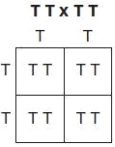
0 in 4
1 in 4
2 in 4
4 in 4
41
Multiple Choice
Aa
red hair
heterozygous
DNA
42
Multiple Choice
Aa
red hair
heterozygous
DNA
43
Multiple Choice
44
Multiple Choice
45
Multiple Choice
In the punnett square below, what belongs in the missing square
46
Multiple Choice
The genotype for a yellow plant is...
47
Multiple Choice
48
Multiple Choice
49
Multiple Choice
50
Multiple Choice
51
Multiple Choice
52
Multiple Choice
53
Multiple Choice
54
Multiple Choice
55
Multiple Choice
56
Multiple Choice
homozygous dominant
heterozygous
alleleerific
homozygous recessive
57
Multiple Choice
Dominant
Homozygous
Genotype
Phenotype
58
Multiple Choice
59
Multiple Choice
60
Multiple Choice
What is correct probability
TT = 25% Tt= 50% tt=25%
all tall
TT= 75% tt = 25%
Tt = 100%
61
Multiple Choice
62
Multiple Choice
63
Multiple Choice
64
Multiple Choice
65
Multiple Choice
66
Multiple Choice
67
Multiple Choice
68
Multiple Choice
B = brown fur b = white fur
In the Punnett square, what is the probability for white fur?
0%
25%
50%
75%
69
Drag and Drop
70
Dropdown
71
Multiple Choice
Two parents have a heterozygous genotype for eye color. What is the chance of having a blue eye baby?
0%
25%
50%
75%
100%
72
Multiple Choice
73
Multiple Choice
74
Multiple Choice
75
Multiple Choice
76
Multiple Choice
77
Multiple Choice
Whose traits are on the outside of the Punnett square?
Mom
Parents
Dad
Offspring
78
Multiple Choice
What percent of offspring show the recessive trait?
25
50
75
100
79
Multiple Choice
The study of how traits are inherited.
genotype
phenotype
heredity
genetics
80
Multiple Choice
Made of DNA that contains all the information an organism needs to grow and function.
allele
chromosome
gene
DNA
81
Multiple Choice
What is the top parent's genotype?
homozygous dominant
homozygous reccessive
heterozygous
superzygous
82
Multiple Choice
Which is homozygous dominant?
AA
Aa
aa
None of them
83
Multiple Choice
Which is homozygous recessive?
AA
Aa
aa
None of them
84
Multiple Choice
What is this diagram called?
Venn diagram
Punnett Square
Probability Chart
Phylogenetic Tree
85
Multiple Choice
Father of genetics; 1st person to use probability to explain heredity.
Mendeleev
Mendel
Darwin
Currie
86
Multiple Choice
The study of how traits are inherited.
genotype
phenotype
heredity
genetics
87
Multiple Choice
Capital letter; this represents the trait that always shows.
recessive
heterozygous
dominant
homozygous
88
Multiple Choice
Lower case letter; this represents what is hidden when a dominant allele is present
recessive
homozygous
dominant
heterozygous
89
Multiple Choice
Whose traits are on the outside of the Punnett square?
Mom
Parents
Dad
Offspring
90
Multiple Choice
What percent of offspring show the recessive trait?
25
50
75
100
91
Multiple Choice
What is the top parent's genotype?
homozygous dominant
homozygous reccessive
heterozygous
superzygous
92
Multiple Choice
Which is homozygous dominant?
AA
Aa
aa
None of them
93
Multiple Choice
Which is homozygous recessive?
AA
Aa
aa
None of them
94
Multiple Choice
Which of these is a genotype?
Green Peas
ATTAGCCG
Gg
None of these
95
Multiple Choice
Which of these is a phenotype?
Green peas
AAATCCGCTC
Gg
None of these
96
Multiple Choice
The father's genotype is _____________.
homozygous dominant
heterozygous
homozygous recessive
None of these
97
Multiple Choice
The mother's genotype is _____________.
homozygous dominant
heterozygous
homozygous recessive
none of these
98
Multiple Choice
What percentage of these offspring will be homozygous dominant?
25
50
75
100
99
Multiple Choice
What percentage of these offspring will be heterozygous?
25
50
75
0
100
Multiple Choice
Mutations are always bad
true
false
101
Multiple Choice
What describes a change in the DNA sequence?
Transcription
Translation
DNA replication
Mutation
Apoptosis
In the punnett square below, what belongs in the missing square
tt
Tt
Bb
TT
Show answer
Auto Play
Slide 1 / 101
MULTIPLE CHOICE

Similar Resources on Wayground
95 questions
Matter & Its Properties
Presentation
•
University
94 questions
MGT400_CONTROL
Presentation
•
University
93 questions
NCCER Module 26110-23PT 10
Presentation
•
11th Grade
92 questions
Applied Biology Muscles Day 1
Presentation
•
11th - 12th Grade
96 questions
Cell DCA REVIEW Lesson
Presentation
•
12th Grade
102 questions
Wealth & Net Worth
Presentation
•
12th Grade
94 questions
Imperialism Japan
Presentation
•
KG - University
94 questions
Crystalline Structures
Presentation
•
KG - Professional Dev...
Popular Resources on Wayground
20 questions
STAAR Review Quiz #3
Quiz
•
8th Grade
20 questions
Equivalent Fractions
Quiz
•
3rd Grade
6 questions
Marshmallow Farm Quiz
Quiz
•
2nd - 5th Grade
20 questions
Main Idea and Details
Quiz
•
5th Grade
20 questions
Context Clues
Quiz
•
6th Grade
20 questions
Inferences
Quiz
•
4th Grade
19 questions
Classifying Quadrilaterals
Quiz
•
3rd Grade
12 questions
What makes Nebraska's government unique?
Quiz
•
4th - 5th Grade
Discover more resources for Science
46 questions
Unit 4 Geosphere Test Review
Quiz
•
9th - 12th Grade
10 questions
Explore Genetic Drift and Its Effects-March madness week 4
Quiz
•
9th - 12th Grade
20 questions
9B Fossil Record Vocabulary.S26
Quiz
•
9th - 12th Grade
13 questions
Amoeba Sisters: Biomolecules
Interactive video
•
9th - 12th Grade
20 questions
Climate Change
Quiz
•
6th - 12th Grade
26 questions
Adaptation and Natural Selection
Quiz
•
9th - 12th Grade