

3.2 Magnetism - The Sun and Earth Extension 3

Presentation
•
Science
•
1st - 5th Grade
•
Easy
+13
Standards-aligned

Jeffrey Reed
Used 3+ times
FREE Resource
31 Slides • 10 Questions
1

2
The region around the magnet where magnetic materials experience a force
(feels pulled towards the magnet)
3
Iron fillings are very small pieces of iron that become magnetised when they are in a magnetic field
When magnet is brought around iron fillings, they will line up at every point where they feel the force from the magnet
Because there are so many of them, they line up until we can see the shape of the magnetic field.

4
The magnetic field of the Earth looks similar to that of a bar magnet
The compass needle point to the North, which is actually the magnetic south pole of the Earth

5
Multiple Choice
What is the shape of a magnetic field around the Earth?
6
Our magnetic field is decreasing by 5% a century Jupiter has a super-strong magnetic field What would happen if our magnetic field was much stronger?

7
Draw and Label this

8
Earth’s magnetic field protects us from the solar wind by deflecting these particles and trapping them in two huge rings (Van Allen belts).

9

10
What protects us from the deadly solar wind?

11
Solar wind is a supersonic plasma (Remember, that’s charged particles or ions) that flows outward from Sun at high speeds & bathes planets in a flood of high-energy particles. (Which isn’t very good for us!)

12
The auroras are created when
high-energy particles in Van Allen belts collide with gases in Earth’s atmosphere & give off light

13

14

15


It’s Not Always Sunny on the Sun
Weather Isn’t Just for Planets!
The sun, like any star, is a huge ball of electrically-charged
hot gas –– and this gas doesn’t stay still. It moves!
16


As the sun’s gases move
around, they generate a
magnetic field.
Think of a magnetic field as an invisible force field that surrounds a magnet, represented by the arrows in this image. The lines always go from one end of the magnet to the other.
Magnetic Fields
17
Dropdown
18
Dropdown

19

20

When weather is calm on the sun, it’s called a
season of low activity, or solar minimum.
.
When things heat up, it’s called a season of high activity, or solar maximum.
Solar Minimum & Maximum
Watch this video to see the seasonal differences.
21

What the Flip?
Check out the model in this video to see how the
transformation works. The pink lines represent magnetic
waves from the sun’s north pole and the green are from
the south pole.
During each solar cycle, the sun’s magnetic field “flips.” In other words, its north-south lines trade places with the
south-north ones.
22
Multiple Choice
What is the SOLAR CYCLE?
A cycle where the sun’s magnetic field changes.
A setting on solar-powered washing machines or dishwashers.
A setting in a weather tracking app.
A cycle where Alpha Centauri and Proxima Centauri trade places.
23
Dropdown
24

As the sun’s magnetic fields tangle up, they cause sunspots.
Sunspots
Sunspots are areas of the sun where electromagnetic activity is super intense. This video shows how sunspots form.
25

When the sunspots’
magnetic fields get super twisted up, they release a huge burst of energy in the form of electromagnetic
waves called radiation.
Solar Flares
These big explosions on the sun are called solar flares.
Watch the video to see how they work.
When the Sun Goes Boom!
26
Multiple Select
Sunspots are .... (choose 2)
A sign of iron deficiency in the sun.
Spots on the sun where electromagnetic activity is super intense.
Areas on the sun where solar flares burst out.
Similar to the Big Dipper but in the Yucatan.
27

Solar Wind
Not all solar weather is as explosive or destructive as solar flares, which only occur during the solar maximum.
.
The sun also emits a continuous stream of charged particles that drift through the solar system throughout the solar cycle.
The constant movement of these particles through space is called the solar wind.
28
Dropdown
29
30
31
Multiple Choice
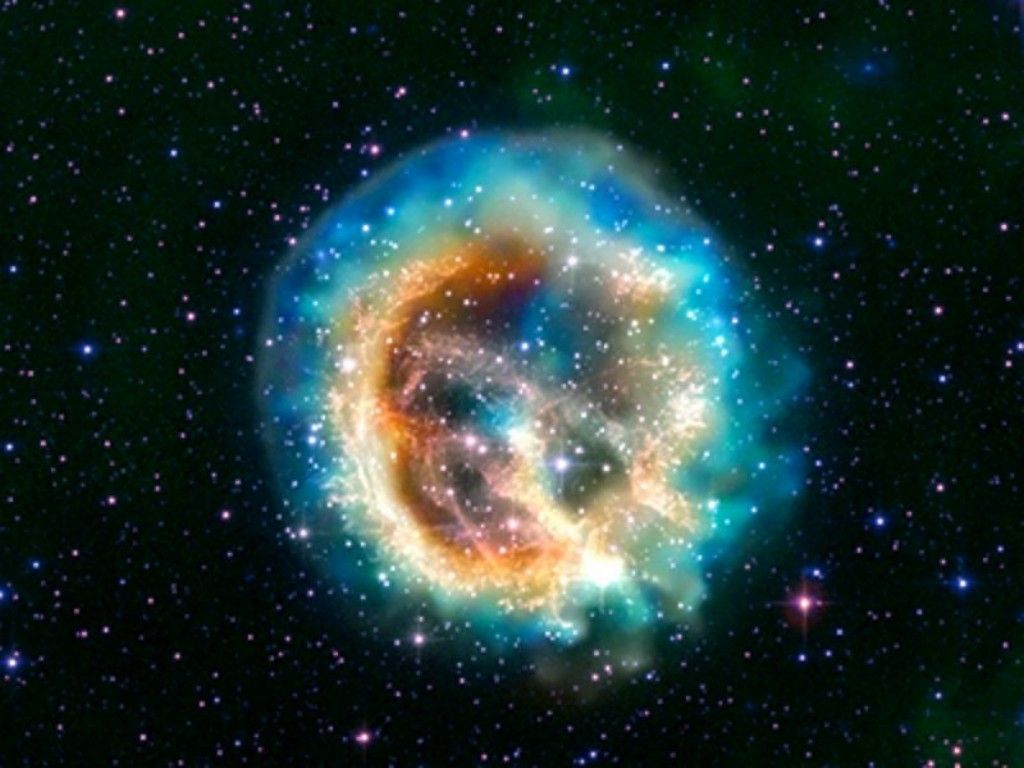
Supernova
Nebula
Red Giant
White Dwarf
32
Magnetic fields
One of the strongest in the universe
trillions of time stronger than Earth's
Neutron stars with very strong magnetic fields are called magnetars
Have strong magnetic fields because of powerful electric currents
Dipolar structure, similar to Earth's
Magnetic fields can fade over time
33
Density
Very high density
a single teaspoon can weigh up to billion of tons; 10^17 to 10^18 kilos per cubic meter
Very dense because tightly pack neutrons
One of the densest things in the universe, surpassed only by black holes
34
A huge collection of:
- Gas
- Space Dust
- Millions to trillions of stars and any planets surrounding them
- "Rogue Planets"
35
Galaxies spin, similar to the objects in our solar system
We don't know how many there are.
Current estimates are at more than 2 trillion

36

37

38

No one knows for sure just how big the universe is, but scientists have taken pictures of objects that are nearly 14 billion light years away. That means the universe reaches at least that far in all directions, and maybe farther.
39
Reorder
Reorder the following in term of smallest (1) to biggest (4)
Planet
Galaxy
Solar System
Universe
40
Match
Match the term with its definition
All of space and the matter and objects within it
A measurement equal to the distance that light travels in a year
A giant ball of burning gases that gives off light
A very loose mass of cosmic dust and gases
System of stars, dust, and gas held together by gravity
Nebula
Galaxy
Universe
Star
Light year
Nebula
Galaxy
Universe
Star
Light year
41
Show answer
Auto Play
Slide 1 / 41
SLIDE
Similar Resources on Wayground

37 questions
Two Dimensional Shapes
Presentation
•
1st - 5th Grade
37 questions
Space Club 2
Presentation
•
1st - 5th Grade
39 questions
Space Club 7
Presentation
•
1st - 5th Grade
40 questions
Work and Power
Presentation
•
KG
32 questions
Weather Fronts and Air Masses
Presentation
•
KG
35 questions
ENT1225. Unit 1+2: Introduce someone
Presentation
•
KG
35 questions
Chaney Lesson
Presentation
•
KG
36 questions
Punctuation
Presentation
•
KG
Popular Resources on Wayground
10 questions
How much do you know about our Portrait of an Eagle?

Quiz
•
10th Grade
10 questions
Fast Food Slogans
Quiz
•
6th - 8th Grade
21 questions
Continents and Oceans
Quiz
•
6th Grade
20 questions
Parts of Speech
Quiz
•
5th Grade
16 questions
Subject & Predicate
Quiz
•
5th Grade
25 questions
Multiplication Facts
Quiz
•
5th Grade
12 questions
Map Skills
Quiz
•
3rd Grade
22 questions
Continents and Oceans
Quiz
•
5th Grade
Discover more resources for Science
9 questions
Properties of matter and Mixtures
Quiz
•
5th Grade
20 questions
Mixtures and Solutions Practice
Quiz
•
5th Grade
10 questions
Mixtures and Solutions
Quiz
•
4th Grade
20 questions
Food Chains and Food Webs Review
Quiz
•
5th Grade
11 questions
Understanding Light Review 4
Quiz
•
5th Grade
15 questions
Force and Motion
Presentation
•
5th Grade
20 questions
Force and Motion
Quiz
•
3rd - 4th Grade
20 questions
Food Chains & Food Webs
Quiz
•
5th - 7th Grade