Search Header Logo
GMO and selective Breeding

GMO and selective Breeding

Assessment

Presentation

Science

8th Grade

Easy

NGSS
MS-LS4-4, MS-LS3-1, MS-LS4-5

+4

Standards-aligned

Created by

Theuns Swanepoel

Used 2+ times

FREE Resource

0 Slides • 27 Questions

1

Multiple Choice

Question image

What is a GMO?

1

An organism that has had its DNA modified by humans

2

An organism missing a chromosome

3

Epigenetics

4

A genetically identical organism

2

Multiple Choice

Selective breeding is...

1

a process to create an organism with desired traits from parents with those desired traits to benefit humans

2

natural method of producing offspring with desired traits

3

creating a new species

4

making organisms reproduce during times of stress

3

Multiple Choice

Question image
What are genetically modified (GM) organisms and GM foods?
1
Foods or organisms with better taste
2
Foods or organisms grown in the USA, only
3
Foods or organisms with DNA modified in a way that doesn't occur naturally
4
Food and organisms that have been injected with hormones

4

Multiple Choice

An example of selective breeding is

1

a dog breeder mating 2 dogs to make more dogs

2

a farmer grows bees to pollinate the plants on his farm

3

a person pollinates 2 white rose plants to only create white roses

5

Multiple Choice

Question image
Advantages of genetically modified crops include(s)
1
insect resistance
2
drought/freeze resistance
3
higher yield
4
all of these are reasons for using GMOs

6

Multiple Choice

One problem with selective breeding is

1

creating a new species

2

gene variety is lost

3

extinction of a species

7

Multiple Choice

Question image

Concerns about genetically modified organisms include(s)

1

risk to human health

2

may be harmful to ecosystems

3

seed/pollen drift to organic farms

4

all of these are valid concerns

8

Multiple Choice

Which is another term for selective breeding?
1
Artificial selection
2
Natural Selection
3
Intelligent selection

9

Multiple Choice

What mutation has occurred here?

T-G-A-C-C-A

T-G-A-G-C-A

1

Substitution

2

Deletion

3

Insertion

4

Frameshift

10

Multiple Choice

Question image
Evidence shows that the wolf is the ancestor to all of the breeds of dogs shown below. How did this variation arise in a relatively short period of time?
1
A.  Genetic manipulation
2
Natural selection
3
Random chance
4
Selective breeding

11

Multiple Choice

Question image

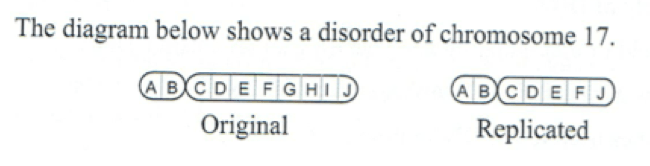
What type of chromosomal mutation has occurred?

1

substitution

2

insertion

3

deletion

4

nondisjunction

12

Multiple Choice

Problems with selective breeding include

1

Better animals

2

Increased meat production

3

Animals can have bad health problems

4

more diversity

13

Multiple Choice

A mutation in which only one nucleotide is altered is called a:

1

Frameshift Mutation

2

Deletion Mutation

3

Point Mutation

4

Insertion Mutation

14

Multiple Choice

Which is NOT a result of selective breeding?

1

Large seedless watermelons that consumer demand

2

Bright oranges that are all about the same size

3

An insect that matches the color of the environment

4

A dog that has been bred to have short hair

15

Multiple Choice

A mutation is defined as:

1

A change in the cell's structure

2

Anything that changes in an embryo

3

Any change in the physical features of a human

4

A change in the DNA sequence

16

Multiple Choice

Which of the following best represents inbreeding?

1

removing DNA from an organism

2

changing traits based on environment

3

crossing 2 similiar animals

4

crossing 2 different animals

17

Multiple Choice

What mutation has occurred here?

T-G-A-C-C-A

T-G-A-G-C-A

1

Substitution

2

Deletion

3

Insertion

4

Frameshift

18

Multiple Choice

Scientists genetically engineer corn to be immune to corn diseases. This is BENEFICIAL because
1
This causes corn to be less likely to reproduce
2
This causes corn to be less likely to survive
3
This causes corn to be smaller
4
This allows increased production of corn

19

Multiple Choice

Identify the DELETION mutation form the following:

ATG CCA AAT

1

ATG TCA AAT

2

ATG CCT AAA T

3

ATC CA AT

4

ATG CCA AAT

20

Multiple Choice

The purpose of selective breeding is to

1

get bigger animals

2

get smaller animals

3

create animals with desirable traits

4

create animals with bad traits

21

Multiple Choice

Identify the SUBSTITUTION mutation form the following:

ATG CCA AAT

1

ATG TCA AAT

2

ATG CCT AAA T

3

ATC CA AT

4

ATG CCA AAT

22

Multiple Select

Question image

When selective breeding food crops what might a farmer select for? (Select all that apply.)

1

The plant the produced the most grain

2

The plant the produced the largest sized grain

3

The plant that was the most disease resistant

4

The plant that was the smallest

5

The smelliest plant

23

Multiple Choice

GMO stands for

1

Genetically modified organism

2

Genetically made organism

3

Generically made organ

4

Generically modified organism

24

Multiple Choice

GMOs can be

1

plants only

2

animals only

3

plant, animal, and bacteria

4

plant and animal only

25

Multiple Choice

The purpose of selective breeding is to

1

Get bigger animals

2

get smaller animals

3

create animals with desirable traits

4

create animals with bad traits

26

Multiple Choice

The corn that we eat today

1

was created through selective breeding of the teosinte plant.

2

was created by natural selection of the teosinte plant.

3

has not changed in thousands of years.

4

none of these

27

Multiple Choice

What does bio mean?

1

copy

2

imitation

3

life

4

fake

Question image

What is a GMO?

1

An organism that has had its DNA modified by humans

2

An organism missing a chromosome

3

Epigenetics

4

A genetically identical organism

Show answer

Auto Play

Slide 1 / 27

MULTIPLE CHOICE