
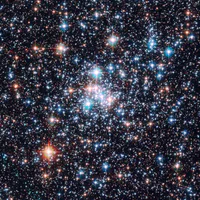
Things to know about stars
Presentation
•
Science
•
10th Grade
•
Practice Problem
•
Medium
+15
Standards-aligned
Mrs. Bertram
Used 2+ times
FREE Resource
26 Slides • 24 Questions
1
Poll
How confident are you feeling about understanding this unit?
very
Somewhat
still missing some things
What have we even been doing?
2
Things to know about stars
Star Color and Temperature color is a clue to a star’s
Life cycle
3
Apparent Magnitude (luminosity)
• Apparent magnitude is the brightness of a
star when viewed from Earth.
• Three factors control the apparent brightness
of a star as seen from Earth: how big it is,
how hot it is, and how far away it is.
Absolute Magnitude
• Absolute magnitude is the apparent
brightness of a star if it were viewed from a
distance of 32.6 light-years.
4
Fill in the Blanks
5
Open Ended
How is Absolute magnitude different than apparent magnitude?
6
7
A Hertzsprung–Russell diagram shows
the relationship between the absolute
magnitude and temperature of stars.
Hertzsprung–Russell Diagram
In your ESRT
8
Hertzsprung–Russell Diagram
9
10
The secret lives of stars
Stars age at different rates.
- Massive stars use fuel faster and exist for only
a few million years.
- All stars, regardless of their size, eventually run
out of fuel and collapse due to gravity
11
Stellar Evolution (baby stars)
Protostar Stage
• A protostar is a collapsing cloud of gas and
dust destined to become a star—a developing
star not yet hot enough to engage in nuclear
fusion.
• When the core of a protostar has reached
about 10 million K, pressure within is so great
that nuclear fusion of hydrogen begins, and a
star is born.
12
Nebula, Birthplace of Stars
13
Main Sequence (all stars)
◆ A main-sequence star is a star that falls
into the main sequence category on the
H–R diagram. This category contains the
majority of stars and runs diagonally from
the upper left to the lower right on the H–R
diagram.
◆ A star spends 90 percent of its life in the
main-sequence stage.
14
Red Giant (start of the end)
Red-Giant Stage
• Hydrogen burning migrates outward. The
star’s outer envelope expands.
• The core collapses as helium is converted to
carbon. Eventually all nuclear fuel is used
and gravity squeezes the star.
• Its surface cools and becomes red.
A red giant is a large, cool star of high
luminosity; it occupies the upper-right
portion of the H–R diagram.
15
Draw
What is happening to a star that is in the Red giant stage. Be sure to talk about gravity and Fusion pressure
16
Planetary Nebula
• Cats Eye nebula
17
Stellar Evolution
Death of Medium-Mass Stars
• Stars with masses similar to the sun evolve in
essentially the same way as low-mass stars.
• During their collapse from red giants to white
dwarfs, medium-mass stars are thought to
cast off their bloated outer layer, creating an
expanding round cloud of gas called
planetary nebula.
• The end for a medium mass star:
A white dwarf is a star that has exhausted most or
all of its nuclear fuel and has collapsed to a very
small size, believed to be near its final stage of
evolution.
18
Stars (Large stars)
A supergiant is a very large, very bright
red giant star.
A Supernova is a very large explosion
that causes the outer layer of the star to
blow off
A Neutron star is a very tiny dense star.
A Black hole Forms when the core of the
massive star is greater than 3x our sun.
19
Interstellar Matter
• A nova is a star that explosively increases in brightness.
20
Images of a Nova Taken
Two Months Apart
21
Stellar Evolution (Death)
All stars, regardless of their size,
eventually run out of fuel and collapse
due to gravity.
• Stars less than one-half the mass of the sun
never evolve to the red giant stage but
remain in the stable main-sequence stage
until they consume all their hydrogen fuel
and collapse into a white dwarf.
Death of Low-Mass Stars
22
Planetary Nebula
23
Draw
What is happening to a star that is in the last stage of stars. Be sure to talk about gravity and Fusion pressure
24
Stellar Evolution
• In contrast to sunlike stars, stars that are
over three times the sun’s mass have
relatively short life spans, which end in a
supernova event.
Death of Massive Stars
• A supernova is an exploding massive star
that increases in brightness many thousands
of times.
• The massive star’s interior condenses and
may produce a hot, dense object that is either
a neutron star or a black hole.
25
Crab Nebula in the
Constellation Taurus
26
Stellar Evolution
White Dwarfs
• A white dwarf is a star that has exhausted
most or all of its nuclear fuel and has
collapsed to a very small size, believed to be
near its final stage of evolution.
27
The Sun
• The sun begins as a nebula, spends much
of its life as a main-sequence star, and
then becomes a red giant, a planetary
nebula, a white dwarf, and, finally, a black
dwarf.
28
Stellar Evolution
Neutron Stars
• A neutron star is a star of extremely high
density composed entirely of neutrons.
• Neutron stars are thought to be remnants of
supernova events.
Supernovae
• A pulsar is a source that radiates short bursts
or pulses of radio energy in very regular
periods.
• A pulsar found in the Crab Nebula during the
1970s is undoubtedly the remains of the
supernova of 1054.
29
Stellar Evolution
Black Holes
• A black hole is a massive star that has
collapsed to such a small volume that its
gravity prevents the escape of everything,
including light.
• Scientists think that as matter is pulled into a
black hole, it should become very hot and
emit a flood of X-rays before being pulled in.
30
Reorder
Organize the stages of a one mass star from start to finish
Main sequence
Red Giant
White dwarf
Black Dwarf
31
Stellar Evolution
32
Life Cycle of a Sunlike Star
33
Multiple Choice
The photograph shows a feature of the universe as seen through a telescope. This feature is best identified as
a galaxy
a comet
an asteroid
a star
34
Multiple Choice
USE YOUR ESRT! To an observer on Earth, the Sun appears brighter than the star Rigel because the Sun is
hotter than Rigel
more luminous than Rigel
closer than Rigel
larger than Rigel
35
Multiple Choice
Which two stars are most similar in luminosity?
A) Betelgeuse and Barnard's Star
B) Procyon B and Proxima Centauri
Alpha Centauri and Sirius
Polaris and the Sun
36
Multiple Choice
Which star is cooler and less luminous than the Sun?
Proxima Centauri
Pollux
Rigel
40 Eridani
37
Multiple Choice
During which stage of development does the star have a cool surface temperature and the greatest luminosity?
protostar
main sequence
giant
white dwarf
38
Multiple Choice
Energy is produced within a star's core by the process of
A) insolation
conduction
nuclear fusion
radioactive decay
39
Multiple Choice
In the graph, which shows changes in the Sun’s magnetic activity and changes in the number of sunspots over a period of approximately 100 years. Sunspots are dark, cooler areas within the Sun’s photosphere that can be seen from Earth.
Which graph best represents the relationship between the number of sunspots and the amount of magnetic activity in the Sun?
40
Multiple Choice
In the graph, which shows changes in the Sun’s magnetic activity and changes in the number of sunspots over a period of approximately 100 years. Sunspots are dark, cooler areas within the Sun’s photosphere that can be seen from Earth.
The graph indicates that years having the greatest number of sunspots occur
precisely at the beginning of each decade
randomly and unpredictably
in a cyclic pattern, repeating approximately every 6 years
in a cyclic pattern, repeating approximately every 11 years
41
Multiple Choice
As the sun ages it will be composed of
hydrogen
helium
Heavier elements like Gold
42
Multiple Choice
Which statement describes the general relationship between the temperature and the luminosity of main sequence stars?
As temperature decreases, luminosity increases.
As temperature decreases, luminosity remains the same.
As temperature increases, luminosity increases.
As temperature increases, luminosity remains the same.
43
Multiple Choice
The star Algol is estimated to have approximately the same luminosity as the star Aldebaran approximately the same temperature as the Rigel.
Algol is best classified as a:
44
Multiple Choice
Compared with our Sun, the star Betelgeuse is
larger hotter and more Luminous
Smaller cooler and more luminous
smaller, hotter, and less luminous
larger, cooler, and more luminous
45
Multiple Choice
Which star color indicates the hottest star surface temperature?
white
46
Multiple Choice
Compared to other stars, the sun is
among the hottest stars
very unique
among the smallest stars
about average in all respects
47
Multiple Choice
Which of the following elements is/are represented in the spectrum?
Hydrogen only
Helium only
Hydrogen and Helium
Calcium only
48
Multiple Choice
Which element is not represented in the star spectrum below?
Hydrogen
Helium
Calcium
Magnesium
49
Multiple Choice
Base your answer to the following question on The reaction represents an energy-producing process
The reaction represents how energy is produced
in the Sun by fusion
when water condenses in Earth’s atmosphere
from the movement of crustal plates
during nuclear decay
50
Poll
How confident are you feeling now after doing this about understanding this unit?
very
Somewhat
still missing some things
I didn't read any of the slides so I don't know anything still
How confident are you feeling about understanding this unit?
very
Somewhat
still missing some things
What have we even been doing?
Show answer
Auto Play
Slide 1 / 50
POLL

Similar Resources on Wayground
47 questions
Temperature Scales
Presentation
•
10th Grade
44 questions
How to Improve Your Essay in CEFR-aligned SPM Writing Part 2
Presentation
•
10th - 11th Grade
42 questions
The Travels of Swift’s Satire
Presentation
•
10th Grade
43 questions
Meiosis
Presentation
•
9th Grade
45 questions
3-1 Inequalities and Their Graphs
Presentation
•
10th Grade
46 questions
Unit 3: Integumentary Review
Presentation
•
10th Grade
44 questions
Evolution Through Natural Selection
Presentation
•
10th Grade
Popular Resources on Wayground
20 questions
STAAR Review Quiz #3
Quiz
•
8th Grade
20 questions
Equivalent Fractions
Quiz
•
3rd Grade
6 questions
Marshmallow Farm Quiz
Quiz
•
2nd - 5th Grade
20 questions
Main Idea and Details
Quiz
•
5th Grade
20 questions
Context Clues
Quiz
•
6th Grade
20 questions
Inferences
Quiz
•
4th Grade
19 questions
Classifying Quadrilaterals
Quiz
•
3rd Grade
12 questions
What makes Nebraska's government unique?
Quiz
•
4th - 5th Grade
Discover more resources for Science
46 questions
Unit 4 Geosphere Test Review
Quiz
•
9th - 12th Grade
10 questions
Exploring Alfred Wegener's Continental Drift Theory
Interactive video
•
6th - 10th Grade
10 questions
Exploring Mechanical and Electromagnetic Waves
Interactive video
•
6th - 10th Grade
10 questions
Explore Genetic Drift and Its Effects-March madness week 4
Quiz
•
9th - 12th Grade
5 questions
DOL REC: Dilution
Quiz
•
10th Grade
31 questions
Spring Break Trivia
Quiz
•
10th Grade
20 questions
Mechanisms of Evolution Quiz
Quiz
•
10th Grade
20 questions
9B Fossil Record Vocabulary.S26
Quiz
•
9th - 12th Grade