

Early Cultures /Eastern Woodlands People Gr. 5 Ch. 1/2 combo

Presentation
•
Other
•
5th Grade
•
Practice Problem
•
Easy

Steven Honeywell
Used 22+ times
FREE Resource
17 Slides • 40 Questions
1
Early Cultures & Native Americans of the Woodlands
Chapter 2
Social Studies 5
Mr. Honeywell
(Combination Chapter 1/2- Condensed)


2
Thousands of years ago, Earth went through periods of extreme cold called the Ice Ages. During the Ice Ages, much of Earth's water was frozen into huge ice sheets called glaciers. So much of Earth's water froze into glaciers that the ocean levels lowered and some land that had once been covered in water appeared. Some of this land connected areas once separated by water.
The First Americans

3
Multiple Choice
What was the time period called on Earth when much the Earth was covered by large glaciers.
Ice Time
Cold Era
Ice Age
Freezing Age
4
Multiple Choice
Large sheets of ice that covered much of the Earth during the Ice Age are called ____.
icicles
ice bergs
glaciers
snow bands
5
Multiple Choice
When much of the Earth's water became trapped in the ice, what happened to the levels of the ocean?
Ocean levels increased (went up)
Ocean levels decreased (went down)
Ocean levels stayed the same.
6
Hunters and animals walked across these "land bridges" where large bodies of water are found today. One of these land bridges is called Beringia. Scientists believe that some people crossed Beringia from Asia and arrived in the Americas. Some people may also have come by boat as they floated close to the coast. Others may have also come to North America along a North Atlantic route.
Over thousands of years, these hunter-gatherers migrated to different parts of North America and South America. Hunter-gatherers were people who survived by hunting animals and gathering plants, berries, nuts, and roots from the wild.
The First Americans

7
Multiple Choice
What was "Beringia?"
land that was once above the ocean that now is beneath the ocean.
A place where early people shopped for groceries.
An animal that was hunted by early people,
The name of the ocean that once existed during the Ice Age.
8
Multiple Choice
From which continent do scientists believe early people crossed Beringia?
Africa
Asia
South America
Antarctica
9
Multiple Choice
Another possibility of how early people came here was by _____.
small boats
alien spacecraft
flying airplanes
trains
10
Multiple Choice
How did the earliest people who came over the land bridge of Beringia survive?
shopped for food
traded for food
farmed
hunted and gathered their food
11
Prehistory is a time before people wrote down or recorded information. So how do we know about the earliest Americans and how they arrived here?
Archaeologists are scientists who study people of past cultures to learn about the past. They do this by finding and studying ancient artifacts. Artifacts are items that are made by people of the past that are left behind. Artifacts can tell us a great deal about where the first Americans may have come from and how they lived.
How Do We Know?


12
Multiple Choice
A time before people wrote things down is called _____.
history
post-history
prehistory
prewriting
13
Multiple Choice
Archaeologists study ______ in order to learn about people of the past.
dinosaur bones
old people who are still alive
video games
artifacts
14
Multiple Choice
Which of these items is not an artifact?
prehistoric stone arrowheads
necklace from Ancient Egypt
stone axe
15
The first settlers in the Americas survived by hunting animals and gathering plants that grew in the wild. Some early settlers hunted animals called mastodons (mammoth), which were Ice Age animals that looked like elephants with long, curved tusks and thick, shaggy hair. They no longer exist on Earth.
Hunter-Gatherers

16
Multiple Choice
What animal were the early people who came into America following?
fish
rabbits
squirrels
mastodons
17
Multiple Choice
Mastodons looked much like ____, but they had larger tusks and shaggy hair.
walruses
rhinoceros
deer
elephants
18
Multiple Choice
What was another way early people got the food they needed for survival besides hunting?
shopping
stealing
gathering plants
baking
19
By about 10,000 B.C. (12,000 years ago), the glaciers of the Ice Age began to melt as the Earth warmed. This caused the oceans to rise again and the land bridges were again under the ocean. Asia and North America were separated again and hunter-gatherers in the Americas could not return to Asia. Many began to settle in one area as wild plants were more available.
Discoveries in South America and central Mexico show that people started to plant seeds there as early as 7,000 B.C. (9,000 years ago) This area had a very warm climate and was rich in natural resources. Many larger animals had been hunted out, leaving only smaller animals. For food, the first farmers grew corn, beans, squash, tomatoes, and sunflowers.
These first farmers began the first civilizations in the Americas. A civilization is a kind of culture that has systems of government, education, and religion.
These early civilizations were America's first people- Native Americans.
The Earliest Farmers


20
Multiple Choice
Which food was not grown by the earliest Americans?
corn
beans
squash
bacon
21
Multiple Choice
What did hunter-gatherers eventually begin to do when the climate warmed and large animals were not available?
leave for the Moon
grow their own food
steal food from each other
buy their food at Walmart
22
Multiple Choice
An organized culture that has education, religion, and government (leaders) is a(n) _____
hunter-gatherer society
civilization
recreation
association
23
Native Americans of the Woodlands
Big Question:
How did the Iroquois (Haudenosaunee) bring peace to their people?

24
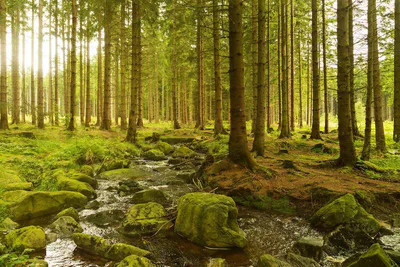
The land east of the Mississippi River was once almost completely covered in forests. This area was home to many groups of Native Americans. The languages spoken by the Native Americans of these Eastern Woodlands belonged to one of two groups. The larger one was Algonkian. The other group was Iroquoian.
Background


25
Multiple Choice
The Eastern Woodlands region of the U.S. is mostly covered by _____.
ocean water
glaciers
grasslands
forests
26
The Eastern Woodlands is a huge area. It stretches from the Atlantic Ocean to the Mississippi River and from Canada to Florida. Its forests, lakes, rivers, and the Atlantic Ocean provide many natural resources for the many different people who live there.
In the forests were many kinds of animals to hunt for food. Forests also provided wood for building homes and canoes. Many wild plants and berries could be eaten or used for medicine. The soil of the coastal plains and river valleys was ideal for farming. Its bodies of water were filled with fish, shellfish, and sea animals.
A Rich Environment


27
Multiple Choice
The central idea of the previous slide is _______.
the Eastern Woodlands region is big
the Eastern Woodlands region has many lakes and rivers.
the Eastern Woodland region is large and filled with natural resources.
the Eastern Woodlands region has many plants that can be eaten and used for medicines.
28
Multiple Choice
The Eastern Woodlands region stretches from the Atlantic Coast in the east to the ______ River in the west.
St. Lawrence
Ohio
Oswegatchie
Mississippi
29
The Native Americans of the Eastern Woodlands were mostly farmers who lived in permanent villages. They hunted also for their meat. Many Woodland people built wigwams. Wigwams were homes with bent sapling frames. They were covered with cattail mats or elm bark. Many people fished and traveled far in canoes made of birchbark.
The Wigwam


30
Multiple Choice
Many Woodland people lived in homes called _____.
igloos
tepees
huts
wigwams
31
Multiple Choice
Most people of the Eastern Woodlands got their food from ______.
hunting and gathering
shopping
hunting and farming
gathering and begging
32
Multiple Choice
The canoes of the Eastern Woodland people were made from burned out logs covered by _____.
plastic wrap
saplings
birch bark
animal skins
33
Today we know the Haudenosaunee as the Iroquois because they spoke the Iroquoian language. The Haudenosaunee lived mainly in what is now New York State. They included 5 groups, the Seneca, the Cayuga, the Onondaga, the Oneida, and the Mohawk.
The Haudenosaunee

34
Multiple Choice
What language did the Iroquois speak many years ago?
Algonkian
English
French
Iroquoian
35
Multiple Choice
Which was NOT an Iroquois group?
Mohawk
Seneca
Oneida
Algonkian
36
Multiple Choice
Which U.S. state did most of the Iroquois people live in?
Florida
Montana
Virginia
New York
37
Haudenosaunee means "people of the longhouse" in Iroquoian language. Longhouses are long buildings made of poles covered with sheets of bark. Each longhouse held several families.
"The People of the Longhouse"

38
Multiple Choice
What does the name "Haudenosaunee" mean?
People of the Night
People of the Snake World
People of the Wigwams
People of the Longhouse
39
Multiple Choice
Longhouses were different than wigwams because they were ______.
larger and held multiple families
smaller and covered in elm bark
the same size but covered with animal skins
made of saplings only
40
What do you see in these images?
Inside the Longhouse


41
Multiple Choice
Where were the fires located in a longhouse?
down the center corridor
in the bed areas
hanging from the upper rooftop
on the sides of the longhouse
42
Multiple Choice
Roofs had holes cut out to ______.
allow children to escape
allow cold air in during winter
allow smoke to exit the longhouse
allow birds in to feed
43
The Haudenosaunee made fine beadwork called wampum. Wampum was a belt or string of small polished beads made from shells and strung or woven together. Wampum was used in ceremonies, to seal agreements, or as a gift. Wampum was very time-consuming to make, but very valuable to the people.
Wampum



44
Multiple Choice
Wampum was made from _____.
tree bark
saplings
seaweed
sea shells
45
Multiple Choice
Wampum could be used _____.
as a gift
during special ceremonies
to finalize a deal
All choices are correct.
46
During the 1500s the Haudenosaunee lands were connected. One route, the Haudenosaunee Trail, connected the main village of all 5 Iroquois groups.
The Haudenosaunee Trail

47
Multiple Choice
What was the trail that connected the 5 major groups of the Iroquois?
The Longhouse Trail
The Haudenosaunee Trail
The Genesee Trail
The Iroquois Road
48
Haudenosaunee women were the leaders of their clans. A clan is a group of families that share a common ancestor. Clans controlled the land. Women also were in charge of the longhouses. After marriage, a husband would move into his wife's longhouse and lived with her family.
For all important decisions clan mothers had to give their approval.
The clan mothers also chose the village leaders who were men. If the men who were chosen to be leaders did not do their jobs well, then the clan mothers could get rid of the leader.
Clan Mothers


49
Multiple Choice
Groups of family members that could trace their ancestors back together to one female ancestor were called ____.
clans
tribes
gangs
villages
50
Multiple Choice
In an Iroquois clan, all people in that clan could trace their ancestors back to one ____.
man
woman
wolf
longhouse
51
Multiple Choice
True or False
When an Iroquois man and woman were married, the woman became part of her husband's clan.
True
False
52
Multiple Choice
Which of the statements is true about clan mothers?
All important decisions made by the chiefs had to get the clan mothers' approval.
Clan mothers chose the men to become village leaders.
Clan mothers could remove leaders who were not doing their job as chief.
All of these choices are correct.
53
The Haudenosaunee mainly cooperated with each other until around 1300 when their numbers began to grow. Then fighting began, often over hunting grounds. There was great sadness and loss of life. This war and conflict ended when two leaders came up with a bold idea. These leaders were Deganawida and Hiawatha. Around 1452 Hiawatha and Deganawida spoke to all Haudenosaunee groups to convince them to join the Iroquois Confederacy. A confederacy is a large of people who join together for strength or peace. The Iroquois created an organized government with the goal of maintaining peace among the 5 groups, or nations. In 1722 they became the 6 Nations when the Tuscarora joined the Confederacy.
The Iroquois Confederacy still remains to this day.
The Iroquois Confederacy


54
Multiple Choice
Why are Hiawatha and Deganawida remembered as heroes for by the Iroquois people?
They were the greatest warriors in their history.
They were able to break the Iroquois Confederacy apart.
They were able to get the 5 warring groups of the Iroquois to join the new confederacy.
None of these choices is correct.
55
Multiple Choice
Why did Iroquois groups fight about in earlier years?
hunting grounds
stolen food
bad weather
None of these choices is correct.
56
Multiple Choice
A large group of people that join together for strength and peace is a _____.
state
village
confederacy
empire
57
Multiple Choice
True or False
The Iroquois Confederacy only lasted a short time.
True
False
Early Cultures & Native Americans of the Woodlands
Chapter 2
Social Studies 5
Mr. Honeywell
(Combination Chapter 1/2- Condensed)
Show answer
Auto Play
Slide 1 / 57
SLIDE
Similar Resources on Wayground

56 questions
Word Processing Prep
Presentation
•
4th - 5th Grade
56 questions
World War 1 and 2
Presentation
•
5th - 6th Grade
51 questions
NEWTON'S FIRST LAW: INERTIA
Presentation
•
5th Grade
52 questions
Q2 Module 2: Tools and Materials in Sewing
Presentation
•
6th Grade
50 questions
FIL5 Academic Contest
Presentation
•
5th Grade
50 questions
Classification of Organisms
Presentation
•
6th Grade
52 questions
Multiplication and Division Word Problems
Presentation
•
5th Grade
50 questions
geosphere and biosphere
Presentation
•
5th Grade
Popular Resources on Wayground
6 questions
PRIDE Always and Everywhere
Presentation
•
12th Grade
20 questions
Lab Safety Quiz

Quiz
•
6th Grade
26 questions
KOR Review Kahoot Questions
Quiz
•
8th Grade
21 questions
Continents and Oceans
Quiz
•
6th Grade
12 questions
Unit Zero lesson 2 cafeteria
Presentation
•
9th - 12th Grade
20 questions
Parts of Speech
Quiz
•
5th Grade
10 questions
Riddles Riddles fun Riddles
Quiz
•
6th - 12th Grade
16 questions
Subject & Predicate
Quiz
•
5th Grade
Discover more resources for Other
20 questions
Parts of Speech
Quiz
•
5th Grade
16 questions
Subject & Predicate
Quiz
•
5th Grade
25 questions
Multiplication Facts
Quiz
•
5th Grade
22 questions
Continents and Oceans
Quiz
•
5th Grade
15 questions
Rounding Decimals
Quiz
•
5th Grade
20 questions
Lab Safety
Quiz
•
5th - 8th Grade
20 questions
Mixtures and Solutions Practice
Quiz
•
5th Grade
10 questions
Soup, Salad, or Sandwich?
Quiz
•
1st Grade - Professio...