
Enzymes lesson

Presentation
•
Biology
•
9th Grade
•
Medium

Mansi Patel
Used 2+ times
FREE Resource
21 Slides • 26 Questions
1

Chemical Reactions
& Enzymes
9C Identify and investigate the role of enzymes (Supporting TEKS)
2
Multiple Choice
3
Multiple Choice
What is the main purpose of enzymes inside of living cells?
Store Energy for later use by the cell
Repel water from the cell's surface
Provide cells with structure and support
To speed up and direct chemical reactions
4
Multiple Choice
What is the role of protein in the body?
Is the main source of energy for the body
Helps to build and repair body tissue
Provide warmth and cushioning to the body's organs
Helps to transport vitamins through the body
All of the above are roles of protein in the body
5
Multiple Select
Which elements can be found in proteins?
C
H
N
P
O
6
Multiple Choice
7

What are some examples or functions of proteins?
Role (Examples){Functions}
●Digestive enzyme (Amylase, lipase, pepsin){Break down nutrients in food into
small pieces that can be readily absorbed}
●Transport (Hemoglobin){Carry substances throughout the body in blood or lymph}
●Structure (Actin, tubulin, keratin){Build different structures, like the cytoskeleton}
●Hormone signaling (Insulin, glucagon){Coordinate the activity of different body systems}
●Defense (Antibodies) {Protect the body from foreign pathogens}
●Contraction (Myosin){Carry out muscle contraction}
●Storage (Legume storage proteins, egg white (albumin)) {Provide food for the
early development of the embryo or the seedling}
8
Multiple Select
Select all the functions of the proteins
immune response
structural support
hormone signaling
enzymatic activity
transport
9
Match
Match the proteins with their functions
Amylase
Hemoglobin
Insulin
Collagen
Antibodies
Breaks down starches
Transports oxygen
Regulates blood sugar
Provides structural support
Fights infections
Breaks down starches
Transports oxygen
Regulates blood sugar
Provides structural support
Fights infections
10
Match
Match the protein to its function
Albumin
Myosin
Lipase
Glucagon
Keratin
Food for early development of the embryo
Muscle contraction
Breakdown lipids
Hormone signaling
Structural support
Food for early development of the embryo
Muscle contraction
Breakdown lipids
Hormone signaling
Structural support
11

Chemical Reactions
process that changes one set of chemicals into
another set of chemicals. This involves a change in
chemical bonds.
CO2 + H2O H2CO3
Reactants
Products
what you start with
what you end up with
12
Multiple Choice
What is underlined in the chemical equation below?
Na + Cl ---> NaCl
Products
Reactants
13
Multiple Choice
In the chemical equation below, the product is....
Na + Cl ---> NaCl
Na
NaCL
Cl
NaCl
14
Hotspot
Select all the reactants
15


Energy
Energy can be released or absorbed whenever
chemical bonds are made or broken.
Many chemical reactions need energy to occur (will
not proceed without a source of energy).
Potential Energy
16
Multiple Choice
Knowing that energy is stored in the bonds,
which biomolecule holds more energy:
carbohydrates
lipids
17


Activation Energy
energy needed to activate or start a reaction.
18


Activation Energy
energy needed to activate or start a reaction.
Simply put, to get
this ball to move
down the hill, you
need to put in
some energy first
by pushing it up
(activation energy).
Activation Energy
19
20


Enzymes
specialized proteins that act as biological catalyst
(substance that speeds up rate of chemical reaction by lowering activation energy)
21
Living cells use enzymes to speed up virtually every important chemical reaction that takes place in cells.
These reactions would otherwise be too slow to sustain life.
can increase reaction speeds 1010 times
22

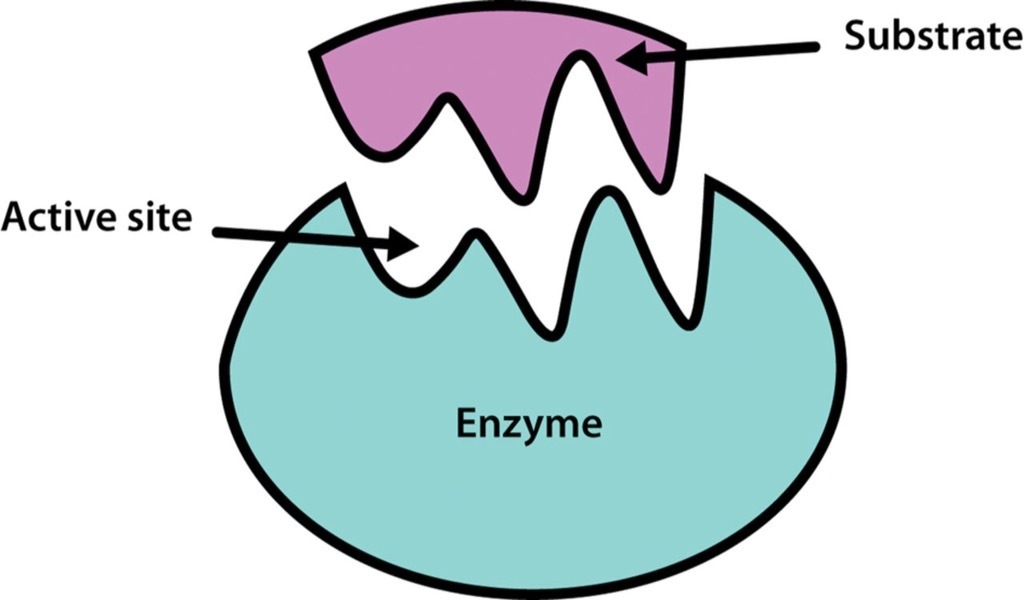
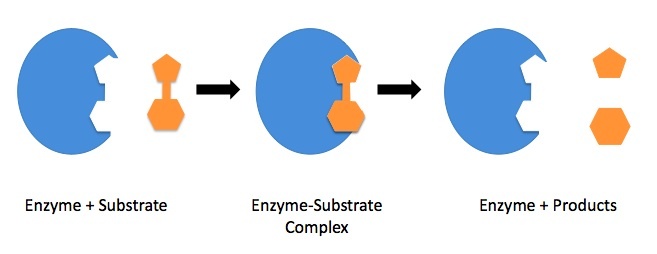
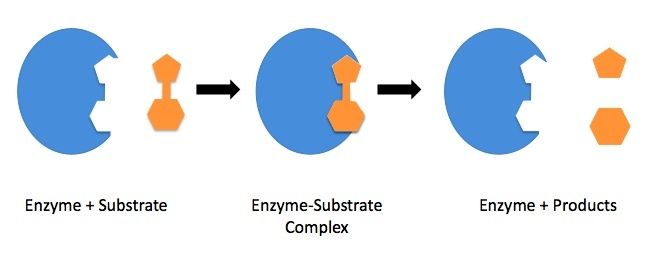
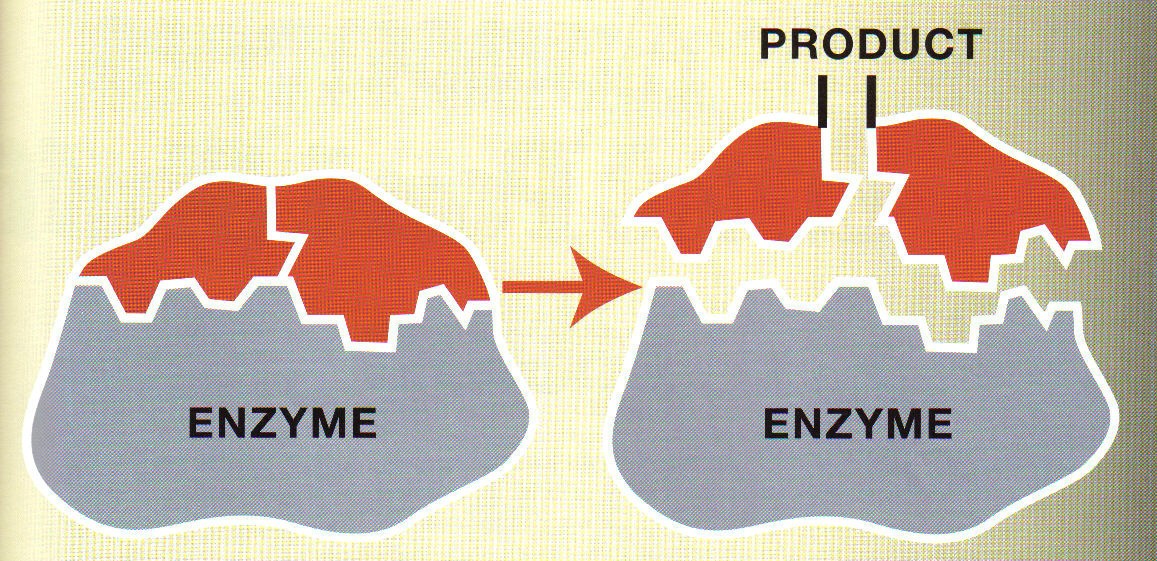
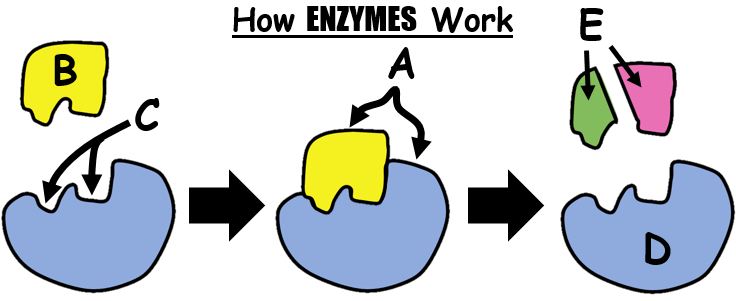
Enzymes are specific to their substrate. They combine at
the active site to form an enzyme-substrate complex.
The products are the substrate broken apart.
Enzymes
Not used during
reaction.
Enzyme can be
reused for more
reactions.
23


Name of enzyme derived from reaction it catalyzes
(ends in -ase)
Example: Lactase breaks apart lactose.
Enzymes
Enzymes are specific:
Lactase can only break
down lactose, not
sucrose.
24
Labeling
Label the image:
Active site
Enzyme-substrate complex
Substrate
Enzyme
Products
25
Labeling
Label the image
Products
Enzyme
Enzyme substrate complex
Substrates
26
Two Models

Lock-and-key: substrate molecules have the right shape to fit an enzyme
Induced Fit: interaction between enzyme and substrate causes the enzyme to change shape to provide a suitable fit.
27
Some molecules (inhibitors) can interfere with enzyme activity by sitting in the active site or changing the shape of the enzyme.
Inhibitors
decrease enzyme activity

28
Multiple Choice
29
Multiple Choice
30
Multiple Choice
A receptor site that a molecule can bind to that changes the shape of the active site is called a(n):
Allosteric Site
Active Site
Activation site
Reactant site
31


(or cofactors) a substance that works with an enzyme
to change the rate of reaction.
Coenzymes
increase enzyme activity
32
Multiple Choice
How does a noncompetitive inhibitor decrease reaction rates?
Binds to the active site
Binds to the allosteric site
Increases the free energy
Increases the substrate concentration
33
Multiple Choice
Molecules that bind to enzymes and enhance an enzyme's ability are called:
CoFactors
Competitive Inhibitors
Allosteric Inhibitors
34
35

Digestive Enzymes and Digestive Enzyme Supplements | Johns Hopkins Medicine
You can open this webpage in a new tab.
36
Match
Match the enzyme with their substrates
made in the mouth and pancreas; breaks down complex carbohydrates
produced in the pancreas; helps digest proteins
secreted by the pancreas; converts fats into fatty acids
found in the small intestine; breaks down Lactose
found in the small intestine; breaks down Sucrose
Amylase
Protease
Lipase
Lactase
Sucrase
Amylase
Protease
Lipase
Lactase
Sucrase
37
Open Ended

Brainstorm to explain what
DENATURE
means and how it would affect the enzyme activity
38


Enzyme activity is affected by pH, temperature, and
concentration of enzyme/substrate
Enzymes can denature(unfold from its 3D structure)
and lose its function under extreme conditions (high
temperature or very acidic/basic pH).
Factors Affecting Enzymes
39

Enzymes are sensitive
to changes in pH.
-Enzymes found in the
stomach are more
optimal in acidic pH.
-If it is too acidic or too
basic, enzyme will slow
down or denature.
pH
40

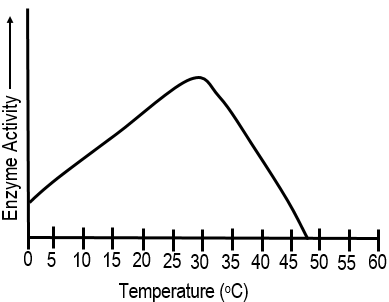
Temperature
Enzymes function optimally
at certain temperatures.
-High temperatures will
inactivate or denature
enzyme
-Warm temperatures
increases speed
-Cold temperatures will
decrease speed.
41
Multiple Choice
42


When concentration increases, reaction is faster.
When concentration decreases, reaction is slower.
Concentration of
Enzyme/Substrate
43


Amylase: found in saliva, breaks down carbohydrates
Protease: found in stomach, break down protein
Lipase: found in small intestines, breaks down lipids
Important Enzymes in your Body
44
Multiple Choice
45
Multiple Choice
Which of the following would NOT denature an enzyme?
HIGH temperature
LOW pH
HIGH pH
LOW temperature
46
Multiple Choice
47
Multiple Choice
What happens to the reaction rate if an enzyme is denatured or nonfunctional?
No change in the reaction rate
Increase in reaction rate
Decrease in reaction rate
Decrease then increase in reaction rate
Chemical Reactions
& Enzymes
9C Identify and investigate the role of enzymes (Supporting TEKS)
Show answer
Auto Play
Slide 1 / 47
SLIDE
Similar Resources on Wayground

42 questions
Europe Map 2
Presentation
•
9th Grade
39 questions
DNA and Protein Synthesis STAAR Review lesson HONORS
Presentation
•
9th Grade
43 questions
3.1 Introduction to Global Systems
Presentation
•
9th Grade
40 questions
Concordância verbal
Presentation
•
KG
42 questions
Prokaryotic Cells
Presentation
•
9th Grade
42 questions
Eukaryotic Organelles
Presentation
•
9th Grade
42 questions
Eukaryotes vs Prokaryotes and Organelles
Presentation
•
9th Grade
40 questions
If - Joseph Rudyard Kipling
Presentation
•
9th Grade
Popular Resources on Wayground
10 questions
How much do you know about our Portrait of an Eagle?

Quiz
•
10th Grade
10 questions
Fast Food Slogans
Quiz
•
6th - 8th Grade
21 questions
Continents and Oceans
Quiz
•
6th Grade
20 questions
Parts of Speech
Quiz
•
5th Grade
16 questions
Subject & Predicate
Quiz
•
5th Grade
25 questions
Multiplication Facts
Quiz
•
5th Grade
12 questions
Map Skills
Quiz
•
3rd Grade
22 questions
Continents and Oceans
Quiz
•
5th Grade
Discover more resources for Biology
20 questions
Characteristics of Life
Quiz
•
9th - 10th Grade
10 questions
Exploring the 4 Major Macromolecules and Their Functions

Interactive video
•
9th - 12th Grade
20 questions
Cell Transport
Quiz
•
9th - 12th Grade
25 questions
photosynthesis and cellular respiration
Quiz
•
9th Grade
16 questions
Population Ecology
Quiz
•
9th - 12th Grade
20 questions
Cell Organelles
Quiz
•
9th Grade
18 questions
Water Properties
Quiz
•
9th Grade
36 questions
U3 Review Cell Cycle and Specialization Quiz
Quiz
•
9th Grade