
8.1Contact Forces Lesson 12, how do we sense different textures?

Presentation
•
Science
•
8th Grade
•
Practice Problem
•
Easy
+6
Standards-aligned

Kelly Koller
Used 2+ times
FREE Resource
7 Slides • 10 Questions
1
How do we sense different textures?
Discovering the intricacies and wonders of our tactile perception through scientific exploration and sensory experiences.
2
When we touch a material, we feel the texture of that material. We can tell if something is hard or soft just by placing our skin on the object. Have you ever considered how we can tell if something is hard or soft? It turns out the answer is deformation due to a contact force!
We learned in Lesson 5 that we can feel objects when the pressure sensors in our skin deform. We also learned these pressure sensors, or force detectors, are all over our body. It is estimated that you have roughly 150,000 of these in each hand! The special sensors for detecting force are called mechanoreceptors. Let’s learn more about how the skin senses different textures and softnesses.
3
Multiple Choice
What is the role of pressure sensors in our sense of touch?
Detecting and measuring pressure applied to the skin's surface
Enhancing our sense of taste
Regulating body temperature
Improving our sense of smell
4
Dropdown
5
Deformation & Contact Force
Sense of Touch: Vital for perception & interaction
Deformation: How objects change shape when touched
Contact Force: Pressure exerted during touch
6
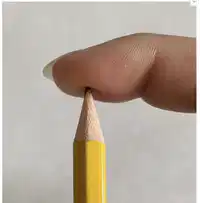
When your finger touches a surface, part of your finger deforms. Things that feel sharper deform more of your finger and touch less surface area. Take a finger and touch your desk. Your finger touches the surface and then it starts to deform so that the entire pad of your finger is touching the surface of the desk. Now, take your pencil and use the point of your pencil to touch the pad of your finger. Does it feel different? The reason that the pencil feels sharper is because it makes your finger deform more and less surface area is in contact with the object. The table felt smooth or dull because it did not indent, or deform, your finger as much as the pencil point. The table also pressed on the whole pad of the finger, not just a small area.
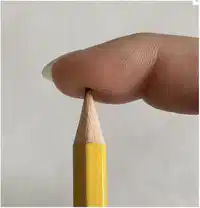
This pencil causes a lot of deformation to the pad of the finger, but it touches a very small surface area at the lead point. Because it touches such a small area and there is a large deformation, the brain senses this pencil as sharp.
7
Dropdown
8
The feeling of smooth vs rough
When you run your hand across different surfaces, some feel smooth and others feel rough. Run your hand across a surface that is rougher, like the stitching on your backpack, a zipper, or the metal part of your pencil. Now run your hand across a surface that is smoother, like the top of your desk or the side of your pencil. Which one had more areas of deformation as you moved your finger across the surface? The rough surface makes many different spots on your finger deform as your finger moves across the surface, and the smooth surface does not have as many spots that cause deformation to the finger on multiple locations. The smooth surface does not deform your finger as much when your finger runs across the surface.
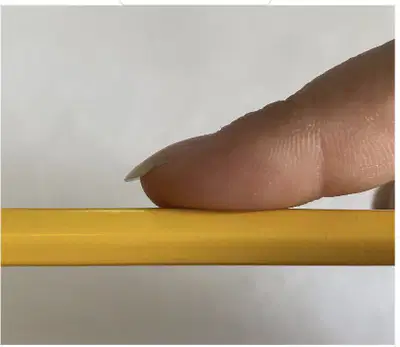
As the finger runs across this pencil, it does not encounter multiple areas of deformation and the pressure is consistent on the pad of the finger. This causes the brain to sense the pencil side as smooth.
9
Draw
Create an illustration that visually explains how different textures are detected on the skin. Use arrows and labels to show the process of deformation and the role of mechanoreceptors in sensing texture
10
Multiple Choice
A rough surface makes many different spots on your finger deform as your finger moves across the surface
True
False
11
The feeling of soft vs hard
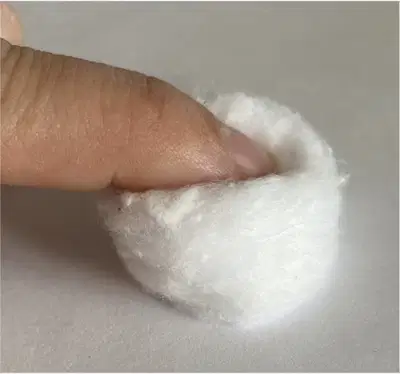
When your hand touches something soft, the soft item deforms around your finger. The soft surface is deformed due to the pressure of your finger pushing on it. If your finger deforms the surface instead of the surface deforming your finger, it feels softer. Cotton balls feel soft because of how much they deform when we apply pressure. The surface touches a very large part of our fingertips with very little force being applied. Our bodies know when we are applying pressure, and the more we apply pressure without the resistance, the softer an object feels.
This cotton ball deforms when a contact force from the finger is applied. The finger senses that it is in contact with the cotton ball, and the cotton ball deforms more than the pad of the finger. This causes the brain to sense the cotton ball as soft.
12
Drag and Drop
13
How our brains receive the signal
Our sense of soft vs. hard depends on the amount of pressure and deformation on our skin. When the finger is deformed, it sends signals through our nerves to the brain that then interprets the texture of the objects. Our brain turns this signal into information that we can use.

14
Multiple Choice
What makes a surface feel smooth?
Multiple areas of deformation
Consistent pressure on the finger
Less deformation of the finger
More spots causing deformation
15
Multiple Choice
What happens when a soft surface is touched?
The surface deforms the finger
The finger deforms the surface
No deformation occurs
The finger slides off the surface
16
Multiple Choice
What determines our sense of soft vs. hard?
The color of the object
The temperature of the object
The amount of pressure and deformation on our skin
The weight of the object
17
Multiple Choice
How does our brain receive the signal of texture?
Through our nerves
Through our sense of smell
Through our sense of hearing
Through our sense of sight
How do we sense different textures?
Discovering the intricacies and wonders of our tactile perception through scientific exploration and sensory experiences.
Show answer
Auto Play
Slide 1 / 17
SLIDE
Similar Resources on Wayground

12 questions
Interdependence and Competition
Presentation
•
7th - 8th Grade
15 questions
Weathering, Erosion & Deposition
Presentation
•
8th Grade
9 questions
Subscripts, Coefficients and Counting Atoms
Presentation
•
8th Grade
16 questions
8.7 c tides
Presentation
•
8th Grade
12 questions
Thermal Energy
Presentation
•
8th Grade
11 questions
Charles's & Boyle's Laws
Presentation
•
8th Grade
10 questions
Physical versus Chemical Changes
Presentation
•
8th Grade
15 questions
Magnets
Presentation
•
8th Grade
Popular Resources on Wayground
10 questions
How much do you know about our Portrait of an Eagle?

Quiz
•
10th Grade
10 questions
Fast Food Slogans
Quiz
•
6th - 8th Grade
21 questions
Continents and Oceans
Quiz
•
6th Grade
20 questions
Parts of Speech
Quiz
•
5th Grade
16 questions
Subject & Predicate
Quiz
•
5th Grade
25 questions
Multiplication Facts
Quiz
•
5th Grade
12 questions
Map Skills
Quiz
•
3rd Grade
22 questions
Continents and Oceans
Quiz
•
5th Grade
Discover more resources for Science
20 questions
Scientific Method and Variables
Quiz
•
8th Grade
20 questions
Scientific method and variables
Quiz
•
8th Grade
27 questions
Counting Atoms - Subscripts
Quiz
•
8th Grade
20 questions
Claim, Evidence and Reasoning (CER)
Quiz
•
6th - 8th Grade
18 questions
Counting Atoms
Quiz
•
7th - 8th Grade
20 questions
Elements, Compounds and Mixtures
Quiz
•
8th Grade
10 questions
Exploring Chemical and Physical Changes

Interactive video
•
6th - 10th Grade
10 questions
Decoding the Periodic Table of Elements
Interactive video
•
6th - 10th Grade