
Unit 4: Forces

Presentation
•
Science
•
9th Grade
•
Practice Problem
•
Medium
+20
Standards-aligned

Mikayla Deiotte
Used 17+ times
FREE Resource
67 Slides • 23 Questions
1

Unit 4: Forces and Newton’s Laws
Chapters 5 and 6
2
Key Points
●Understand how unbalanced forces alter motion- Newton’s first and second
laws of motion
●Understand that forces are vector quantities – have a magnitude and
direction
●Understand how unbalanced net force causes acceleration
●The rate of acceleration is inversely proportional to mass
●Understand how two objects exchange forces equal in magnitude and
opposite in direction (interacting force pairs)- Newton’s third law
●Be able to draw force diagrams and calculate net force
●Know the types of forces and how they are depicted on force diagrams
●Be able to describe the field concept as it applies to gravity
3

Main Ideas
● Forces and Cause of Forces
● Units of Force
● Newton’s Laws
○
First Law
○
Second Law
● Force Diagrams
4

Cause of Forces
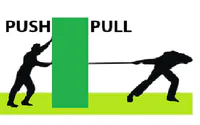
● A force is a push or pull, or an action that has the ability to change motion.
● Forces can increase or decrease the speed of a moving object
● Forces can also change the direction in which an object is moving
5


How are forces created?
Forces are created in many ways.
For example, your muscles create force when you swing a baseball bat.
6
Multiple Select
Which are examples of force
A chair being pushed in
A toy being kicked
A ball slowing to a stop
A merry-go-round being pushed
7


Four Elemental Forces
● All forces in the universe come from only four basic
forces.
● Electromagnetic forces are important to technology.
● Gravity is a universal force.
8

How do forces act?
One way forces act is the result of direct contact.
A contact force is transmitted
by matter directly touching
other matter such as wind
acting to slow a parachute.
9


How do forces act?
The force of gravity between Earth and Moon appears to be what people once called “action at-a distance”.
Today we know that the gravitational force is carried from the Earth to the Moon by a force field.
10

Types of Forces
11
Fill in the Blanks
Friction is an example of a
12
Types of Forces-Contact Forces
Normal Force- support force exerted upon an object that is in contact with another stable object.
Generated by the exchange of forces due to Newton’s Third Law
Applied Force-a force that is applied to an object by a
person or another object.
13

Type of Forces Continued
Tension force- force that is transmitted through a string, rope, cable or wire when it is pulled tight by forces acting from opposite ends.
The force is directed along the length of the wire and pulls equally on the objects on the opposite ends of the wire
The force points in the direction of the pull
14

Type of Forces Continued
Friction force- force that opposes sliding between two surfaces
There are at least two types of friction force - sliding and static friction.
Friction force on an object always points in a direction opposite to relative motion of the object
15

Friction
Friction is a force that resists the motion of objects or surfaces.
Many kinds of friction exist.
1.
Static
2.
Sliding
3.
Rolling
4.
Fluid
16


Friction
Static
Sliding
Rolling
Fluid
17


Friction
Sliding
18
Multiple Choice
A pool ball rolling on a pool table is an example of...
Rolling friction
Sliding friction
Fluid friction
Static friction
19
Types of Forces Continued
Gravitational Force- force with which the earth, moon, or other massively large object attracts another object towards itself. By definition, this is the weight of the object.
Calculated as F=mg
g is gravitational field strength of an object on the
surface of Earth (9.8 N/Kg or m/s2)
20
Multiple Choice
Pushing in a chair is an example of...
gravitational force
applied force
normal force
friction force
21
Multiple Choice
A cup sitting on a table is an example of...
gravitational force
applied force
normal force
friction force
22
Multiple Choice
Leaves falling is an example of...
gravitational force
applied force
normal force
friction force
23
Units of Force
Pounds or Newtons
Conversion: 1lb=4.448 N
We will use Newton in class because it is the SI unit for force
Defined by Newton’s laws of motion
Vector quantity- has a magnitude (strength) and direction
24

Pounds
When you measure weight in pounds on a
postal scale, you are measuring the force of gravity acting on an object.
25

Units of Force
Although we use pounds all the time in our
everyday life, scientists prefer to measure forces in newtons.
The newton (N) is a metric unit of force.
26
Fill in the Blanks
27
Fill in the Blanks
28

Units of Force: Conversions
The newton (N) is a smaller unit of force than the pound (lbf).
One pound of force (1lbf) = 4.448 newtons,.
Example: About twenty percent of the National Football
League weighs more than 300 pounds. Convert their weight to newtons.
29


Gravity
The force of gravity on an object is called weight.
At Earth’s surface, gravity exerts a force of 9.8 N on every kilogram of mass.
30
Weight vs. Mass
Weight and mass are not the same.
Mass is a fundamental property of matter measured in kilograms (kg).
Weight is a force measured in newtons (N).
Weight depends on mass and gravity.
31


Solving Weight Problems
32


33

Weight: Sample Problem #1
What is the weight of an object on Earth that has a mass of 3.5kg?
34
Fill in the Blanks
What is the weight of an object on Earth that has a mass of 3.5 kg? (don't forget the label)
35
Weight Sample Problem #2
What is the weight of a 3.5kg object on Mars?
(acceleration due to gravity on Mars is 3.7m/s2)
36
Fill in the Blanks
What is the weight of a 3.5kg object on Mars? (acceleration due to gravity on Mars is 3.7m/s2)
37

Weight Sample Problem #3
What is the mass of an object on Earth that has a weight of 35N?
38
Fill in the Blanks
What is the mass of an object on Earth that has a weight of 35N?
39

Forces and Equilibrium
40

Equilibrium
When several forces act on the same object:
1.The net force (sum of all the forces) is zero, or
2.The net force is NOT zero.
41


42

Equilibrium and Normal Forces
A normal force is created whenever an object is
in contact with a surface.
The normal force has equal strength to the force
pressing the object into the surface, which is
often the object’s weight.
43


Free Body Diagrams
This diagram shows four forces acting
upon an object.
There aren’t always four forces, For
example, there could be one, two, or three
forces.
44

Problem 1
A book is at rest on a table top. Diagram the
forces acting on the book.
45


Problem 1
In this diagram,
there are normal and gravitational
forces on the book.
46

Problem 2
An egg is free-falling from a nest in a tree.
Neglect air resistance. Draw a free-body
diagram showing the forces involved.
47


Problem 2
Gravity is the only
force acting on the egg as it falls.
48

Problem 3
A flying squirrel is gliding (no wing flaps) from a
tree to the ground at constant velocity.
Consider air resistance. A free body diagram
for this situation looks like…
49


Problem 3
Gravity pulls down on the squirrel while air resistance keeps the
squirrel in the air for a while.
50

Problem 4
A rightward force is applied to a book in order
to move it across a desk. Consider frictional forces. Neglect air resistance. Construct a
free-body diagram. Let’s see what this one
looks like.
51

Problem 4
Note the applied force
arrow pointing to the right.
Notice how friction force
points in the opposite
direction. Finally, there is
still gravity and normal
forces involved.
52

Problem 5
A skydiver is descending with a constant
velocity. Consider air resistance. Draw a
free-body diagram.
53


Problem 5
Gravity pulls down
on the skydiver,
while air resistance
pushes up as she
falls.
54

Problem 6
A man drags a sled across loosely packed
snow with a rightward acceleration. Draw a free-body diagram.
55


Problem 6
The rightward force arrow
points to the right. Friction
slows his progress and
pulls in the opposite
direction. Since there is not
information that we are in a blizzard, normal forces still apply as does gravitational force since we are on planet Earth.
56

Problem 7
A football is moving upwards toward its peak
after having been booted by the punter. Draw a free-body diagram.
57


Problem 7
The force of
gravity is the only
force described.
It is not a windy
day (no air
resistance).
58

Problem 8
A car runs out of gas and is coasting down a hill.
59


Problem 8
Even though the
car is coasting
down the hill, there
is still the dragging
friction of the road
(left pointing arrow)
as well as gravity
and normal forces.
60
Multiple Choice
Which force is present in every free-body diagram?
applied force
gravitational force
normal force
friction force
61
Acceleration Application and Forces
Motion of an object depends on the TOTAL force on the object
The concept is called net force
When forces are balanced, then the net force = zero and this means there is no acceleration
Therefore acceleration is caused by having an unbalanced force
Acceleration is in the same direction as the unbalanced force
62


How do you know if an object will accelerate?
Draw a force diagram and calculate net force
Free-body diagrams are used to show the relative
magnitude and direction of all forces acting on an object.
63


Example 1
Is the object accelerating?
64
Multiple Choice
Is the object accelerating?
Yes
No
65


Example 2
Is the object
accelerating? Why or why not?
66
Multiple Choice
Is the object accelerating? Why or why not?
Yes, there is more force pushing downward
Yes, there is more force pushing upward
No, there is a net force of zero
No, the object is staying still
67


Acceleration and Forces
●Ask: Is the object accelerating?
●Predict the position time and velocity time graph from that.
Yes:
Position Time Graph
Velocity Time Graph
68


Acceleration and Forces
●Ask: Is the object accelerating?
●Predict the position time and velocity time graph from that.
No:
Position Time Graph
Velocity Time Graph
69

Newton’s Laws: Chapter 6
70
Newton’s First Law
Object at rest stays at rest unless acted upon by an unbalanced force.
If the net force is zero, an object at rest will stay at rest.
If an object is acted upon by unbalanced
forces, its motion will change.
71


72


Which ball has more inertia?
Inertia is the property of an object that resists
changes in motion.
Objects with more mass
have more inertia and are more resistant to
changes in their motion.
73

Illustrations
What happens if you are in a car, and the driver presses on the accelerator quickly? Why?
What happens if you are in a moving car, and the driver slams on the brakes? Why?
74
Multiple Choice
______ is the property of matter that resists changes in motion
mass
acceleration
gravity
inertia
75
Multiple Select
What is Newton's first law of motion?
An object in motion stays in motion
An object has mass
An object at rest will remain at rest unless acted upon by an outside force
w=mg
76
Newton’s Second Law
Summed up by stating Fnet =ma
An object will accelerate as a result of unbalanced net forces
The acceleration of the object will be in the same direction as the force that is applied
The amount of acceleration generated is related to its mass (mass resists motion)
Acceleration is inversely proportional to the mass of the object a=Fnet/ m
77


78
Newton’s Second Law
There are three main ideas related to Newton’s Second Law:
Acceleration is the result of unbalanced forces.
A larger force makes a proportionally larger acceleration.
Acceleration is inversely proportional to mass.
79
Multiple Choice
A larger force makes a proportionally ______ acceleration
inverse
smaller
larger
unbalanced
80
Multiple Choice
Acceleration is _________ proportional to mass
inversely
smaller
larger
unbalanced
81
Practice Problems
An object has a mass of 5.0 kg, and an acceleration of 0.5m/s2 . What is the net force on the object?
82
Fill in the Blanks
An object has a mass of 5.0 kg, and an acceleration of 0.5m/s2 . What is the net force on the object?
83
Practice Problems
A catcher in a professional baseball game exerts of force of -65.0 N to stop a ball. If the baseball has a mass of 0.145Kg, what is its acceleration as it is being caught?
84
Fill in the Blanks
A catcher in a professional baseball game exerts of force of -65.0 N to stop a ball. If the baseball has a mass of 0.145Kg, what is its acceleration as it is being caught?
85

Practice Problems
Suppose an empty grocery cart rolls downhill in a parking lot. The cart has a maximum speed of
1.3m/sec when it hits the side of the store and
comes to rest 0.30 seconds later. If the cart has
a mass of 15,120 g, what was the force required
to stop the cart?
86
Multiple Choice
Suppose an empty grocery cart rolls downhill in a parking lot. The cart has a maximum speed of
1.3m/sec when it hits the side of the store and
comes to rest 0.30 seconds later. If the cart has
a mass of 15,120 g, what was the force required to stop the cart?
3,516 N
65,520 N
65.52 N
5,896 N
87
Multiple Choice
What is Newton's second law?
F=ma
For every action, there is an equal and opposite reaction
An object in motion stays in motion and an object at rest stays at rest unless acted upon by an outside force
88

Newton’s 3rd Law
Interactive force pairs
Forces exchanged when objects interact are equal in magnitude and opposite in direction
The forces exchanged NEVER cancel out
This is because the forces exchanged act on different objects
89


90
Multiple Choice
What is Newton's third law?
F=ma
For every action, there is an equal and opposite reaction
An object in motion stays in motion and an object at rest stays at rest unless acted upon by an outside force
Unit 4: Forces and Newton’s Laws
Chapters 5 and 6
Show answer
Auto Play
Slide 1 / 90
SLIDE
Similar Resources on Wayground

80 questions
Evolution Intro and Natural Selection
Presentation
•
9th Grade
87 questions
naming compounds
Presentation
•
8th Grade
88 questions
AKS 9 Waves
Presentation
•
8th Grade
80 questions
Classification Practice
Presentation
•
9th Grade
84 questions
Антифейкова гра
Presentation
•
9th Grade
86 questions
review
Presentation
•
8th Grade
89 questions
Midterm Review 2023
Presentation
•
8th Grade
80 questions
Unit 1- Economic Systems
Presentation
•
9th Grade
Popular Resources on Wayground
10 questions
Safety Day 2026 – Student Review

Quiz
•
9th Grade
21 questions
Continents and Oceans
Quiz
•
6th Grade
20 questions
Parts of Speech
Quiz
•
5th Grade
16 questions
Subject & Predicate
Quiz
•
5th Grade
25 questions
Multiplication Facts
Quiz
•
5th Grade
12 questions
Map Skills
Quiz
•
3rd Grade
22 questions
Continents and Oceans
Quiz
•
5th Grade
15 questions
Rounding Decimals
Quiz
•
5th Grade
Discover more resources for Science
10 questions
Exploring Chemical and Physical Changes

Interactive video
•
6th - 10th Grade
20 questions
Atomic Structure
Quiz
•
9th Grade
10 questions
Exploring the Electromagnetic Spectrum for Middle School Science
Interactive video
•
6th - 10th Grade
10 questions
Exploring Force and Motion Concepts
Interactive video
•
6th - 10th Grade
10 questions
Exploring Air Masses and Weather Fronts
Interactive video
•
6th - 10th Grade
10 questions
Exploring the States of Matter
Interactive video
•
6th - 10th Grade
10 questions
Exploring Forces: Net Force, Normal Force, Gravity, and Friction
Interactive video
•
6th - 10th Grade
10 questions
Differentiating Thermal Energy and Temperature
Interactive video
•
6th - 10th Grade