

Unit 3 Protocols and Modules

Presentation
•
Computers
•
12th Grade
•
Practice Problem
•
Easy

Anthony DellaRosa
Used 2+ times
FREE Resource
67 Slides • 1 Question
1

Module 3: Protocols and
Models
Introduction to Networks 7.0
(ITN)
2

13
© 2016 Cisco and/or its affiliates. All rights reserved. Cisco Confidential
Module Objectives
Module Title: Protocols and Models
Module Objective: Explain how network protocols enable devices to access local and remote
network resources.
Topic Title
Topic Objective
The Rules
Describe the types of rules that are necessary to successfully communicate.
Protocols
Explain why protocols are necessary in network communication.
Protocol Suites
Explain the purpose of adhering to a protocol suite.
Standards Organizations
Explain the role of standards organizations in establishing protocols for network
interoperability.
Reference Models
Explain how the TCP/IP model and the OSI model are used to facilitate
standardization in the communication process.
Data Encapsulation
Explain how data encapsulation allows data to be transported across the
network.
Data Access
Explain how local hosts access local resources on a network.
3

14
© 2016 Cisco and/or its affiliates. All rights reserved. Cisco Confidential
Class Activity – Design a Communications System
Design a Communications System
Objectives:
• Explain the role of protocols and standards organizations in facilitating
interoperability in network communications.
4

15
© 2016 Cisco and/or its affiliates. All rights reserved. Cisco Confidential
3.1 The Rules
5

16
© 2016 Cisco and/or its affiliates. All rights reserved. Cisco Confidential
The Rules
Video – Devices in a Bubble
This video will explain the protocols that devices use to see their place in the
network and communicate with other devices.
Login to the netacad and watch the video 3.1.1 Device in a bubble.
6

17
© 2016 Cisco and/or its affiliates. All rights reserved. Cisco Confidential
The Rules
Communications Fundamentals
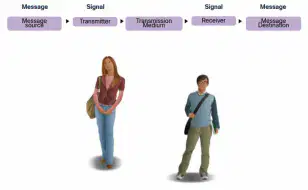
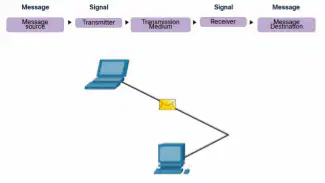
Networks can vary in size and complexity. It is not enough to have a connection,
devices must agree on “how” to communicate.
There are three elements to any communication:
• There will be a source (sender).
• There will be a destination (receiver).
• There will be a channel (media) that provides for the path of communications to
occur.
7
Open Ended
List and describe the three common elements all communication methods have in common.
8

18
© 2016 Cisco and/or its affiliates. All rights reserved. Cisco Confidential
The Rules
Communications Protocols
• All communications are governed by protocols.
• Protocols are the rules that communications will follow.
• These rules will vary depending on the protocol.
9



19
© 2016 Cisco and/or its affiliates. All rights reserved. Cisco Confidential
The Rules
Rule Establishment
• Individuals must use established rules or agreements to govern the conversation.
• The first message is difficult to read because it is not formatted properly. The second shows
the message properly formatted
10

20
© 2016 Cisco and/or its affiliates. All rights reserved. Cisco Confidential
The Rules
Rule Establishment (Cont.)
Protocols must account for the following requirements:
• An identified sender and receiver
• Common language and grammar
• Speed and timing of delivery
• Confirmation or acknowledgment requirements
11

21
© 2016 Cisco and/or its affiliates. All rights reserved. Cisco Confidential
The Rules
Network Protocol Requirements
Common computer protocols must be in agreement and include the following
requirements:
• Message encoding
• Message formatting and encapsulation
• Message size
• Message timing
• Message delivery options
12

22
© 2016 Cisco and/or its affiliates. All rights reserved. Cisco Confidential
The Rules
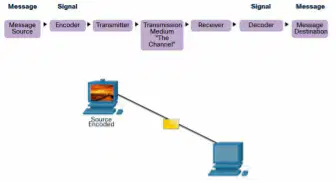
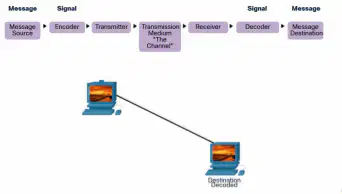
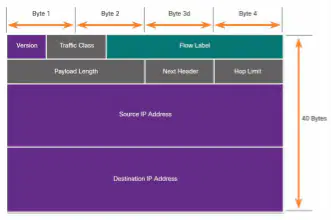
Message Encoding
• Encoding is the process of converting information into another acceptable form for
transmission.
• Decoding reverses this process to interpret the information.
13


23
© 2016 Cisco and/or its affiliates. All rights reserved. Cisco Confidential
The Rules
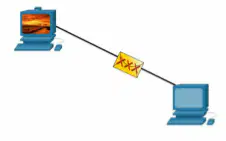
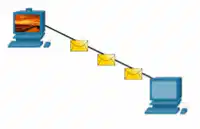
Message Formatting and Encapsulation
• When a message is sent, it must use a specific format or structure.
• Message formats depend on the type of message and the channel that is used to
deliver the message.
14

24
© 2016 Cisco and/or its affiliates. All rights reserved. Cisco Confidential
The Rules
Message Size
Encoding between hosts must be in an appropriate format for the medium.
• Messages sent across the network are converted to bits
• The bits are encoded into a pattern of light, sound, or electrical impulses.
• The destination host must decode the signals to interpret the message.
15

25
© 2016 Cisco and/or its affiliates. All rights reserved. Cisco Confidential
The Rules
Message Timing
Message timing includes the following:
Flow Control – Manages the rate of data transmission and defines how much information
can be sent and the speed at which it can be delivered.
Response Timeout – Manages how long a device waits when it does not hear a reply from
the destination.
Access method - Determines when someone can send a message.
• There may be various rules governing issues like “collisions”. This is when more than one
device sends traffic at the same time and the messages become corrupt.
• Some protocols are proactive and attempt to prevent collisions; other protocols are
reactive and establish a recovery method after the collision occurs.
16

26
© 2016 Cisco and/or its affiliates. All rights reserved. Cisco Confidential
The Rules
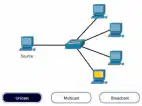
Message Delivery Options
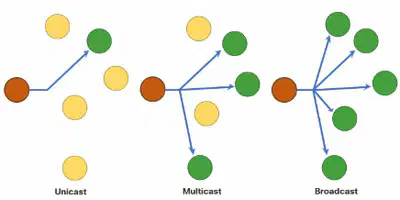
Message delivery may one of the following methods:
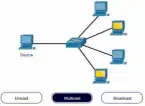
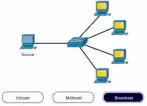
• Unicast – one to one communication
• Multicast – one to many, typically not all
• Broadcast – one to all
Note: Broadcasts are used in IPv4 networks, but are not an option for IPv6. Later we will also
see “Anycast” as an additional delivery option for IPv6.
17

27
© 2016 Cisco and/or its affiliates. All rights reserved. Cisco Confidential
The Rules
A Note About the Node Icon
• Documents may use the node icon , typically a circle, to represent all devices.
• The figure illustrates the use of the node icon for delivery options.
18

28
© 2016 Cisco and/or its affiliates. All rights reserved. Cisco Confidential
3.2 Protocols
19

29
© 2016 Cisco and/or its affiliates. All rights reserved. Cisco Confidential
Protocols
Network Protocol Overview
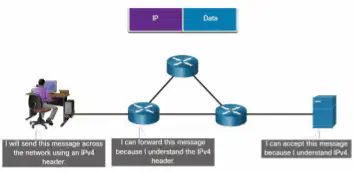
Network protocols define a
common set of rules.
• Can be implemented on
devices in:
• Software
• Hardware
• Both
• Protocols have their own:
• Function
• Format
• Rules
Protocol Type
Description
Network
Communications
enable two or more devices to communicate over
one or more networks
Network Security
secure data to provide authentication, data
integrity, and data encryption
Routing
enable routers to exchange route information,
compare path information, and select best path
Service
Discovery
used for the automatic detection of devices or
services
20

30
© 2016 Cisco and/or its affiliates. All rights reserved. Cisco Confidential
Protocols
Network Protocol Functions
• Devices use agreed-upon protocols
to communicate .
• Protocols may have may have one
or functions.
Function
Description
Addressing
Identifies sender and receiver
Reliability
Provides guaranteed delivery
Flow Control
Ensures data flows at an efficient rate
Sequencing
Uniquely labels each transmitted segment of data
Error Detection
Determines if data became corrupted during transmission
Application Interface
Process-to-process communications between network applications
21

31
© 2016 Cisco and/or its affiliates. All rights reserved. Cisco Confidential
Protocols
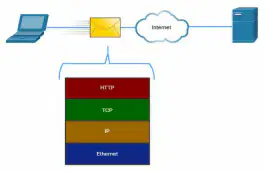
Protocol Interaction
• Networks require the use of several protocols.
• Each protocol has its own function and
format.
Protocol
Function
Hypertext Transfer
Protocol (HTTP)
▪Governs the way a web server and a web client interact
▪Defines content and format
Transmission Control
Protocol (TCP)
▪Manages the individual conversations
▪Provides guaranteed delivery
▪Manages flow control
Internet Protocol (IP)
Delivers messages globally from the sender to the receiver
Ethernet
Delivers messages from one NIC to another NIC on the same Ethernet Local
Area Network (LAN)
22

32
© 2016 Cisco and/or its affiliates. All rights reserved. Cisco Confidential
3.3 Protocol Suites
23

33
© 2016 Cisco and/or its affiliates. All rights reserved. Cisco Confidential
Protocol Suites
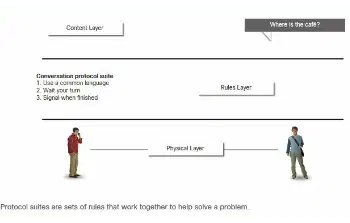
Network Protocol Suites
Protocols must be able to work with other
protocols.
Protocol suite:
• A group of inter-related protocols
necessary to perform a communication
function
• Sets of rules that work together to help
solve a problem
The protocols are viewed in terms of layers:
• Higher Layers
• Lower Layers- concerned with moving
data and provide services to upper layers
24

34
© 2016 Cisco and/or its affiliates. All rights reserved. Cisco Confidential
Protocol Suites
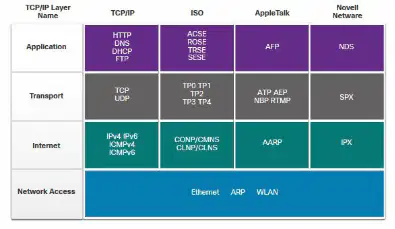
Evolution of Protocol Suites
There are several protocol suites.
• Internet Protocol Suite or TCP/IP- The
most common protocol suite and maintained
by the Internet Engineering Task Force
(IETF)
• Open Systems Interconnection (OSI)
protocols- Developedby the International
Organization for Standardization (ISO) and
the International Telecommunications Union
(ITU)
• AppleTalk- Proprietary suite release by
Apple Inc.
• Novell NetWare- Proprietary suite
developed by Novell Inc.
25

35
© 2016 Cisco and/or its affiliates. All rights reserved. Cisco Confidential
Protocol Suites
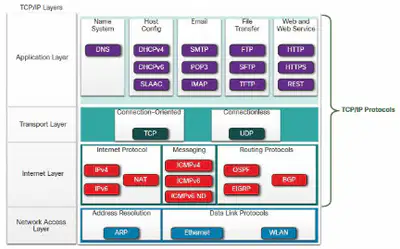
TCP/IP Protocol Example
• TCP/IP protocols operate at the
application, transport, and
internet layers.
• The most common network
access layer LAN protocols are
Ethernet and WLAN (wireless
LAN).
26

36
© 2016 Cisco and/or its affiliates. All rights reserved. Cisco Confidential
Protocol Suites
TCP/IP Protocol Suite
• TCP/IP is the protocol suite used by
the internet and includes many
protocols.
• TCP/IP is:
• An open standard protocol suite
that is freely available to the public
and can be used by any vendor
• A standards-based protocol suite
that is endorsed by the networking
industry and approved by a
standards organization to ensure
interoperability
27

37
© 2016 Cisco and/or its affiliates. All rights reserved. Cisco Confidential
Protocol Suites
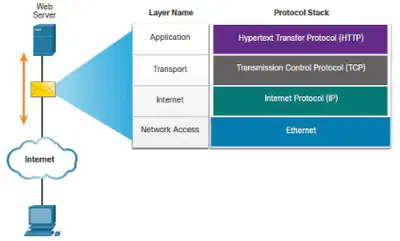
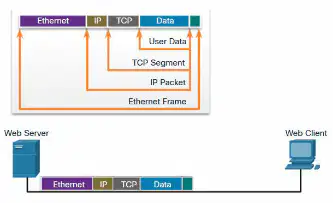
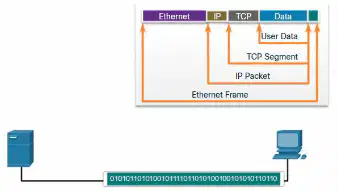
TCP/IP Communication Process
• A web server encapsulating and sending a
web page to a client.
• A client de-encapsulating the web page for
the web browser
28

38
© 2016 Cisco and/or its affiliates. All rights reserved. Cisco Confidential
3.4 Standards Organizations
29


39
© 2016 Cisco and/or its affiliates. All rights reserved. Cisco Confidential
Standards Organizations
Open Standards
Open standards encourage:
• interoperability
• competition
• innovation
Standards organizations are:
• vendor-neutral
• non-profit organizations
• established to develop and promote the
concept of open standards.
30

40
© 2016 Cisco and/or its affiliates. All rights reserved. Cisco Confidential
Standards Organizations
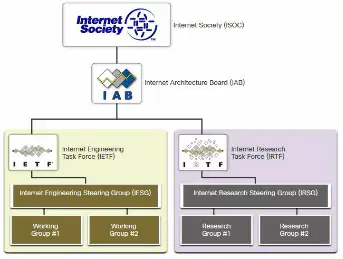
Internet Standards
• Internet Society (ISOC) - Promotes
the open development and evolution of
internet
• Internet Architecture Board (IAB) -
Responsible for management and
development of internet standards
• Internet Engineering Task Force
(IETF) - Develops, updates, and
maintains internet and TCP/IP
technologies
• Internet Research Task Force
(IRTF) - Focused on long-term
research related to internet and
TCP/IP protocols
31

41
© 2016 Cisco and/or its affiliates. All rights reserved. Cisco Confidential
Standards Organizations
Internet Standards (Cont.)
Standards organizations involved with the
development and support of TCP/IP
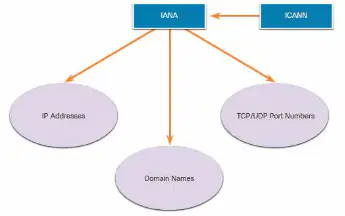
• Internet Corporation for Assigned
Names and Numbers (ICANN) -
Coordinates IP address allocation, the
management of domain names, and
assignment of other information
• Internet Assigned Numbers Authority
(IANA) - Oversees and manages IP
address allocation, domain name
management, and protocol identifiers
for ICANN
32

42
© 2016 Cisco and/or its affiliates. All rights reserved. Cisco Confidential
Standards Organizations
Electronic and Communications Standards
• Institute of Electrical and Electronics Engineers (IEEE, pronounced “I-triple-E”)
- dedicated to creating standards in power and energy, healthcare,
telecommunications, and networking
• Electronic Industries Alliance (EIA) - develops standards relating to electrical
wiring, connectors, and the 19-inch racks used to mount networking equipment
• Telecommunications Industry Association (TIA) - develops communication
standards in radio equipment, cellular towers, Voice over IP (VoIP) devices,
satellite communications, and more
• International Telecommunications Union-Telecommunication
Standardization Sector (ITU-T) - defines standards for video compression,
Internet Protocol Television (IPTV), and broadband communications, such as a
digital subscriber line (DSL)
33

43
© 2016 Cisco and/or its affiliates. All rights reserved. Cisco Confidential
Standards Organizations
Lab – Researching Networking Standards
In this lab, you will do the following:
• Part 1: Research Networking Standards Organizations
• Part 2: Reflect on Internet and Computer Networking Experience
34

44
© 2016 Cisco and/or its affiliates. All rights reserved. Cisco Confidential
3.5 Reference Models
35

45
© 2016 Cisco and/or its affiliates. All rights reserved. Cisco Confidential
Reference Models
The Benefits of Using a Layered Model
Complex concepts such as how a
network operates can be difficult to
explain and understand. For this
reason, a layered model is used.
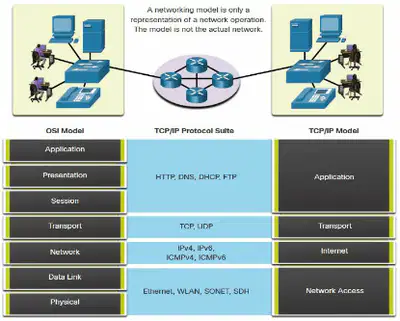
Two layered models describe network
operations:
• Open System Interconnection (OSI)
Reference Model
• TCP/IP Reference Model
36

46
© 2016 Cisco and/or its affiliates. All rights reserved. Cisco Confidential
Reference Models
The Benefits of Using a Layered Model (Cont.)
These are the benefits of using a layered model:
• Assist in protocol design because protocols that operate at a specific layer have
defined information that they act upon and a defined interface to the layers above
and below
• Foster competition because products from different vendors can work together
• Prevent technology or capability changes in one layer from affecting other layers
above and below
• Provide a common language to describe networking functions and capabilities
37

47
© 2016 Cisco and/or its affiliates. All rights reserved. Cisco Confidential
Reference Models
The OSI Reference Model
OSI Model Layer
Description
7 - Application
Contains protocols used for process-to-process communications.
6 - Presentation
Provides for common representation of the data transferred between application
layer services.
5 - Session
Provides services to the presentation layer and to manage data exchange.
4 - Transport
Defines services to segment, transfer, and reassemble the data for individual
communications.
3 - Network
Provides services to exchange the individual pieces of data over the network.
2 - Data Link
Describes methods for exchanging data frames over a common media.
1 - Physical
Describes the means to activate, maintain, and de-activate physical connections.
38

48
© 2016 Cisco and/or its affiliates. All rights reserved. Cisco Confidential
Reference Models
The TCP/IP Reference Model
TCP/IP Model
Layer
Description
Application
Represents data to the user, plus encoding and dialog control.
Transport
Supports communication between various devices across diverse networks.
Internet
Determines the best path through the network.
Network Access
Controls the hardware devices and media that make up the network.
39

49
© 2016 Cisco and/or its affiliates. All rights reserved. Cisco Confidential
Reference Models
OSI and TCP/IP Model Comparison
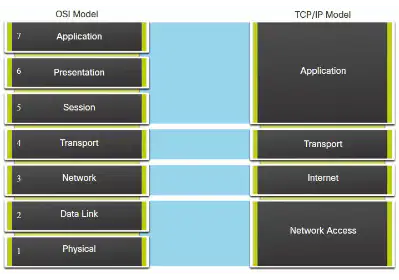
• The OSI model divides the network
access layer and the application
layer of the TCP/IP model into
multiple layers.
• The TCP/IP protocol suite does not
specify which protocols to use when
transmitting over a physical medium.
• OSI Layers 1 and 2 discuss the
necessary procedures to access the
media and the physical means to
send data over a network.
40

50
© 2016 Cisco and/or its affiliates. All rights reserved. Cisco Confidential
Reference Models
Packet Tracer – Investigate the TCP/IP and OSI Models in Action
This simulation activity is intended to provide a foundation for understanding the
TCP/IP protocol suite and the relationship to the OSI model. Simulation mode
allows you to view the data contents being sent across the network at each layer.
In this Packet Tracer, you will:
• Part 1: Examine HTTP Web Traffic
• Part 2: Display Elements of the TCP/IP Protocol Suite
41

51
© 2016 Cisco and/or its affiliates. All rights reserved. Cisco Confidential
3.6 Data Encapsulation
42

52
© 2016 Cisco and/or its affiliates. All rights reserved. Cisco Confidential
Data Encapsulation
Segmenting Messages
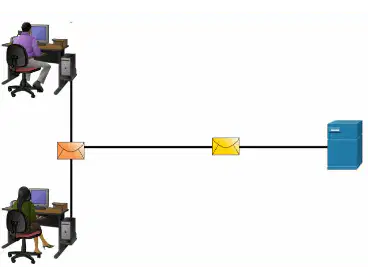
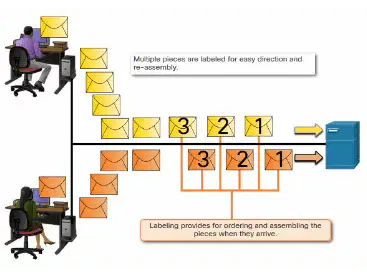
Segmenting is the process of breaking up
messages into smaller units. Multiplexing is
the processes of taking multiple streams of
segmented data and interleaving them
together.
Segmenting messages has two primary
benefits:
• Increases speed - Large amounts of
data can be sent over the network
without tying up a communications link.
• Increases efficiency - Only segments
which fail to reach the destination need to
be retransmitted, not the entire data
stream.
43

53
© 2016 Cisco and/or its affiliates. All rights reserved. Cisco Confidential
Data Encapsulation
Sequencing
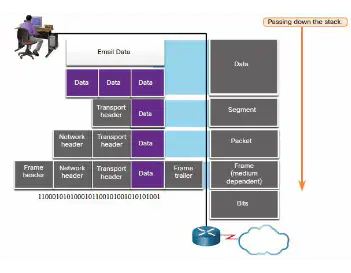
Sequencing messages is the process of
numbering the segments so that the
message may be reassembled at the
destination.
TCP is responsible for sequencing the
individual segments.
44

54
© 2016 Cisco and/or its affiliates. All rights reserved. Cisco Confidential
Data Encapsulation
Protocol Data Units
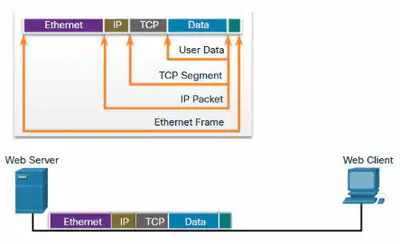
Encapsulation is the process where protocols
add their information to the data.
• At each stage of the process, a PDU has a
different name to reflect its new functions.
• There is no universal naming convention for
PDUs, in this course, the PDUs are named
according to the protocols of the TCP/IP
suite.
• PDUs passing down the stack are as
follows:
1.
Data (Data Stream)
2.
Segment
3.
Packet
4.
Frame
5.
Bits (Bit Stream)
45

55
© 2016 Cisco and/or its affiliates. All rights reserved. Cisco Confidential
Data Encapsulation
Encapsulation Example
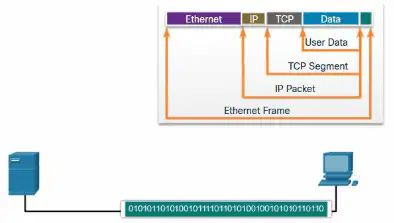
• Encapsulation is a top down
process.
• The level above does its
process and then passes it
down to the next level of the
model. This process is
repeated by each layer until
it is sent out as a bit stream.
46

56
© 2016 Cisco and/or its affiliates. All rights reserved. Cisco Confidential
Data Encapsulation
De-encapsulation Example
• Data is de-encapsulated as it moves up
the stack.
• When a layer completes its process,
that layer strips off its header and
passes it up to the next level to be
processed. This is repeated at each
layer until it is a data stream that the
application can process.
1.
Received as Bits (Bit Stream)
2.
Frame
3.
Packet
4.
Segment
5.
Data (Data Stream)
47

57
© 2016 Cisco and/or its affiliates. All rights reserved. Cisco Confidential
3.7 Data Access
48

58
© 2016 Cisco and/or its affiliates. All rights reserved. Cisco Confidential
Data Access
Addresses
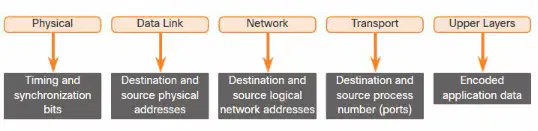
Both the data link and network layers use addressing to deliver data from source to
destination.
Network layer source and destination addresses - Responsible for delivering the IP
packet from original source to the final destination.
Data link layer source and destination addresses – Responsible for delivering the data
link frame from one network interface card (NIC) to another NIC on the same network.
49

59
© 2016 Cisco and/or its affiliates. All rights reserved. Cisco Confidential
Data Access
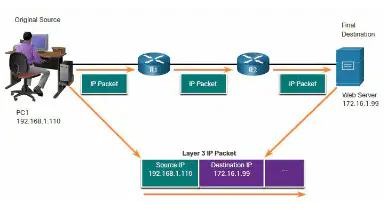
Layer 3 Logical Address
The IP packet contains two IP
addresses:
• Source IP address - The IP
address of the sending device,
original source of the packet.
• Destination IP address - The IP
address of the receiving device,
final destination of the packet.
These addresses may be on the same
link or remote.
50

60
© 2016 Cisco and/or its affiliates. All rights reserved. Cisco Confidential
Data Access
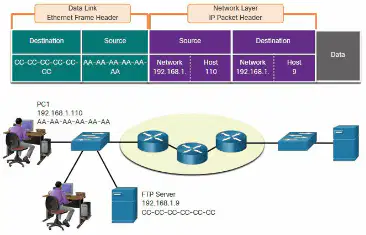
Layer 3 Logical Address (Cont.)
An IP address contains two parts:
• Network portion (IPv4) or Prefix (IPv6)
• The left-most part of the address indicates
the network group which the IP address is
a member.
• Each LAN or WAN will have the same
network portion.
• Host portion (IPv4) or Interface ID
(IPv6)
• The remaining part of the address identifies
a specific device within the group.
• This portion is unique for each device on
the network.
51

61
© 2016 Cisco and/or its affiliates. All rights reserved. Cisco Confidential
Data Access
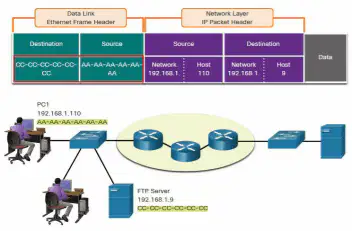
Devices on the Same Network
When devices are on the same
network the source and destination will
have the same number in network
portion of the address.
• PC1 – 192.168.1.110
• FTP Server – 192.168.1.9
52

62
© 2016 Cisco and/or its affiliates. All rights reserved. Cisco Confidential
Data Access
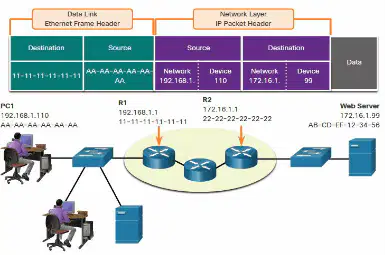
Role of the Data Link Layer Addresses: Same IP Network
When devices are on the same Ethernet
network the data link frame will use the
actual MAC address of the destination
NIC.
MAC addresses are physically embedded
into the Ethernet NIC and are local
addressing.
• The Source MAC address will be that of
the originator on the link.
• The Destination MAC address will
always be on the same link as the
source, even if the ultimate destination
is remote.
53

63
© 2016 Cisco and/or its affiliates. All rights reserved. Cisco Confidential
Data Access
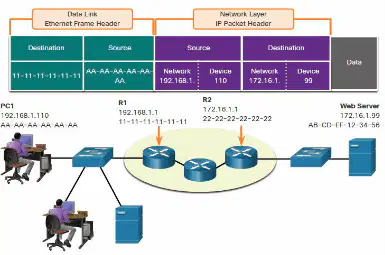
Devices on a Remote Network
• What happens when the actual
(ultimate) destination is not on the
same LAN and is remote?
• What happens when PC1 tries to
reach the Web Server?
• Does this impact the network and data
link layers?
54

64
© 2016 Cisco and/or its affiliates. All rights reserved. Cisco Confidential
Data Access
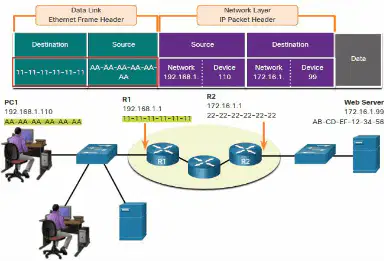
Role of the Network Layer Addresses
When the source and destination have
a different network portion, this means
they are on different networks.
• PC1 – 192.168.1
• Web Server – 172.16.1
55

65
© 2016 Cisco and/or its affiliates. All rights reserved. Cisco Confidential
Data Access
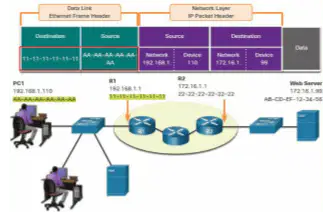
Role of the Data Link Layer Addresses: Different IP Networks
When the final destination is remote, Layer 3
will provide Layer 2 with the local default
gateway IP address, also known as the
router address.
• The default gateway (DGW) is the router
interface IP address that is part of this
LAN and will be the “door” or “gateway” to
all other remote locations.
• All devices on the LAN must be told about
this address or their traffic will be confined
to the LAN only.
• Once Layer 2 on PC1 forwards to the
default gateway (Router), the router then
can start the routing process of getting the
information to actual destination.
56

66
© 2016 Cisco and/or its affiliates. All rights reserved. Cisco Confidential
Data Access
Role of the Data Link Layer Addresses: Different IP Networks
(Cont.)
• The data link addressing is local
addressing so it will have a source and
destination for each link.
• The MAC addressing for the first
segment is :
• Source – AA-AA-AA-AA-AA-AA
(PC1) Sends the frame.
• Destination – 11-11-11-11-11-11 (R1-
Default Gateway MAC) Receives the
frame.
Note: While the L2 local addressing will
change from link to link or hop to hop, the
L3 addressing remains the same.
57

67
© 2016 Cisco and/or its affiliates. All rights reserved. Cisco Confidential
Data Access
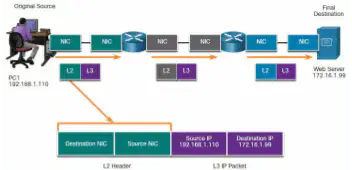
Data Link Addresses
• Since data link addressing is local addressing, it will have a source and destination for
each segment or hop of the journey to the destination.
• The MAC addressing for the first segment is:
• Source – (PC1 NIC) sends frame
• Destination – (First Router- DGW interface) receives frame
58

68
© 2016 Cisco and/or its affiliates. All rights reserved. Cisco Confidential
Data Access
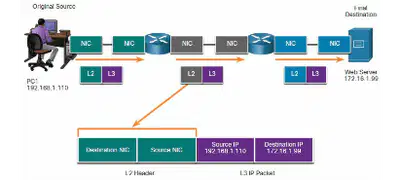
Data Link Addresses (Cont.)
The MAC addressing for the second hop is:
• Source – (First Router- exit interface) sends frame
• Destination – (Second Router) receives frame
59

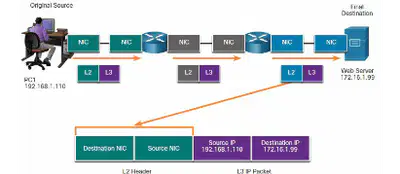
69
© 2016 Cisco and/or its affiliates. All rights reserved. Cisco Confidential
Data Access
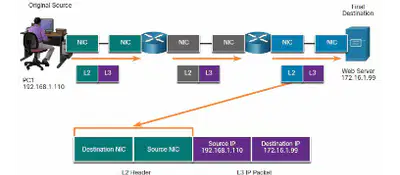
Data Link Addresses (Cont.)
The MAC addressing for the last segment is:
• Source – (Second Router- exit interface) sends frame
• Destination – (Web Server NIC) receives frame
60

70
© 2016 Cisco and/or its affiliates. All rights reserved. Cisco Confidential
Data Access
Data Link Addresses (Cont.)
• Notice that the packet is not modified, but the frame is changed, therefore the L3 IP
addressing does not change from segment to segment like the L2 MAC addressing.
• The L3 addressing remains the same since it is global and the ultimate destination is still
the Web Server.
61

71
© 2016 Cisco and/or its affiliates. All rights reserved. Cisco Confidential
Data Access
Lab – Install Wireshark
In this lab you will do the following:
• Download and Install Wireshark
62

72
© 2016 Cisco and/or its affiliates. All rights reserved. Cisco Confidential
Data Access
Lab – Use Wireshark to View Network Traffic
In this lab, you will do the following:
• Part 1: Capture and Analyze Local ICMP Data in Wireshark
• Part 2: Capture and Analyze Remote ICMP Data in Wireshark
63

73
© 2016 Cisco and/or its affiliates. All rights reserved. Cisco Confidential
3.8 Module Practice and Quiz
64

74
© 2016 Cisco and/or its affiliates. All rights reserved. Cisco Confidential
Module Practice and Quiz
What did I learn in this module?
The Rules
• Protocols must have a sender and a receiver.
• Common computer protocols include these requirements: message encoding, formatting
and encapsulation, size, timing, and delivery options.
Protocols
• To send a message across the network requires the use of several protocols.
• Each network protocol has its own function, format, and rules for communications.
Protocol Suites
• A protocol suite is a group of inter-related protocols.
• TCP/IP protocol suite are the protocols used today.
Standards Organizations
• Open standards encourage interoperability, competition, and innovation.
65

75
© 2016 Cisco and/or its affiliates. All rights reserved. Cisco Confidential
Module Practice and Quiz
What did I learn in this module? (Cont.)
Reference Models
• The two models used in networking are the TCP/IP and the OSI model.
• The TCP/IP model has 4 layers and the OSI model has 7 layers.
Data Encapsulation
• The form that a piece of data takes at any layer is called a protocol data unit (PDU).
• There are five different PDUs used in the data encapsulation process: data, segment, packet,
frame, and bits
Data Access
• The Network and Data Link layers are going to provide addressing to move data through the
network.
• Layer 3 will provide IP addressing and layer 2 will provide MAC addressing.
• The way these layers handle addressing will depend on whether the source and the destination
are on the same network or if the destination is on a different network from the source.
66

76
© 2016 Cisco and/or its affiliates. All rights reserved. Cisco Confidential
New Terms and Commands
• encoding
• protocol
• channel
• flow control
• response timeout
• acknowledgement
• unicast
• multicast
• broadcast
• protocol suite
• Ethernet
• standard
• proprietary protocol
• 802.3 (Ethernet)
• 802.11 (wireless Ethernet)
• segmentation
• default gateway
• Hypertext Transfer Protocol (HTTP)
• Simple Mail Transfer Protocol (SMTP)
• Post Office Protocol (POP)
• Transmission Control Protocol (TCP)
• transport
• data link
• network access
• Advanced Research Projects Agency
Network (ARPANET)
67

77
© 2016 Cisco and/or its affiliates. All rights reserved. Cisco Confidential
New Terms and Commands (Cont.)
• Internet Message Access Protocol (IMAP)
• File Transfer Protocol (FTP)
• Trivial File Transfer Protocol (TFTP)
• User Datagram Protocol (UDP)
• Network Address Translation (NAT)
• Internet Control Messaging Protocol
(ICMP)
• Open Shortest Path First (OSPF)
• Enhanced Interior Gateway Routing
Protocol (EIGRP)
• Address Resolution Protocol (ARP)
• Dynamic Host Configuration (DHCP)
• encapsulation
• de-encapsulation
• protocol data unit (PDU)
• segment
• packet
• frame
68
Module 3: Protocols and
Models
Introduction to Networks 7.0
(ITN)
Show answer
Auto Play
Slide 1 / 68
SLIDE
Similar Resources on Wayground

65 questions
Week 15 - ¿Cómo estás?
Presentation
•
12th Grade
65 questions
4-OS-Lessons-4
Presentation
•
12th Grade
62 questions
Module 3 - VGD
Presentation
•
12th Grade
61 questions
Federal Budget
Presentation
•
11th - 12th Grade
63 questions
CHAPTER 1 INTRODUCTION TO ACCOUNTING
Presentation
•
12th Grade
62 questions
Ch. 5: The American Revolution (AB Tech)
Presentation
•
12th Grade
64 questions
3.4 The National Government and the States
Presentation
•
12th Grade
65 questions
SFP124 DNA and Gene Expression
Presentation
•
12th Grade
Popular Resources on Wayground
10 questions
Safety Day 2026 – Student Review

Quiz
•
9th Grade
21 questions
Continents and Oceans
Quiz
•
6th Grade
20 questions
Parts of Speech
Quiz
•
5th Grade
16 questions
Subject & Predicate
Quiz
•
5th Grade
25 questions
Multiplication Facts
Quiz
•
5th Grade
12 questions
Map Skills
Quiz
•
3rd Grade
22 questions
Continents and Oceans
Quiz
•
5th Grade
15 questions
Rounding Decimals
Quiz
•
5th Grade