
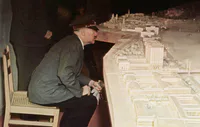
The Plunder of Cultural Artifacts during World War II

Presentation
•
Social Studies
•
9th - 12th Grade
•
Practice Problem
•
Hard

Kelli Seawright
Used 1+ times
FREE Resource
9 Slides • 4 Questions
1
The Plunder of Cultural Artifacts
The theft and destruction of cultural artifacts during World War II, a tragic loss of historical and artistic treasures.
2
The Plunder of Cultural Artifacts
3
Multiple Choice
What was the purpose of Hitler's directive to assist Alfred Rosenberg?
To destroy Jewish cultural heritage
To acquire libraries and archives in Paris
To assemble a library for the Hohe Schule
To loot cultural objects during WWII
4
Hitler's Directive
Trivia: Hitler directed to assemble a library for the Hohe Schule. This institution aimed to be the center of Nazi intellectual and cultural life. It was planned to house a vast collection of books and archives, showcasing the Nazi ideology and promoting their racial theories.
5
Plunder of Cultural Artifacts
6
Multiple Choice
Which organization was responsible for confiscating cultural artifacts during World War II?
Masonic lodges
ERR
Rothschild libraries
Nazi propaganda
7
Confiscation of Cultural Artifacts
Trivia: During World War II, the Nazi propaganda was responsible for confiscating cultural artifacts. This included looting valuable artworks, manuscripts, and historical artifacts from occupied territories. The stolen items were often used to fund the Nazi regime or were stored in secret locations. The recovery and restitution of these artifacts continue to be an ongoing effort today.
8
The Plunder of Cultural Artifacts
During World War II, cultural artifacts were looted from various institutions in Belarus and Vilnius. Local staff sold library books for income. Jewish book collections were seized and some were sold for pulp. Evacuation efforts were made to prevent materials from falling into enemy hands. Communist Party archives were evacuated to Vilnius and later to Pless castle. Many books suffered damage during evacuation. Seized collections were moved to depots in the countryside in Germany due to Allied bombing. Hundreds of thousands of books from Europe were found at the end of the war.
9
Multiple Choice
What happened to the cultural artifacts during World War II?
They were sold for pulp
They were evacuated to Vilnius
They were moved to depots in Germany
They were found at the end of the war
10
Cultural Artifacts in WWII
Trivia: During World War II, cultural artifacts were at risk of being lost forever. However, they were found at the end of the war. These precious treasures were saved from destruction and continue to inspire and educate us today.
11
The Plunder of Cultural Artifacts
The systematic looting of cultural objects during World War II by the Nazis and the Allies is a dark chapter in history. This slide explores the Nazi's efforts to control and collate 'enemy materials', unintentionally preserving some looted items. It also highlights the importance of detailed archival research in clarifying the fate of 'lost' items and returning them to their rightful owners.
12
Multiple Choice
What is the significance of detailed archival research in clarifying the fate of 'lost' items?
To preserve looted items
To control and collate 'enemy materials'
To return looted items to their rightful owners
To explore the Nazi's efforts in preserving looted items
13
Lost and Found
To return looted items to their rightful owners. Detailed archival research plays a crucial role in uncovering the history and provenance of 'lost' items, enabling their restitution to the rightful owners. It helps in rectifying the injustices of the past and preserving cultural heritage. Archivists and researchers tirelessly work to trace the origins and document the journey of these items, ensuring their rightful return.
The Plunder of Cultural Artifacts
The theft and destruction of cultural artifacts during World War II, a tragic loss of historical and artistic treasures.
Show answer
Auto Play
Slide 1 / 13
SLIDE
Similar Resources on Wayground

10 questions
Genetics Dihybrid Crosses
Presentation
•
9th - 12th Grade
10 questions
1B Adjectives
Presentation
•
9th - 12th Grade
9 questions
Fall of the Roman Empire- Lesson
Presentation
•
9th - 12th Grade
13 questions
Civil War Battles
Presentation
•
9th - 12th Grade
11 questions
Adaptations
Presentation
•
9th - 12th Grade
11 questions
Pythagorean Theorem
Presentation
•
9th - 12th Grade
10 questions
Grammar 4A - ir + a + infinitive
Presentation
•
9th - 12th Grade
10 questions
Synthetic Division
Presentation
•
9th - 12th Grade
Popular Resources on Wayground
10 questions
Impact of 9/11 and the War on Terror

Interactive video
•
10th - 12th Grade
21 questions
Continents and Oceans

Quiz
•
6th Grade
5 questions
9/11
Interactive video
•
9th Grade
20 questions
Parts of Speech
Quiz
•
5th Grade
16 questions
Subject & Predicate
Quiz
•
5th Grade
10 questions
Riddles Riddles fun Riddles
Quiz
•
6th - 12th Grade
21 questions
Lab Safety
Quiz
•
10th Grade
6 questions
PRIDE in the Hallways and Bathrooms
Presentation
•
12th Grade
Discover more resources for Social Studies
5 questions
9/11
Interactive video
•
9th Grade
6 questions
PRIDE in the Hallways and Bathrooms
Presentation
•
12th Grade
10 questions
Exploring the Age of Exploration: Key Events and Figures
Interactive video
•
6th - 10th Grade
16 questions
USHC 4.8 Immigration and Urbanization
Quiz
•
9th - 12th Grade
64 questions
USHC 4 Key Terms 22-23
Quiz
•
11th Grade - University
10 questions
Exploring Types of Maps for Middle Schoolers
Interactive video
•
6th - 10th Grade
16 questions
Unit 3.1 Quiz Review
Quiz
•
11th Grade
30 questions
Reconstruction Era Test
Quiz
•
11th Grade