Search Header Logo
26 Oct 2023 S1R Bio Chap 13

26 Oct 2023 S1R Bio Chap 13

Assessment

Presentation

Science

9th - 12th Grade

Medium

Created by

LEONG LIM

Used 1+ times

FREE Resource

19 Slides • 40 Questions

1

media

2

media

3

Multiple Choice

Question image
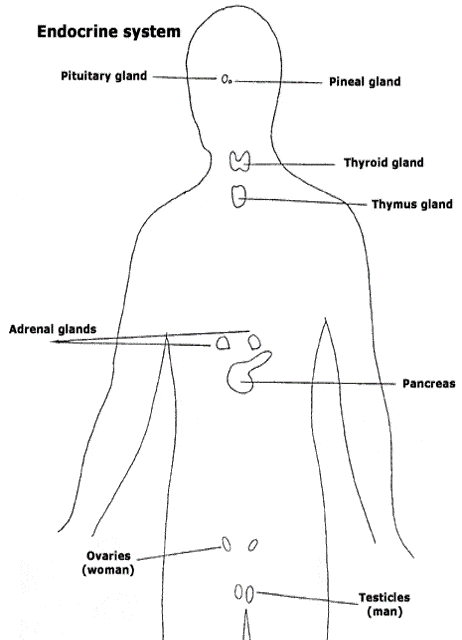
a body system that controls growth and homeostasis by secreting hormones from glands.
1
skeletal system
2
nervous system
3
endocrine sytem
4
integumentary system

4

media

5

Multiple Choice

What is the evaporation of a liquid to cool the body?
1
Shivering
2
Sweating
3
Vasodilation
4
Vasoconstriction

6

Multiple Choice

Homeostasis
1
allows for a wildly fluctuating internal environment
2
is impossible in vertebrates
3
is the maintenance of a relatively stable internal environment and often incorporates a form of feedback regulation
4
is the maintenance of a relatively stable external environment and often incorporates a form of feedback regulation

7

Multiple Choice

Homeostasis in the human body is often maintained by a: 
1
neutral feedback loop 
2
solar feedback loop
3
positive feedback loop
4
negative feedback loop

8

media

9

Multiple Choice

When you get cut, your skin cells release hormones that signal platelets to come and stop the bleeding. Platelets then release more hormones that signal even more platelets to help stop bleeding. The hormone signals continue until the cut is closed.
1
Positive Feedback Response
2
Negative Feedback Loop 

10

Multiple Choice

If the environment gets cold, we will often shiver in order to:
1
keep body temperature the same as the external temperature
2
decrease body temperature
3
increase body temperature
4
regulate blood pressure

11

Multiple Choice

A student walks into a cold room.

Which of the following happens to his body?

1

Sweating and vasodilation of blood vessels.

2

Shivering and vasoconstriction of blood vessels

3

Sweating and vasoconstriction of blood vessels.

4

Shivering and vasodilation of blood vessels.

12

Multiple Select

Question image

Diagram shows the cross section of human skin.

Which of the following will occur when the surrounding temperature drops below 10 ° C?

1

R constrict

2

Q relax

3

P erect

4

S become active

13

Multiple Choice

Which organ acts as a control centre of a homeostasis process?

1
2
3
4

14

Multiple Select

Question image

Choose Corrective mechanisms when body temperature increases

1

Hair lies flat

2

Hair stands erect

3

Blood vessel dilates

4

Blood vessel constricts

5

More sweats is produced

15

Multiple Select

Question image

Choose corrective mechanisms when body temperature decreases

1

Hair Lies flat , blood vessel dilates

2

Hair stands erect , blood vessel constricts

3

Skeletal muscles move passively

4

Skeletal muscle move actively - shivering

5

decrease sweating

16

Multiple Choice

Question image

Why our hair will stands erect during cold days?

1

To increase body metabolism

2

To trap air which acts as heat insulator

3

To let more blood flows near skin surface

4

To cool down skin when sweats is evaporated

17

media

18

Multiple Choice

Question image

Blood sugar regulation is an example of a ______________ loop

1

positive

2

negative

19

Multiple Choice

Question image
which of the organ will balance the glucose level in the body?
1
Stomach
2
Small intensine
3
Deodenum
4
Pancrease

20

Multiple Choice

Question image

The hormone that makes the liver store sugars is

1

glucose

2

glycogen

3

glucagon

4

insulin

21

Multiple Choice

Question image

The liver normally stores blood sugar as

1

glucose

2

glycogen

3

glucagon

4

fats

22

Multiple Choice

Question image

High blood sugar levels after a meal usually stimulate

1

Glucagon release from the liver

2

Glucagon release from the pancreas

3

Insulin release from the liver

4

Insulin release from the pancreas

23

Multiple Choice

Which component of the pancreas that produces hormone to regulate blood sugar

1

Acinar Cells

2

Beta Cells

3

Delta Cells

4

Islet of Langerhans

24

Multiple Choice

Choose one which not the function of Insulin

1

Convert glycogen to glucose

2

Oxidise glucose for energy

3

Convert glucose to glycogen for storage

4

Process glucose uptake from body

25

media

26

media

27

media

28

media

29

media

30

media

31

media

32

media

33

Multiple Choice

Question image

Urine passes through the:

1

Collecting duct to the bladder to the ureter

2

Renal tubule to ureter to bladder then to the urethra

3

Glomerulus to ureter to renal tubule

4

Collecting duct to urethra to bladder

34

Multiple Choice

The functional unit of the kidney is the:

1

Urethra

2

Ureter

3

Nephron

4

Hilus

35

Multiple Choice

Which of the following regions is NOT found in the renal tubule?

1

Glomerulus

2

Bowman's capsule

3

Loop of Henle

4

Collecting Duct

36

Multiple Choice

Question image

The enlarged, funnel-like region of the renal tubule is called:

1

Glomerulus

2

Loop of Henle

3

Bowman's capsule

4

Collection duct

37

Multiple Choice

Which sequence represents the correct pathway for the removal of urine from the human body?
1
kidney → ureter → urinary bladder → urethra
2
kidney → urethra → urinary bladder → ureter
3
ureter → kidney → urinary bladder → urethra
4
urethra → kidney → urinary bladder → ureter

38

Multiple Choice

Which of the following kidney structures if composed of capillaries & urine collecting tubules?

1

Renal corpuscle

2

Renal cortex

3

Renal medulla

4

Renal pelvis

39

Multiple Choice

Nephrons are located in the...

1

Renal pelvis

2

Renal columns

3

Renal medulla

4

Renal cortex

40

Multiple Choice

Which process helps maintain blood pH?

1

Glomerular filtration

2

Tubular Reabsorption

3

Tubular secretion

4

Glomerular secretion

41

media

42

media

43

media

44

Multiple Choice

what is osmoregulation?

1

Control of water and salt in the body

2

Control of blood pressure in the body

3

Control of blood glucose in the body

45

Multiple Choice

Question image

The figure above shows a part of the nephron.Which of the following is true about the processes that happen to blood in X, glucose in Y and water in Z?

1

X: Diffusion , Y: Active transport , Z: Osmosis

2

X: Osmosis, Y: Re-absorption, Z:Diffusion

3

X: Active transport, Y: Diffusion, Z:Reabsorption

4

X: Ultra filtration, Y: Assisted diffusion, Z: Osmosis

46

Multiple Choice

About 85% of water is reabsorbed from the filtrate at

1

Bowman's capsule.

2

Proximal uriniferous tubule.

3

Collecting duct.

4

Henle's loop.

47

Multiple Choice

The substance present in blood passes through the glomerulus and the Bowman's capsule by a process called

1

diffusion.

2

ultra filtration.

3

active transport.

4

osmosis.

48

Multiple Choice

Which one of the following substances can pass into the Bowman's capsule?

1

Serum albumin.

2

Serum globulin.

3

Ascorbic acid.

4

Fibrinogen.

49

Multiple Choice

The process whereby the kidney maintains the concentration of water, salt and ions at an optimum level is called

1

osmoregulation.

2

metabolism.

3

homeostasis.

4

excretion.

50

Multiple Choice

In a mammal that had just ingested a large volume of water, what would be secreted into the bloodstream?

1

A. More ADH (vasopressin)

2

B. Less epinephrine (adrenaline)

3

C. More epinephrine (adrenaline)

4

D. Less ADH (vasopressin)

51

Multiple Choice

Question image

In which part of the nephron is salt secreted from the tubule to increase osmotic potential?

1

A

2

B

3

C

4

D

52

Multiple Choice

During urine production, what happens if the water content of the blood is too low?

1

A. Membrane channels are produced in the cells of the collecting duct.

2

B. The pituitary gland stops secreting ADH.

3

C. The collecting duct becomes less permeable to water.

4

D. Large volumes of dilute urine are formed.

53

Multiple Choice

Which structure is acted upon by ADH (vasopressin)?

1

A. Proximal convoluted tubule

2

B. Bowman’s capsule

3

C. Loop of Henle

4

D. Collecting duct

54

Multiple Choice

Question image

What would result from drinking large quantities of water?

1

A

2

B

3

C

4

D

55

Multiple Choice

What is the function of the loop of Henle?

1

To reabsorb salt

2

To maintain a hypertonic solution in the medulla

3

To transport liquid from the collecting ducts to the convoluted tubules

4

To reabsorb glucose

56

media

57

media

58

Multiple Select

Which is one of the problems/diseases of the excretory system?

1

Kidney stones

2

Goodpasture syndrome

3

Kidney infection

4

Amyloidosis

59

media
media

Show answer

Auto Play

Slide 1 / 59

SLIDE