

amplify u4 lesson 5 pt 1

Presentation
•
Mathematics
•
5th Grade
•
Practice Problem
•
Hard

Stefany Ramirez
Used 2+ times
FREE Resource
49 Slides • 0 Questions
1
spelling test
2


Lesson Objectives
LO: I am learning to determine the
main elements of the plot.
SC:
I can identify the setting of the
story.
I can identify the conflict with the
story.
I can identify the climax of the
story.
I can identify the resolution of the
story.
3

Lesson 5
Vocabulary
noun
verb
adverb
adjective
4


deceive
I did not deceive you
intentionally.
verb
to make someone believe
something that is not true;
trick or fool
5


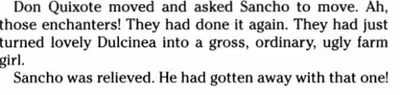
confounded
The women
cursed those
confounded
novels of
knighthood for
the millionth time.
adjective
terrible or annoying
6


fortune
You must agree that
fortune was not with
us.
noun
luck
7


sexton
The priest and the
sexton live in that
house across the
street.
noun
a person who takes care of
church buildings and
surrounding property
8

folks
What do these town
folks think we are?
noun
people
9

Who are the two
members of Don
Quixote’s household,
and who are his two
friends?
10


Describe Sancho
Panza and his family.
11


In what ways are Don Quixote and
Sancho similar to and different from
one another?
“Don Quixote is ________ but Sancho is ________.”
“One difference between Don Quixote and Sancho is
_______________.”
“One way in which Don Quixote and Sancho differ is that Don Quixote
_________ , whereas Sancho _________.”
Think-Pair-Share
12

Elements of Fiction
The plot refers to the events that happen in the
story.
The setting is where and when the story takes
place.
The characters are the people and animals
(maybe) that are part of the story.
The conflict is a problem that the main character
(protagonist) faces.
The theme is the message the author is trying to
communicate to the reader.
13

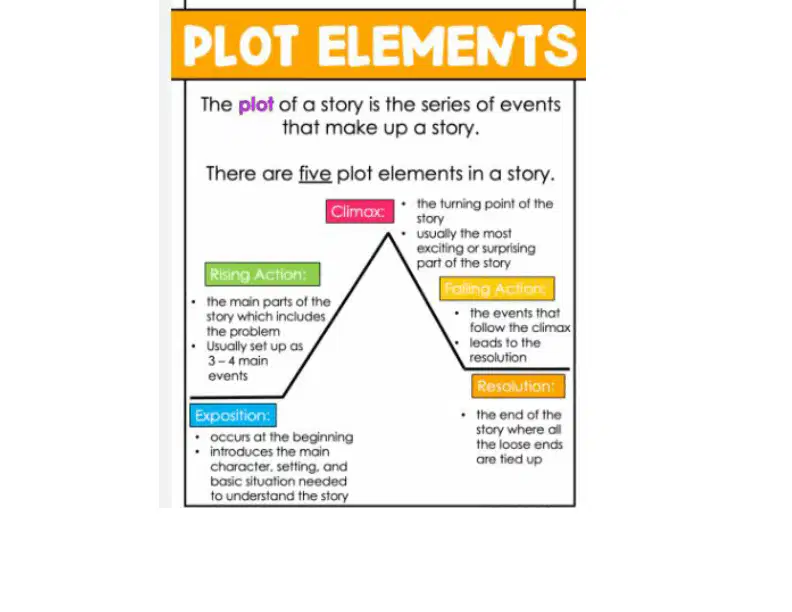
Elements of Plot
The plot refers to the events that happen in the story.
The setting is where and when the story takes place.
The rising action is the part of a story when the main conflict, or
problem, unfolds and starts to create interest, or builds tension or
suspense; the rising action leads up to the story’s climax.
The conflict is a problem that the main character (protagonist)
faces.
The climax is the highest point of tension or drama in a story, or its
major turning point.
The falling action is the part of a story immediately following the
climax, when the story starts to slow down.
The resolution is the part of the story when the main conflict is
resolved.
JOURNAL
14
15

Reading
Purpose for
Reading:
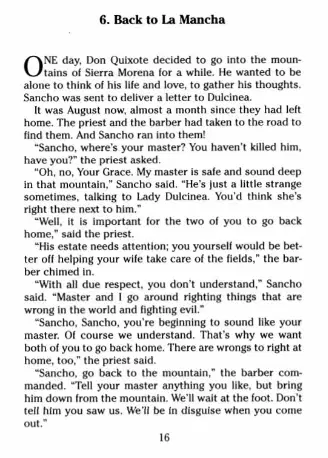
Read to learn how Don
Quixote and Sancho
return home and what
happens when they
meet Dulcinea.
16

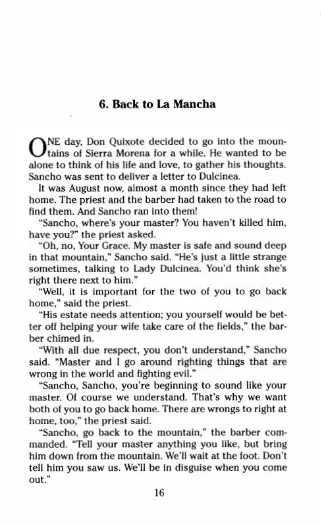
The phrase “with all due respect” is
used when someone is going to
disagree with or criticize someone they
do not want to offend. Why do you think
Sancho uses that phrase here?
(question 1)
What plot elements can you identify?
●
How is paragraph #2 important to
the plot of the story?
17


Check for Understanding
Correct/Incorrect
After a long walk home, I
finally made it home safe
and sound.
With all due respect, Ms.
Smith, I have to agree with
your statement.
18

Rising Action:
Sancho’s encounter
with the priest and
barber
(builds tension and
suspense because it
involves the main
conflict: the priest
and the barber are
trying to find Don
Quixote and bring him
home . Now that they
found him, what
next?)
Setting/Conflict
Rising Action
Climax/
Turning Point
Falling Action
Resolution
Plot
Elements
19

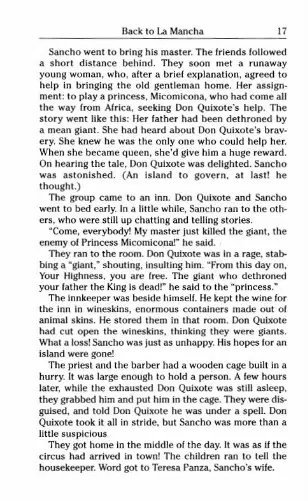
What is the friends’ plan to bring
Don Quixote and Sancho home?
(question 3)
What does Don Quixote do to
make the innkeeper angry?
(question 4)
What plot elements can you
identify on page 17?
20

Rising Action:
Sancho’s encounter
with the priest and
barber
(builds tension and
suspense because it
involves the main
conflict: the priest
and the barber are
trying to find Don
Quixote and bring him
home . Now that they
found him, what
next?)
Setting/Conflict
Rising Action
Climax/
Turning Point
Falling Action
Resolution
Climax/Turning Point:
Don Quixote is yelling
and destroying the
wineskins. Sancho and
the innkeeper are very
upset, and the priest and
the barber are rushing to
have a cage built.
21

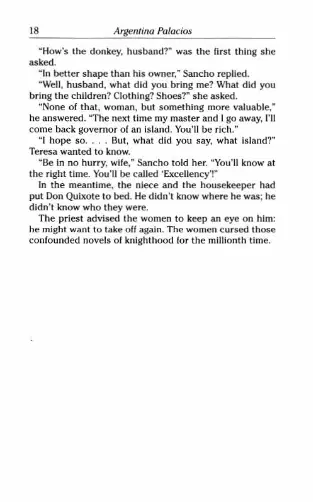
Contrast Sancho’s wife’s
reaction to his return and
the reaction of the women
in Don Quixote’s
household. (question 5)
What plot element is found
on page 18?
22

Rising Action:
Sancho’s encounter
with the priest and
barber
(builds tension and
suspense because it
involves the main
conflict: the priest
and the barber are
trying to find Don
Quixote and bring him
home . Now that they
found him, what
next?)
Setting/Conflict
Rising Action
Climax/
Turning Point
Falling Action
Resolution
Climax/Turning Point:
Don Quixote is yelling and
destroying the wineskins.
Sancho and the innkeeper
are very upset, and the
priest and the barber are
rushing to have a cage
built.
Resolution:
The main conflict has
been solved now that
the priest and barber
have brought Don
Quixote home and
ended his adventure.
23

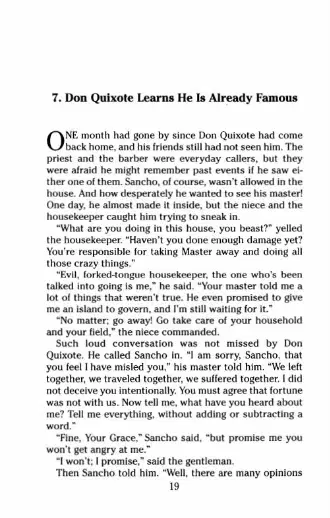
Whom does Sancho
blame for not finding an
island for him to govern?
24

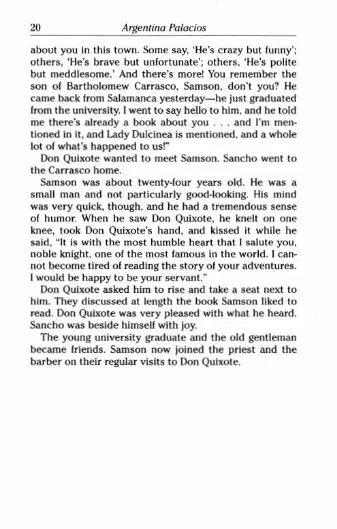
If the verb meddle means
“to interfere with someone
else’s business,” what do
you think the adjective
meddlesome means?
Why do Don Quixote and
Samson become friends?
(question 6)
25

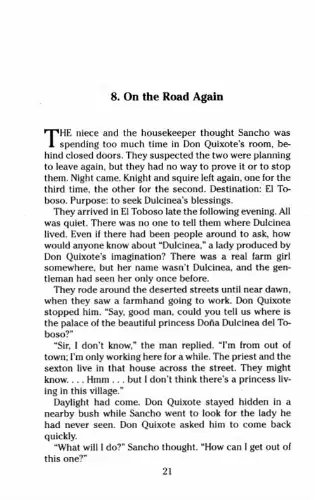
What were some of the
obstacles to finding
Dulcinea?
Why does Sancho say, “What
will I do? How can I get out of
this one?” (question 7)
26

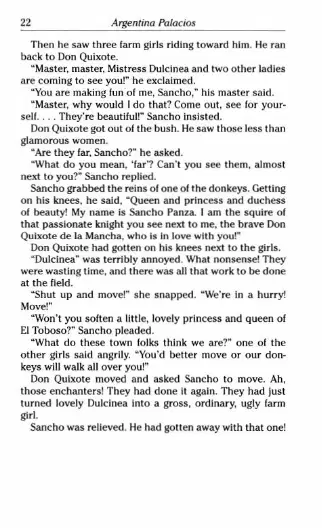
Why did the author put the
word “Dulcinea” in
quotation marks on this
page?
Why does Sancho ask
Dulcinea to “soften a
little”? (question 8)
Does Dulcinea soften her
tone with them?
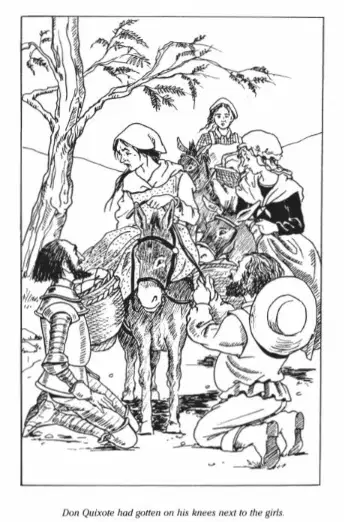
How does Don Quixote
explain the difference
between the way Dulcinea
looks and acts and the
way he imagined her?
27

28


At the end of
chapter 8, why
does Sancho
feel relieved
that his fib had
worked?
Wrap Up
Discussion Questions
29

Discussion Questions
Individual Slides
30



Discussion Questions
Where did Sancho run into
the priest and the barber?
Page 16
31


Discussion Questions
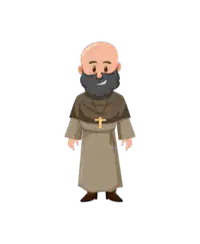
What is the priest’s reaction
when he sees Sancho
without Don Quixote?
Page 16
32


Discussion Questions
The phrase with all due respect is
used when someone is going to
disagree with, or criticize, someone
they do not want to offend. Why do
you think Sancho uses that phrase
here?
Activity Page 5.2 Question 1
Page 16
33

Discussion Questions
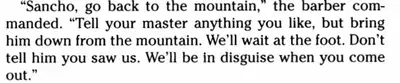
Why does the barber ask
Sancho not to tell Don Quixote
that he saw them, and why
will they be in disguise?
Activity Page 5.2 Question 2
Page 16
34

Discussion Questions
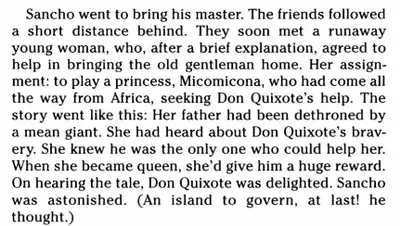
What is the friends’ plan to
bring Don Quixote and Sancho
home?
Activity Page 5.2 Question 3
Page 17
35

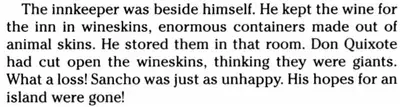

Discussion Questions
What does Don Quixote do to
make the innkeeper angry?
Activity Page 5.2 Question 4
Page 17
36

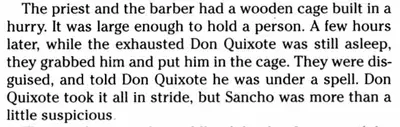

Discussion Questions
How do Don Quixote’s friends
finally manage to get him
home?
Page 17
37

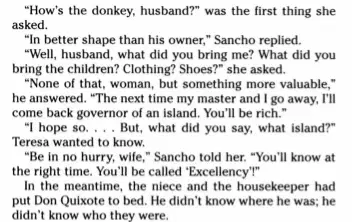
Discussion Questions
Contrast the ways Sancho’s
wife and the women in Don
Quixote’s household react to
their return.
Activity Page 5.2 Question 5
Page 18
38


Discussion Questions
Who does the housekeeper
blame for Don Quixote
leaving his home?
Page 19
39

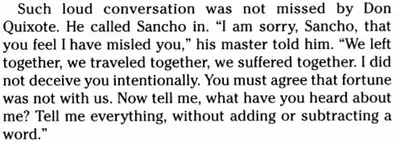
Discussion Questions
Based on the way in which it
is used in this paragraph,
what does the word fortune
mean?
Page 19
40

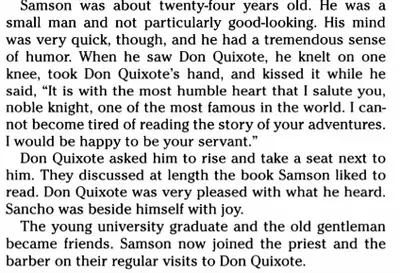
Discussion Questions
Why do Don Quixote and
Samson become friends?
Activity Page 5.2 Question 6
Page 20
41

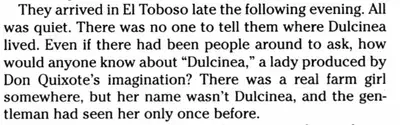
Discussion Questions
What were some of the
obstacles to finding Dulcinea?
Page 21
42

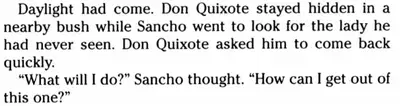
Discussion Questions
Why does Sancho say, “What
will I do? How can I get out of
this one?”
Activity Page 5.2 Question 7
Page 21
43


Discussion Questions
Why did the author put the
word “Dulcinea” in quotes on
this page?
Page 22
44



Discussion Questions
How does Don Quixote explain
that the way Dulcinea looks
and acts is different from the
way he imagines her?
Page 22
45

Discussion Questions
At the end of Chapter 8,
why does Sancho feel
relieved and think he “had
gotten away with that
one”?
46
“I did not deceive you
intentionally.”
The quarterback deceived the
defense into thinking he was going
to pass the football.
To deceive means “to make someone
believe something that is not true.”
- deceive
47


Do you think it is ever a good idea
to deceive someone about
something? Be sure to use the
word deceive in your response.
“It is a good idea to deceive someone
if _________.”
“It is never a good idea to deceive
someone because _________.”
- deceive
48
.
- deceive
Synonyms Antonyms
49

End part 1
spelling test
Show answer
Auto Play
Slide 1 / 49
SLIDE
Similar Resources on Wayground

44 questions
Primary Academic Refresher
Presentation
•
KG
41 questions
Integer Operations - Day 1 - TEKS 6.3D
Presentation
•
6th Grade
42 questions
Fraction Operations Review
Presentation
•
5th Grade
42 questions
3.3 Inequalities on the Number Line
Presentation
•
KG
41 questions
Math 6A Final Review (Gee)
Presentation
•
6th Grade
42 questions
Digital footprints
Presentation
•
4th - 5th Grade
48 questions
POLYGONS & QUADRILATERALS & triangles 5.5A
Presentation
•
5th Grade
42 questions
Geometry Reteach
Presentation
•
4th Grade
Popular Resources on Wayground
6 questions
PRIDE Always and Everywhere
Presentation
•
12th Grade
20 questions
Lab Safety Quiz

Quiz
•
6th Grade
26 questions
KOR Review Kahoot Questions
Quiz
•
8th Grade
21 questions
Continents and Oceans
Quiz
•
6th Grade
12 questions
Unit Zero lesson 2 cafeteria
Presentation
•
9th - 12th Grade
20 questions
Parts of Speech
Quiz
•
5th Grade
10 questions
Riddles Riddles fun Riddles
Quiz
•
6th - 12th Grade
16 questions
Subject & Predicate
Quiz
•
5th Grade
Discover more resources for Mathematics
25 questions
Multiplication Facts
Quiz
•
5th Grade
15 questions
Rounding Decimals
Quiz
•
5th Grade
20 questions
Place Value with Decimals
Quiz
•
5th Grade
10 questions
2 digit by 2 digit Multiplication
Quiz
•
5th Grade
70 questions
Multiplication Facts
Quiz
•
3rd - 6th Grade
10 questions
Adding and Subtracting Decimals
Quiz
•
5th Grade
30 questions
Multiplication Facts 1-12
Quiz
•
2nd - 5th Grade
10 questions
Volume with Unit Cubes
Quiz
•
5th Grade