
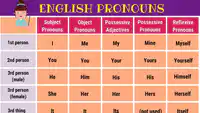
Unleashing the Power of Pronouns

Presentation
•
English
•
6th - 8th Grade
•
Practice Problem
•
Medium
+6
Standards-aligned

Shanae Scott
Used 6+ times
FREE Resource
11 Slides • 5 Questions
1
Unleashing the Power of Pronouns
Exploring the impact and potential of pronouns in communication and identity expression.
2
Unleash the Power of Pronouns
3
Multiple Choice
What is the purpose of pronouns in writing?
To replace nouns in a sentence
To make writing more concise
To avoid repetition
To enhance clear communication
4
Purpose of Pronouns
Pronouns are used to replace nouns in a sentence, making writing more concise and avoiding repetition. They enhance clear communication by allowing for smoother flow and easier understanding. Pronouns play a crucial role in effective writing and are essential for effective communication.
5
Unleashing Pronoun Power
6
Multiple Choice
What is the purpose of intensive pronouns?
To emphasize a noun or pronoun in a sentence
To replace nouns or pronouns in a sentence
To connect two clauses in a sentence
To indicate possession in a sentence
7
Purpose of Intensive Pronouns
8
Intensive Pronouns
9
Multiple Choice
What are intensive pronouns?
Pronouns that emphasize or intensify a noun or pronoun in a sentence
Pronouns that replace nouns in a sentence
Pronouns that indicate possession in a sentence
Pronouns that connect two clauses in a sentence
10
Intensive Pronouns
11
Unleashing Pronoun Power
12
Multiple Choice
What is the purpose of intensive pronouns?
To emphasize a noun or pronoun in a sentence
To replace a noun or pronoun in a sentence
To connect two clauses in a sentence
To indicate possession in a sentence
13
Purpose of Intensive Pronouns
14
Reflexive Pronouns
15
Multiple Choice
What are reflexive pronouns used for?
To emphasize the subject's action on itself
To indicate possession
To connect two clauses
To replace nouns
16
Reflexive Pronouns
To emphasize the subject's action on itself. Reflexive pronouns are used when the subject of a sentence is also the object of the action. They end in -self or -selves. Examples include myself, yourself, and themselves. They add emphasis and clarify the action.
Unleashing the Power of Pronouns
Exploring the impact and potential of pronouns in communication and identity expression.
Show answer
Auto Play
Slide 1 / 16
SLIDE
Similar Resources on Wayground

14 questions
persuasive techniques
Presentation
•
7th - 8th Grade
11 questions
EOG Prep 7th ELA
Presentation
•
7th Grade
10 questions
Affect vs Effect
Presentation
•
6th - 8th Grade
12 questions
Making Inferences
Presentation
•
6th - 8th Grade
14 questions
Capitalization and Punctuation
Presentation
•
6th - 8th Grade
12 questions
Ghost - Pre-reading
Presentation
•
6th - 7th Grade
10 questions
Introduction to Nouns
Presentation
•
6th - 7th Grade
14 questions
Biometrics are not Better Vocabulary
Presentation
•
6th - 7th Grade
Popular Resources on Wayground
20 questions
Math Review

Quiz
•
3rd Grade
15 questions
Fast food
Quiz
•
7th Grade
20 questions
Context Clues
Quiz
•
6th Grade
20 questions
Inferences
Quiz
•
4th Grade
19 questions
Classifying Quadrilaterals
Quiz
•
3rd Grade
20 questions
Figurative Language Review
Quiz
•
6th Grade
20 questions
Equivalent Fractions
Quiz
•
3rd Grade
10 questions
Identify Fractions, Mixed Numbers & Improper Fractions
Quiz
•
3rd - 4th Grade
Discover more resources for English
20 questions
Context Clues
Quiz
•
6th Grade
20 questions
Figurative Language Review
Quiz
•
6th Grade
14 questions
Context Clues
Quiz
•
4th - 6th Grade
50 questions
The Giver Ch 1-23
Quiz
•
6th Grade
34 questions
7th Grade ELA EOG Review
Quiz
•
7th Grade
27 questions
Context Clues
Quiz
•
6th - 7th Grade
43 questions
EOG Review 6th Grade ELA
Quiz
•
6th Grade
40 questions
Esperanza Rising Final Review
Quiz
•
6th Grade