

Chemical Senses: Taste and Smell

Presentation
•
Biology
•
12th Grade
•
Practice Problem
•
Easy

Mitzi Clark
Used 1+ times
FREE Resource
12 Slides • 4 Questions
1

1
2

Receptors for taste and smell are called chemoreceptors because they detect chemicals
Taste and smell complement each other and respond to many of the same stimuli.
Chemoreceptors
3
Thousands of olfactory (smell) receptors are located in the roof of each nasal cavity
Olfactory receptor cells are neurons with olfactory hairs
Olfactory hairs are long cilia that are bathed in mucus.
Olfaction is the act of smelling
4

Hair cells are stimulated by chemicals dissolved in mucus
Impulses are transmitted to the olfactory bulb which then sends smell information to olfactory centers in the temporal lobe
Olfactory pathways are closely tied to the limbic system (emotional-visceral part of the brain) which is why some smells trigger memories and emotions
Olfactory Bulb
5
Multiple Choice
Olfaction is
6
The Sense of Taste
Taste buds are the receptors for the sense of taste
They are found throughout the oral cavity, but most are located on the tongue
Usually found on projections called papillae
Taste likes and dislikes serve a homeostatic function
A particular nutrient the body needs may taste very appealing whereas spoiled food, which could damage the body, usually has an unpleasant taste
The average adult has about 9,000-10,000 taste buds
7
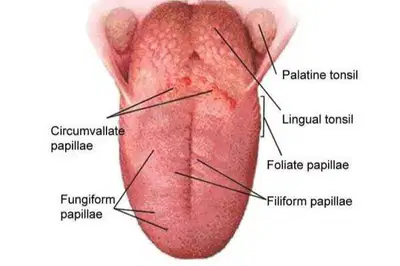
Filiform: provide sense texture and temperature of food, no taste buds
Fungiform: contain taste buds, larger & darker, mostly at tip and along the sides
Circumvallate: large, located at the back of the tongue, contain taste buds in the side walls
8
Categorize
Provide texture
No taste buds
Found at the tip
large
Back of tongue
Larger and darker
Organize these options into the right categories pf papillae
9

Gustation is sensory detection of food on the tongue; the sense of taste.
Taste receptor cells are called gustatory cells
Have long microvilli called gustatory hairs that protrude through a taste pore
Impulses travel to the brain through various cranial nerves.
Each taste bud contains approximately 50-75 Gustatory cells.
Gustatory Cells
10
Multiple Choice
Olfactory cells and Gustatory cells are both examples of
Chemoreceptors
11
5 Basic Taste Sensations
Sweet receptors detect sugar
Sour - acids
Bitter - alkaloids
Salty - metal ions
Umami - amino acid glutamate which is responsible for “beef taste”
12
13

Eyes are not fully functional for several years (Vision is the only special sense that is not fully functional)
Responses to sounds are mostly reflexive
Babies have a highly developed sense of smell and more taste buds than adults
Special Senses at Birth
14

Decreasing lens elasticity makes it difficult to focus on close objects
Lacrimal glands become less active leading to dry eyes
Lens loses clarity
Effect of Aging on Eyesight
15

Organ of Corti & other ear structures begin to deteriorate leading to hearing loss
About half of people over age 80 cannot smell at all & taste is also diminished
Effect of Aging on Other Senses
16
Multiple Choice
This sense is not fully developed in Newborns
1
Show answer
Auto Play
Slide 1 / 16
SLIDE
Similar Resources on Wayground

14 questions
BIOKEEN CHAPTER 7 (Set B)
Presentation
•
12th Grade
13 questions
Mengenal Bioteknologi dan Implikasinya pada Salingtemas
Presentation
•
12th Grade
14 questions
Beginning Payroll
Presentation
•
12th Grade
12 questions
4.4 Conditional probability and Independence
Presentation
•
12th Grade
10 questions
Meet and Greet your Teacher
Presentation
•
12th Grade
12 questions
Anne Frank Character Change
Presentation
•
6th - 9th Grade
11 questions
Relative Clauses
Presentation
•
12th Grade
9 questions
Brain Scans
Presentation
•
12th Grade
Popular Resources on Wayground
10 questions
Safety Day 2026 – Student Review

Quiz
•
9th Grade
21 questions
Continents and Oceans
Quiz
•
6th Grade
20 questions
Parts of Speech
Quiz
•
5th Grade
16 questions
Subject & Predicate
Quiz
•
5th Grade
25 questions
Multiplication Facts
Quiz
•
5th Grade
12 questions
Map Skills
Quiz
•
3rd Grade
22 questions
Continents and Oceans
Quiz
•
5th Grade
15 questions
Rounding Decimals
Quiz
•
5th Grade
Discover more resources for Biology
20 questions
Cell Transport
Quiz
•
9th - 12th Grade
8 questions
DNA vs. RNA
Presentation
•
9th - 12th Grade
16 questions
Epithelial tissues
Quiz
•
11th - 12th Grade
15 questions
DNA Structure and Replication
Quiz
•
9th - 12th Grade
20 questions
Ecological Succession Review
Quiz
•
9th - 12th Grade
3 questions
Enzymes & Energy
Quiz
•
9th - 12th Grade
38 questions
Mitosis & Meiosis
Quiz
•
9th - 12th Grade
37 questions
DNA/RNA practice part 2
Quiz
•
9th - 12th Grade