

Sectionalism

Presentation
•
Social Studies
•
11th Grade
•
Practice Problem
•
Medium

J DiFava
Used 1+ times
FREE Resource
0 Slides • 5 Questions
1
Multiple Choice
In the opinion of the court, the legislation and histories of the times, and the language used in the Declaration of Independence, show, that neither the class of persons who had been imported as slaves, nor their descendants, whether they had become free or not, were then acknowledged as a part of the people, nor intended to be included in the general words used in that memorable instrument.
Source: Roger Taney, Supreme Court Chief Justice
One reason the decision in Dred Scott v. Sanford (1857) was so controversial is that it
strengthened the idea of popular sovereignty
gave enslaved persons full citizenship
ruled that Congress had no power to limit slavery in the territories
supported Harriet Beecher Stowe’s point of view in Uncle Tom’s Cabin
2
Multiple Choice
“Missouri Compromise Allows Two New States Into the Union”
“Congress Agrees to Compromise of 1850”
“Popular Sovereignty Adopted Under Kansas- Nebraska Act”
Which issue is reflected in these headlines?
status of slavery in the territories and states
growth of agriculture on the Great Plains
clash of federal and state powers
conflicts with foreign nations over the West
3
Multiple Choice
… The whole military force of the State is at the service of a Mr. Suttle, a slaveholder from Virginia, to enable him to catch a man whom he calls his property; Is this what all these soldiers, all this training, have been for these seventy-nine years past [since the beginning of the American Revolution]? Have they been trained merely to rob Mexico and carry back fugitive slaves to their masters?…
— Henry David Thoreau, Independence Day speech at Framingham, Massachusetts
The author of this statement is expressing dissatisfaction with a provision included in the
Treaty of Ghent (1815)
Oregon Treaty of 1846
Compromise of 1850
Kansas-Nebraska Act (1854)
4
Multiple Choice
Speaker A: The right way to settle the question of slavery in the territories is to let the people who live there determine if their state is to be slave or free.
The solution proposed by Speaker A is known as
nullification
popular sovereignty
Missouri Compromise
popular sovereignty
5
Multiple Choice
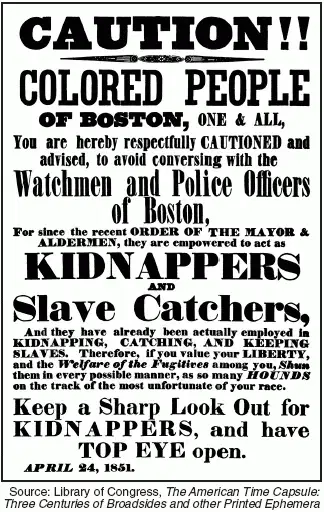
This poster from the 1850s appeared in response to the
passage of the fugitive slave law
start of the Civil War
issuance of the Emancipation Proclamation
enactment of the 13th Amendment
In the opinion of the court, the legislation and histories of the times, and the language used in the Declaration of Independence, show, that neither the class of persons who had been imported as slaves, nor their descendants, whether they had become free or not, were then acknowledged as a part of the people, nor intended to be included in the general words used in that memorable instrument.
Source: Roger Taney, Supreme Court Chief Justice
One reason the decision in Dred Scott v. Sanford (1857) was so controversial is that it
strengthened the idea of popular sovereignty
gave enslaved persons full citizenship
ruled that Congress had no power to limit slavery in the territories
supported Harriet Beecher Stowe’s point of view in Uncle Tom’s Cabin
Show answer
Auto Play
Slide 1 / 5
MULTIPLE CHOICE
Similar Resources on Wayground

4 questions
Antebellum America
Presentation
•
11th Grade
4 questions
8.2 China Turns Communist
Presentation
•
11th Grade
1 questions
Chapter 16 Political Reform
Presentation
•
10th Grade
6 questions
Unit 5, Day 1
Presentation
•
10th Grade
7 questions
Wikang Filipino, Internet at Social Media
Presentation
•
11th Grade
1 questions
CLASS UKG
Presentation
•
KG
1 questions
Untitled Lesson
Presentation
•
KG
5 questions
Unit 5, Day 3
Presentation
•
10th Grade
Popular Resources on Wayground
28 questions
US History Regents Review

Quiz
•
11th Grade
36 questions
Biology Regents Review
Quiz
•
9th - 10th Grade
20 questions
Math Review
Quiz
•
3rd Grade
38 questions
Regents Life Science General Review
Quiz
•
9th Grade
20 questions
Math Review
Quiz
•
6th Grade
21 questions
EOY Grade 6 Benchmark Assessment - Content Skills
Quiz
•
6th Grade
20 questions
Inferences
Quiz
•
4th Grade
20 questions
Figurative Language Review
Quiz
•
6th Grade
Discover more resources for Social Studies
50 questions
US History Comprehensive Final Exam
Quiz
•
9th - 12th Grade
30 questions
US History Regents Review #3
Quiz
•
11th Grade
25 questions
US History Regents Review # 1
Quiz
•
11th Grade
35 questions
US History Regents Exam Practice
Quiz
•
11th Grade
22 questions
Global History Regents Review (MC)
Quiz
•
9th - 12th Grade