
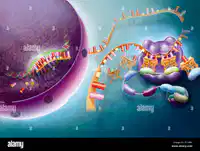
5E-Protein Synthesis

Presentation
•
English
•
University
•
Practice Problem
•
Hard

Giulia Delogu
Used 2+ times
FREE Resource
26 Slides • 8 Questions
1
Understanding the process of protein synthesis and its secrets.
Exploring the key concepts and mechanisms involved in this fundamental biological process.
2
Protein Synthesis
Transcription:Transcription is the process of synthesizing mRNA from DNA. It is a crucial step in gene expression and occurs in the nucleus of eukaryotic cells.
3

During transcription, the DNA sequence is copied into a complementary mRNA molecule, which carries the genetic information to the ribosomes for protein synthesis. RNA polymerase is the enzyme responsible for this process.
4
Protein Synthesis
Processing mRNA: In eukaryotes, the new mRNA is not yet ready for translation. At this stage, it is called pre-mRNA, and it must go through more processing before it leaves the nucleus as mature mRNA. The processing may include splicing, editing, and polyadenylation. These processes modify the mRNA in various ways. Such modifications allow a single gene to be used to make more than one protein.
5
Multiple Choice
Which process comes first in protein synthesis?
Translation
Transcription
Splicing
Polyadenylation
6
Multiple Choice
What happens during transcription?
DNA unfolds and RNA polymerase synthesizes mRNA
Pre-mRNA is processed in the cytoplasm
Introns are removed from mRNA
Ribosomes bind to the mRNA at the start codon
7
Protein Synthesis:
mRNA processing involves splicing, editing, and polyadenylation. Splicing removes introns, leaving only exons that code for the protein. Editing changes nucleotides in mRNA. These modifications allow a single gene to produce multiple proteins. Ribonucleoproteins aid in splicing process.
8

9
Multiple Choice
What is the purpose of splicing?
To remove introns from mRNA
To change some nucleotides in mRNA
To add a tail to the mRNA
To bind ribosomes to the mRNA
10
Splicing
Trivia: Splicing is the process that removes introns from mRNA. Introns are non-coding regions that interrupt the coding sequence. This process ensures that only the necessary coding regions, called exons, are included in the final mRNA molecule. Splicing is crucial for generating functional proteins in eukaryotic organisms.
11
Protein Synthesis:
Editing changes some of the nucleotides in mRNA. For example, a human protein called APOB, which helps transport lipids in the blood, has two different forms as a result of editing.
One form is smaller than the other because editing adds an earlier stop signal in mRNA.
12

13

Polyadenylation adds a 'tail' to the mRNA. The tail consists of a string (series) of adenine bases. It signals the end of mRNA. It is also involved in exporting mRNA from the nucleus and it protects mRNA from enzymes that might break it down.
14
Fill in the Blanks
The function of polyadenylation is to:
15

The second part of the process, called translation, occurs in the cytoplasm where the ribosomes are located. Ribosomes are complex structures composed of both proteins and RNA. They create proteins from all amino acids by binding to the mRNA at the start codon.
TRANSLATION
16

A codon is a sequence of three adjacent nucleotides constituting the genetic code that determines the insertion of a specific amino acid in a polypeptide chain during protein synthesis or the signal to stop protein synthesis.
TRANSLATION
17
When bound to the start codon, the ribosome moves to the elongation phase of protein synthesis.
TRANSLATION
18

During this stage, complexes composed of an amino acid linked to transfer RNA (tRNA) sequentially bind to the appropriate codon in mRNA by forming complementary base pairs with the tRNA anticodon.
TRANSLATION
19
The ribosome travels along the mRNA, reading the genetic code. It adds amino acids one at a time, following the instructions from DNA and mRNA to create a chain of building blocks called a polypeptide.
TRANSLATION
20
At the end of the process, a release factor binds to the stop codon, terminating translation and releasing the complete polypeptide from
the ribosome.
TRANSLATION
21
Protein Synthesis:
During protein synthesis, the ribosome moves from start codon to stop codon along the mRNA. Amino acids are added one by one, translated into polypeptide sequences dictated by DNA and represented by mRNA. At the end, a release factor binds to the stop codon, terminating translation and releasing the complete polypeptide from the ribosome.
22
Location: Translation happens in the cell's cytoplasm, where tiny structures called ribosomes are found.
STEP 1:

23
Reading the Code: Ribosomes read the instructions in the mRNA (messenger RNA), which is like a message carrying the genetic code from the DNA.
STEP 2:

24
Start Codon: The ribosome starts reading at a specific code called the start codon.
STEP 3:
25
Amino Acid Assembly: As the ribosome moves along the mRNA, it reads the genetic code in groups of three letters (codons). Each codon corresponds to a specific amino acid.
STEP 4:
26
Building the Protein: Amino acids are brought to the ribosome by molecules called tRNA (transfer RNA). The ribosome links these amino acids together in a specific order, forming a chain.
STEP 5:
27
Stop Codon: The process continues until the ribosome reaches a stop codon, which signals the end of protein synthesis.
STEP 6:

28
Multiple Choice
Where does translation occur?
Nucleus
Mitochondria
Endoplasmic Reticulum
Cytoplasm
29
Cytoplasm
Cytoplasm is the location where translation occurs in a cell. It is a gel-like substance that fills the cell and contains various organelles. During translation, ribosomes in the cytoplasm read the mRNA and synthesize proteins. This process is essential for cell function and plays a crucial role in protein synthesis.
30
Multiple Choice
What is a codon?
A sequence of three adjacent nucleotides in DNA
A sequence of three adjacent nucleotides in mRNA
A sequence of three adjacent nucleotides in tRNA
A sequence of three adjacent nucleotides in RNA
31
32
Multiple Choice
What happens during the elongation phase of translation?
Ribosomes bind to the start codon
Amino acids are added one by one to the polypeptide chain
Ribosomes move from codon to codon along the mRNA
A release factor binds to the stop codon
33
Multiple Choice
What is the role of the release factor in protein synthesis?
Initiating translation
Terminating translation
Adding amino acids
Reading the mRNA sequence
34
Release Factor: Termination
Trivia: The release factor is responsible for terminating translation, the final step in protein synthesis. It recognizes the stop codon on the mRNA sequence and releases the newly synthesized protein from the ribosome. This ensures that the protein is complete and ready to perform its specific function.
Understanding the process of protein synthesis and its secrets.
Exploring the key concepts and mechanisms involved in this fundamental biological process.
Show answer
Auto Play
Slide 1 / 34
SLIDE
Similar Resources on Wayground

30 questions
Verb and Tense
Presentation
•
University
24 questions
SPM SPEAKING 2021
Presentation
•
University
23 questions
Active and Passive Voice
Presentation
•
University
30 questions
House
Presentation
•
University
25 questions
Use of "Would", "Used to" and "Simple Past"
Presentation
•
University
29 questions
BENG101P - Active Passive Voice
Presentation
•
University
26 questions
Prepositions of Time (in, on, at)
Presentation
•
University
30 questions
Comparative and Superlative Adjectives
Presentation
•
Professional Development
Popular Resources on Wayground
10 questions
Safety Day 2026 – Student Review

Quiz
•
9th Grade
21 questions
Continents and Oceans
Quiz
•
6th Grade
20 questions
Parts of Speech
Quiz
•
5th Grade
16 questions
Subject & Predicate
Quiz
•
5th Grade
25 questions
Multiplication Facts
Quiz
•
5th Grade
12 questions
Map Skills
Quiz
•
3rd Grade
22 questions
Continents and Oceans
Quiz
•
5th Grade
15 questions
Rounding Decimals
Quiz
•
5th Grade
Discover more resources for English
20 questions
Disney Trivia
Quiz
•
University
10 questions
Spanish Greetings and Goodbyes!
Presentation
•
6th Grade - University
20 questions
Physical or Chemical Change/Phases
Quiz
•
8th Grade - University
39 questions
Unit 7 Key Terms
Quiz
•
11th Grade - University
25 questions
SER and Subject Pronouns
Quiz
•
8th Grade - University
38 questions
Unit 6 Key Terms
Quiz
•
11th Grade - University
19 questions
Key Concepts in Buddhism
Quiz
•
University
0 questions
Cell Domain Basic Review (Biology)
Quiz
•
University