

FIL CHAPTER 2

Presentation
•
Business
•
University
•
Practice Problem
•
Hard

Syed Shamin
FREE Resource
68 Slides • 1 Question
1
LICENSING
2

JLD22133
FUNDAMENTALS OF
INTERNATIONAL LOGISTICS
3

2.1
EXPORTING
4

• Exporting is the practice of sending or carrying goods or services to a foreign
country for trade or sale.
• They include the value of merchandise, freight, insurance, transport, travel,
royalties, license fees, and other services, such as communication,
construction, financial, information, business, personal, and government
services.
• To export goods from Malaysia, you are required to make a pledge to the Royal
Malaysian Customs Department (JKDM). Export Duty and Cess will be payable
on dutiable goods.
Definition
5

•In September 2020, Malaysia exported mostly to China (MYR15.6B), Singapore (MYR12.2B),
United States (MYR10.3B), Hong Kong (MYR6.71B), and Japan (MYR4.76B), and imported
mostly from China (MYR15.3B), Singapore (MYR6.51B), United States (MYR5.42B), Japan
(MYR5.4B), and Chinese Taipei (MYR5.14B).
•Malaysia's main exports are: electrical and electronics products (36 percent), chemicals (7.1
percent), petroleum products (7.0 percent), liquefied natural gas (6 percent), and palm oil (5.1
percent). Malaysia's main export partners are: Singapore (14 percent), China (13 percent),
European Union (10 percent), Japan (9.5 percent), the United States (9.4 percent) and Thailand
(6 percent).
Malaysia Export
6

“Exports in Malaysia increased to a three-month
high of 144310.00 MYR Million in September from
141271.00 MYR Million in August of 2022.”
7

S
Malaysia Export
8

• Increased sales and increased profitability
• Reduced reliance on domestic markets due to market diversification
• New opportunities for growth
• Economies of scale (the more you produce, the less each unit costs to
make)
• Use of excess capacity (through increased sales)
• Reduced vulnerability to seasonal fluctuations in the market for your product
Benefits of Exporting
9

• Financial risk: inadequate financing to get your product ready to sell in
foreign markets; taking on short-term debt to cover new operational and
administrative costs while you wait for revenues.
• Risk of non-payment (e.g., accepting payment by open account, credit card
fraud).
• Foreign exchange rate risk: fluctuations in the value of the MYR relative to
the currency of other countries can affect export profits either positively or
negatively.
Risks of Exporting
10

2.2
IMPORTING
11

•An import is a good or service bought in one country that was produced in another.
•They include the value of merchandise, freight, insurance, transport, travel,
royalties, license fees, and other services, such as communication, construction,
financial, information, business, personal, and government services.
•To import goods to Malaysia, you are required to make a declaration to the Royal
Malaysian Customs Department (JKDM). Import Duty, Excise Duty, Sales Tax will
be paid on goods subject to duty/tax if the goods are imported for local
consumption.
Definition
12

•The top imports of Malaysia are Integrated Circuits ($27.8B), Refined Petroleum ($13.4B),
Crude Petroleum ($4.75B), Special Purpose Ships ($4.39B), and Broadcasting Equipment
($3.43B), importing mostly from China ($51.5B), Singapore ($22.9B), United States
($12.4B), Japan ($12.1B), and South Korea ($11.6B).
•Malaysia's main imports are: electrical and electronic products (29.4 percent), chemicals
(9.5 percent), petroleum products (9.3 percent) and machinery, appliances and parts (8.7
percent).
•Main import partners are: China (19 percent), Singapore (12 percent), European Union (10
percent), the United States (8.1 percent), Japan (7.8 percent) and Thailand (6.1 percent).
Malaysia Import
13

“Imports in Malaysia decreased to 112599.30
MYR Million in September from 124410.13 MYR
Million in August of 2022.
14

S
Malaysia Import
15

• Comparative advantage means lower-priced goods
• Higher-quality products.
• Grants access to regionally exclusive resources.
• Various benefits stemming from trade agreements.
Advantages of Import
16

• Lead the erosion of the domestic markets and national economies.
• Conflict in the domestic values due to the acceptance of social
values.
• Currency Risk
• Political Risk
Disadvantages Import
17

Steps of Exporting & Importing
1. Custom Pledge
2. Goods Classification
3. Check if the goods in
question are controlled
goods or export/import
prohibited goods
6. Payment Of Duties /
Cess
5. Goods Inspection
4. Pledge & preparation
of documents for
customs clearance
7. Customs Approval
8. Customs Release
9. Documentation and
Record Keeping
18

All exports & imports of goods must be pledged by:
1. Appointed
Customs
Agent
(check
can
be
done
at
http://www.mytradelink.gov.my/trade-associations); or
2. Self-Declaration
(AEO
Program
-
AEO
Portal
http://customsgc.gov.my/index_aeo.html); or
3. Direct User (Direct User)
1. Custom Pledge
19

Exporters and Importers need to obtain confirmation on the goods to be exported & imported whether
they are subject to any duty / cess by obtaining the correct tariff code for the goods in question. The
tariff code can be checked by referring to:
1.
HS Explorer http://mysstext.customs.gov.my/tariff/; or
2.
Get advice from the Technical Services Division, Classification, Tariff and Drafting Branch, JKDM
http://www.mobile.customs.gov.my/edirektori/portal-branch?x=8; or
3.
Check
with
the
Customs
Duty
Order
2017
http://www.federalgazette.agc.gov.my/outputp/pua_20170103_P.U.(A)52017.pdf
(subject
to
amendment); or
4.
Check with the relevant Free Trade Agreement (FTA) https://fta.miti.gov.my/
2. Goods Classification
20

• Check whether the goods to be exported/imported are controlled goods or subject
to export bans or restrictions by the authorities.
• Check whether the goods in question require an Export/Import Permit / Approval
from the Other Government Agency (OGA) or Permit Issuing Agency (PIA). Permits
/ approvals must be obtained before any export/import is done.
3. Check if the goods in question are controlled goods or
export/import prohibited goods
21

Each exporter must make a full and true declaration regarding the exported/imported goods, either by himself or
by his agent before the exportation/importation is carried out.
1.
The declaration of export is to use Customs Form No.2 (K2) and import is to use Custom Form No.1
(K1) electronically. Link: http://www.dagangnet.com/trade-facilitation/edeclare/
2.
Submit the export/import permit when making the customs declaration either electronically or hard
copy. Link : http://www.dagangnet.com/trade-facilitation/epermit/
The exporter/importer or his agent shall submit such documents as may be requested by the competent customs
officer for the purpose of assessing any declaration made by the exporter/importer. The list of supporting
documents is as follows:
1. Invoice, 2. Packing list, 3. Manifest, 4. Other related documents (export)
1. Bill of Lading / Airway Bill, 2. Invoice, 3. Packing List, 4. Country of Origin Certificate (if applicable), 5. Other
related documents. (import)
4. Pledge & preparation of documents for customs clearance
22

•
The authorities (JKDM) have the right to inspect consignments to
ensure that the exports/imports comply with laws and regulations.
•
Any authorized customs officer may conduct a physical inspection of
any goods when necessary.
5. Goods Inspection
23

1.
Duty / cess payable on exported goods must be paid by the exporter before
exporting the goods.
2.
Duty / tax payable on imported goods must be paid by the importer upon arrival of
the goods.
3.
Payment of duty / cess can be made at the counter or through online payment.
Link : http://www.dagangnet.com/trade-facilitation/epayment/
6. Payment Of Duties / Cess
24

The goods to be exported/imported can be approved for release out of
Malaysia provided that duty / cess has been paid and a permit (if
applicable) has been obtained.
7. Customs Approval
25

Customs clearance can be allowed after all actions that have been
dictated by JKDM have been complied with and fulfilled.
8. Customs Release
26

Export/import records must be kept within Malaysia for a period of seven
(7) years, except as approved by the Director General subject to any
conditions imposed by him.
9. Documentation and Record Keeping
27

You are the logistics manager for an international trading company that specializes in importing and
exporting various goods to and from countries around the world.
Recently, a geopolitical conflict has erupted in a region where your company conducts significant trade.
This conflict has disrupted trade routes, posed security risks, and created uncertainties in the
international logistics landscape.
Your task is to navigate this challenging situation and ensure the continued success of your company's
import and export operations.
Tutorial
28

2.3
LICENSING
29

• A licensing or licence agreement is basically a legally binding contract between
a licensor and a licensee, by which the licensor gives the licensee certain rights
or permission for the use of its IP, which would not otherwise be available to the
licensee.
• Broadly speaking, anything that one owns or has rights to may be licensed.
• In terms of technology licensing, the IP rights protecting the technology, for
example, patents, industrial designs, know-how, trade secrets etc. would
typically be the subject matter of a licence.
Definition
30

• The owner of the IP has the right to license to an interested party or multiple
parties.
• In some cases, the owner may grant a licence to a main or master licensee,
giving him sub-licensing rights. With such rights, the master licensee in turn,
grants further licences, which are referred to as sub-licenses, to other interested
parties. The parties receiving the sub-licences are known as sub-licensees.
• Any interested party, either an individual or a company, may approach the
owner of an IP to obtain a licence to use the same.
Who May License and use a license
31

•Exclusive licence - An exclusive licence is one where the licensee is the only one that is
granted rights by the licensor. An exclusive licence not only disallows the licensor to license the
same rights to any other party, but it also excludes the licensor from using its rights.
•Non-exclusive licence - A non-exclusive licence means that the rights granted by the licensor
to the licensee may also be granted to other parties. In other words, a non-exclusive licence
does not exclude the possibility of the licensor granting further licences to other parties, that is to
say that the licensor may license the same rights to more than one party.
•Sole licence - A sole licence is the same as an exclusive licence with the exception that the
licensor retains its rights to use the IP. This means that, for a sole licence, both the sole licensee
and the licensor have the rights to use the IP.
Types of Licenses
32
Multiple Choice
A software company distributing their license to many user belong to which type of license?
Exclusive License
Sole License
Non-Exclusive License
33

• Revenue generation
• Risk minimization
• Reduction in costs
• Immediate access to new technologies
• Collaboration opportunities
Advantages of Licensing
34

• Loss of control of their intellectual property
• Dependent on the skills, abilities, and resources of the licensee to
generate revenues
• Exposed to intellectual property theft by the licensee
Disadvantages of Licensing
35

Matters for consideration in a License Agreement
36

Matters for consideration in a License Agreement
37

2.4
OFFSHORING
38

• Offshoring is the transferring activities or ownership of a complete business
process to a different country from the country (or countries) where the
company receiving the services is located.
• First of all, firms can relocate “material” and “immaterial” stages of production.
We call these phenomena as “material offshoring” and “service offshoring”,
respectively. The first concept refers to manufacturing tasks, such as assembly
and intermediate goods production, whereas the second captures the offshoring
of business services, such as call-centres, accountancy, financial services and
customer services.
Definition
39

•Companies often offshore manufacturing or services to countries where the hourly labor rate is
significantly lower. In Mexico, for example, the hourly labor rate is only a fraction of the minimum
wage in the United States.
•In addition to saving money on manufacturing costs, companies offshoring manufacturing also
creates more skilled employment opportunities in administrative and operational roles
•Offshoring allows companies to maintain complete control over the operation and production of
the business. While outsourcing relies on an outside vendor to complete tasks, offshoring relies
only on those within the same company.
•For some, offshoring allows for a more cohesive, directionally focused business than
outsourcing does.
Understanding Offshoring
40

• Lower Costs in offshore regions.
• Less stringent regulatory control in offshore regions
• Deregulation of trade facilities offshoring
• Lower Communication and IT Costs.
• Improving capabilities in offshore regions
• Clusters of specific activities (e.g. call centres) emerging in certain
regions
Reasons for Offshoring
41

• Time Zone Differences and Proximity
• Communication and Language Issues
• Quality Control Problems
• Security and Intellectual Property (IP) Issues
• Payrolling and Compliance Issues
• Negative Image Due to a Loss of Domestic Jobs
Risks of Offshoring
42

2.5
OUTSOURCING
43

• Outsourcing is defined as the act of obtaining semi-finished products, finished
products or services from an outside company if these activities were
traditionally performed internally.
• In the previous sentence, the word "product" may be replaced by "service".
• The company that out sources is called "buyer" whereas the company that
provides the service is known as the "vendor". Note that outsourcing leads to a
significant rapprochement between the vendor and the buyer.
Definition
44

• Outsourcing can save costs by accomplishing the same task for less money.
However, just because the task is being accomplished for less money does not
mean that the quality will decline. One of the most attractive aspects of
outsourcing is the reduction in cost while still receiving high quality services.
• Outsourcing can increase efficiency by entrusting business processes to third-
party vendors that specialize in that specific area.
• Outsourcing allows companies to focus on the core areas of their business and
improve their brand by freeing up time, energy and resources.
Understanding Outsourcing
45

• Cost Savings
• Focus on Core Business Processes
• Reduced Operational, Infrastructural and Recruitment Costs
• Increased Efficiency & Expertise
• Access to the latest technology
Reasons for Outsourcing
46

• Risk of Exposing Confidential Corporate Information
• Service Delivery
• Hidden costs
• Lack of flexibility
• instability
Risks of Outsourcing
47
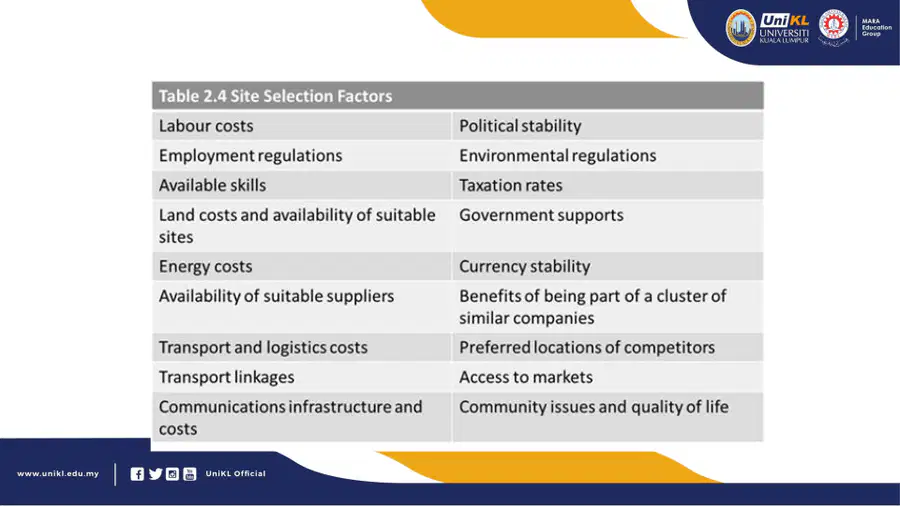
Overseas Site Selection Factors
48

2.6
FOREIGN DIRECT INVESTMENT
(FDI)
49

• Foreign direct investment (FDI) is an ownership stake in a foreign company or
project made by an investor, company, or government from another country.
• Sometimes referred to as direct investment, the investor takes a controlling
interest in a foreign company.
• Generally, the term is used to describe a business decision to acquire a
substantial stake in a foreign business or to buy it outright to expand operations
to a new region.
Definition
50

• Foreign direct investments (FDIs) are substantial, lasting investments made by
a company or government into a foreign concern.
• FDI investors typically take controlling positions in domestic firms or joint
ventures and are actively involved in their management.
• The investment may involve acquiring a source of materials, expanding a
company’s footprint, or developing a multinational presence.
• The top recipients of FDI over the past several years have been the United
States and China.
Understanding FDI
51

• Foreign direct investment (FDI) inflows into the ASEAN region for the 2021
calendar year reached a record level of USD 174 billion, equaling the pre-
pandemic high recorded in 2019.
• Key drivers for rising FDI inflows into Southeast Asia include diversification of
manufacturing supply chains by multinationals, as well as new investments to
tap rapidly growing consumer markets in ASEAN.
• Strong FDI inflows into electronics manufacturing, and also projects related to
electric vehicles, were important contributors to the high level of FDI inflows
recorded in 2021.
ASEAN FDI
52
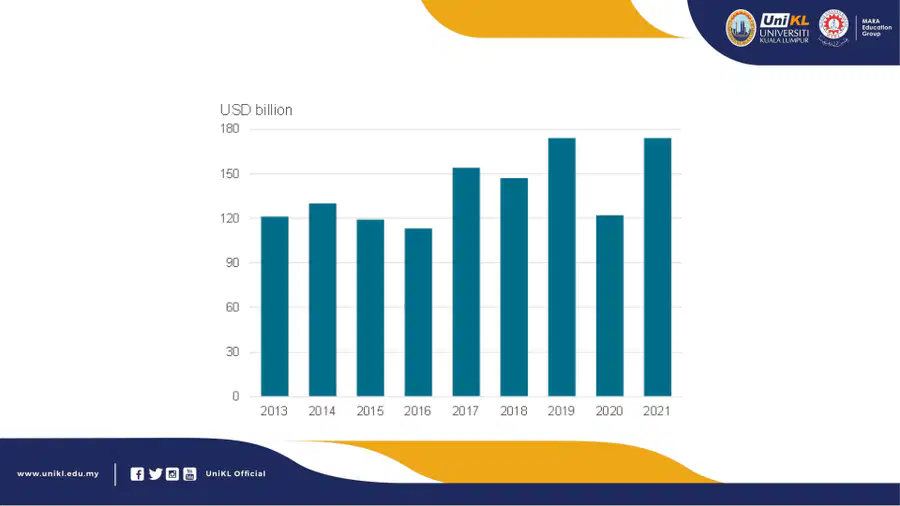
=
ASEAN FDI inflows
53

=
ASEAN FDI in 2021 by Source
54

Flows of Inward FDI to ASEAN Countries
(in million US$)
55

•Horizontal: a business expands its domestic operations to a foreign country. In this
case, the business conducts the same activities but in a foreign country. For
example, McDonald’s opening restaurants in Japan would be considered horizontal
FDI.
•Vertical: a business expands into a foreign country by moving to a different level of
the supply chain. In other words, a firm conducts different activities abroad but
these activities are still related to the main business. Using the same example,
McDonald’s could purchase a large-scale farm in Canada to produce meat for their
restaurants.
Types of FDI
56

•Conglomerate: a business acquires an unrelated business in a foreign country. This is
uncommon, as it requires overcoming two barriers to entry: entering a foreign country
and entering a new industry or market. An example of this would be if Johor Corp,
which is based in the Malaysia, acquired a clothing line in France.
•Platform: a business expands into a foreign country but the output from the foreign
operations is exported to a third country. This is also referred to as export-platform FDI.
Platform FDI commonly happens in low-cost locations inside free-trade areas. For
example, if Ford purchased manufacturing plants in Ireland with the primary purpose of
exporting cars to other countries in the EU.
Types of FDI
57

•FDI can take two different forms: Greenfield or mergers and acquisitions (M&As).
•Greenfield
investment
involves
the
creation
of
a
new
company
or
establishment of facilities abroad. A greenfield investment is a form of market
entry commonly used when a company wants to achieve the highest degree
of control over foreign activities
•Mergers and acquisitions amounts to transferring the ownership of existing
assets to an owner abroad. In a merger, two companies are merged to form
one, while in an acquisition one company is taken over by another.
Methods of FDI
58

• Economic growth
• Human capital development
• Market diversification
• Subsidies
• Access to management expertise, skills, and technology
Advantages of FDI
59

• Hindrance of domestic investment
• The risk from political changes
• Higher costs
• Modern-day economic colonialism
• Expropriation
Disadvantages of FDI
60

2.7
COUNTERTRADE AND
DRAWBACKS
61

•When an international sale takes place, it may be difficult to structure the sale through
conventional means of payment. With countertrade, goods or services are exchanged
rather than currency. This is often known as bartering.
•In countertrade transactions, which involve trading in goods and services as opposed
to money, cash does not change hands. This is oftentimes referred to as bartering,
which is the oldest type of countertrade arrangement.
•Many governments reduce imbalances in trade between countries through the use of a
countertrade system of international trading.
Definition
62

•Enable trade in countries that are unable to pay for imports. This can be the result of a
shortage of foreign currency or lack of commercial credit, for example.
•Help find new export markets or protect the output of domestic industries.
•Balance overseas trade.
•Gain a competitive edge over competing suppliers.
•Sidestep the lack of credit or other alternative financing measures.
•Develop a workaround on the rules and regulations of a foreign country.
•Foster customer goodwill.
Countertrade is Used Primarily to:
63

•Barter - It is a direct and on-the-spot exchange of products of equivalent value or importance. It doesn’t
involve payment using money; parties in the barter system benefit from receiving the products they require
by exchanging what they have in surplus. Since money is not a factor, it helps financially weak countries to
get into international trade. For example, countries enter into barter deals to obtain military equipment by
transferring locally produced commodities.
•Counter Purchase - The counter purchase involves an importer obtaining goods and services from an
exporter with an assurance that the exporter will purchase other specific goods or services from the
importer. For instance, a domestic company can sell its product to a foreign company based on an
agreement to buy another product from the foreign company within a set time. This way, the money does
not change hands. For example – Brazil exports vehicles, steel, and farm products to oil-producing
countries from which it buys oil in return within a set time.
Types of Countertrade
64

•Offset - They are often observed in the deals involving aircraft and military equipment. The agreements
usually portray an exporter manufacturer agreeing to the importer’s terms like marketing their products,
final assembly of exported items in the importer’s country, and buying other goods and services from the
importer’s country. It is generally categorized into direct offset and indirect offset. Direct offset is related to
the product or service involved in the trade, and the agreement involves coproduction or subcontracts.
Indirect offset agreements are not related to the main product, but the exporter may be obliged to buy
goods or services from the importing country.
•Switch Trading - Switch trading involves a minimum of three parties. It enables one party to sell its
obligation or assurance to another party to a third party. For example, country A exports its product to
country B. Country B will ship other products to another country C, known as switch trader. Country C, in
turn, provides or exports the product needed by country A.
Types of Countertrade
65

•Buyback - Buyback occurs when one party provides the inputs like technology and equipment
to another party and, in return, receives a certain amount of finished goods made using those
facilities as a part of compensation. It is also evident that the products shared by the parties to
the agreement are related as input and output. For example, one country provides the auto
parts, machinery, and workforce to another country and receives a large consignment of auto
vehicles.
•Compensation Trade - The form of arrangement in which the repayment against the input
received is done from the revenues generated by that input. It also ensures that payment flow is
partly in goods and cash. For example, an investor is paid back by a share of the proceeds or
results generated by the goods and services that the investor provided.
Types of Countertrade
66

• Allows for entry into difficult markets.
• Increases company sales where the business might not otherwise
have revenues.
• Overcomes credit difficulties.
• Allows for disposal of declining or surplus products.
• Gains competitive advantage over the competition.
Advantages of Countertrade
67

• The time-consuming nature.
• Negotiation complexity.
• Higher transaction costs
• Logistical issues
• Greater uncertainty on the value of the goods being traded and
uncertainty on the quality of the goods.
Disadvantages of Countertrade
68

Individual Tutorial – 5 April 2023. Submit in Power point format. Present Next Class
1.
How can companies ensure that they maintain quality control when offshoring work?
2.
How can companies address cultural and communication barriers when offshoring work to
different countries?
3.
What factors should companies consider when deciding whether to engage in countertrade?
4.
How can companies effectively manage their FDI relationships?
Tutorial
69

THANK YOU
LICENSING
Show answer
Auto Play
Slide 1 / 69
SLIDE
Similar Resources on Wayground

63 questions
Lesson-1-39 (Listening Skills)
Presentation
•
University
62 questions
Topic 1 Introduction to Network
Presentation
•
University
65 questions
AVTC1 - LESSON 15
Presentation
•
University
65 questions
basic 01 - Unit 01-02 review
Presentation
•
University
62 questions
Brandon in Japan
Presentation
•
KG
63 questions
Spanish 101- Lesson 1
Presentation
•
University
65 questions
Week 03 - Economics
Presentation
•
University
66 questions
Interactive Lecture | Predicates and Quantifiers
Presentation
•
University
Popular Resources on Wayground
10 questions
Safety Day 2026 – Student Review

Quiz
•
9th Grade
21 questions
Continents and Oceans
Quiz
•
6th Grade
20 questions
Parts of Speech
Quiz
•
5th Grade
16 questions
Subject & Predicate
Quiz
•
5th Grade
25 questions
Multiplication Facts
Quiz
•
5th Grade
12 questions
Map Skills
Quiz
•
3rd Grade
22 questions
Continents and Oceans
Quiz
•
5th Grade
15 questions
Rounding Decimals
Quiz
•
5th Grade