Search Header Logo
Unit 315 session 8 Flushing and disinfection of systems

Unit 315 session 8 Flushing and disinfection of systems

Assessment

Presentation

•

Other

•

Professional Development

•

Practice Problem

•

Medium

Created by

Plumbers Cymoedd

Used 9+ times

FREE Resource

18 Slides • 17 Questions

1

​Flushing and disinfection of systems
media
media

2

Open Ended

Question image

What do you think is involved with flushing and disinfection of a newly installed system?

3
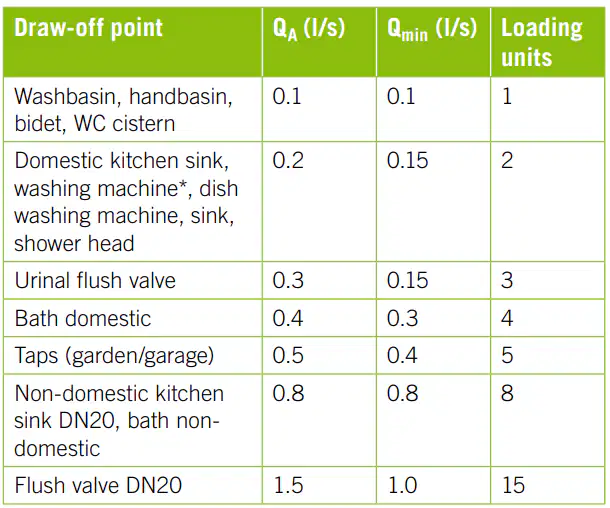
​Before we can disinfect a system we need to calculate how much water the system contains.

media

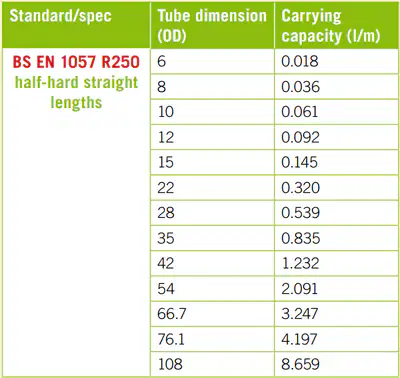
​This table gives the capacity of different pipe sizes per meter.

For example 1m of 15mm pipe will carry 0.145 litres of water, therefore 10m of 15mm pipe will carry 1.45 litres of water.

4

media

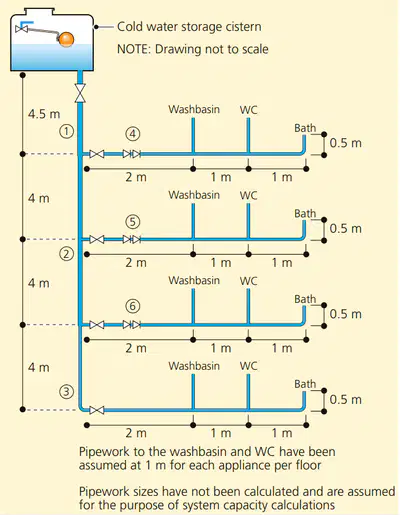
​Lets calculate the volume of water in the system opposite.

media

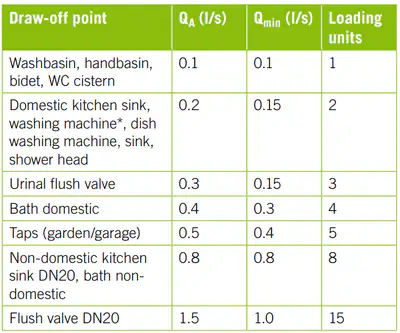
​Using the table above how many loading units does each branch need.

5

Fill in the Blanks

media image

Each branch will require ? loading units

6
media

​Lets calculate the volume of water in the system opposite.

media

There are 4 branches so the total loading units required is?

7

Fill in the Blanks

media image

The total loading units required for all 4 branches is ?

8

media

​Lets calculate the volume of water in the system opposite.

media

So 24 loading units are required, using the table above we can calculate the amount in litres.

9

Fill in the Blanks

media image

How many litres is equal to 24 loading units?

10

media

​Lets calculate the volume of water in the system opposite.

media

So the total required for pipe 1 is 24 LU's, we can use this to determine the pipe sizes for each section of the system.

11

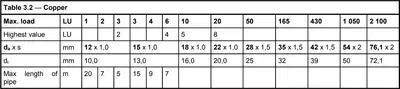
​Using the table from BS 806 part 3 below, we see we would need 28mm for pipe 1 to deliver 24 LU's of water.

so pipe 1 would need to be 28mm.

media
media

12

media
media

​We can now use the information to complete the table

media
media

13

Fill in the Blanks

media image

The capacity of pipe 2 is?

14

Fill in the Blanks

media image

The capacity of pipe 3 is?

15

Fill in the Blanks

media image

The capacity of each pipe 4, 5, 6 & Ground floor is?

(Give the capacity of one of these but use them all for your final calculation)

16

​So the capacities are:
Pipe 1 = 4.58
Pipe 2 = 1.28
Pipe 3 = 1.16
Pipe 4 = 0.58
Pipe 5 = 0.58
Pipe 6 = 0.58


17

Fill in the Blanks

The total system volume is?

18

We add an amount of sodium hypochlorite solution (5 per cent chlorine content) to disinfect the system

Our system volume was 8.76 lts

19

Fill in the Blanks

media image

If our system volume is 8.76 lts

and we need to treat the system with 5% sodium hypochlorite solution,

how much sodium hypochlorite solution will we need to use?

20

​The method of disinfection

​4 Working away from the cistern, open each draw-off until a smell of disinfectant is detected. This should be done at every draw-off to ensure that the system is full of disinfectant.


5 As the water from the cistern is drawn off, it will be necessary to add more disinfectant solution to ensure that the required 50 ppm throughout the installation is achieved.

6 Once the system is full and the float operated valves on the system have shut, the 1-hour test period can begin.

​The method of disinfection is as follows:

1 Thoroughly flush the system with water from the undertaker’s main to remove any swarf, flux residues or other contaminants.

2 Calculate the cistern capacity and the amount of disinfectant required to give the required 50 ppm.

3 Add this to the cistern as it is filling to give a good mix with the cistern water.

We add an amount of sodium hypochlorite solution (5 per cent chlorine content) to disinfect the system

21

​Testing for residual chlorine

​At the end of the 1-hour period, the free residual chlorine content should be 30 ppm at the furthest draw-off point.

If this is not achieved, then the system must be drained and the test started afresh.

​To test for residual chlorine content, a special chemical analysis test is used, which indicates the strength of the chlorine by the colour it turns when the chemical is added to the water.

media
media

22

​Flushing the system after disinfection

​Before draining the system, the advice of the local water undertaker should be sought.

media

23

Open Ended

Question image

Why do you think you must consult the local water authority before flushing disinfectant ?

24

​Once the system has been drained, it should be flushed with clean water until the free residual chlorine content is no more than that in the water undertaker’s mains cold water supply.

media

​Heavily chlorinated water is dangerous to wildlife and fish.
Prolonged contact with copper pipe can also cause cuprous chloride corrosion, which will continue to attack the tube, even after flushing.

media

25

​The flushing procedure for cold water systems and components not requiring disinfection
media

26

​The flushing of cold water systems is a requirement of the British Standards.

All systems, irrespective of their size, must be thoroughly flushed with clean water direct from the water undertaker’s main supply before being taken into service.

media

27

​Simply filling a system and draining down again does not constitute a thorough flushing.

In most cases, this will only move any debris from one point in the system to another.
In practice, the system should be filled and the water run at every outlet until the water runs completely clear and free of any discoloration.

media

28

​Test yourself

29

Multiple Choice

What is the first step in the method of disinfection?

1

Add disinfectant to the cistern

2

Leave in the system for 1 hour

3

Flush the system with water

4

Test for residual chlorine content

30

Multiple Choice

When should disinfectant be added to the cistern?

1

After the 1-hour test period

2

While the system is filling

3

Before flushing the system

4

Only at the furthest draw-off point

31

Multiple Choice

What is the desired free residual chlorine content at the furthest draw-off point after the 1-hour test period?

1

20ppm

2

30ppm

3

40ppm

4

50ppm

32

Multiple Choice

Why might it be necessary to add more disinfectant solution during the process?

1

o speed up the disinfection

2

To prevent corrosion in copper pipes

3

To ensure 100 ppm throughout the installation

4

To achieve 50 ppm at the furthest draw-off

33

Multiple Choice

How is the strength of chlorine tested in the water?

1

Visual observation

2

Smell of disinfectant

3

Chemical analysis test

4

Taste of water

34

Multiple Choice

Why is heavily chlorinated water considered dangerous?

1

It can harm aquatic life

2

It can cause corrosion in pipes

3

It can discolour the water

4

It is not effective in disinfection

35

Multiple Choice

What is the final step after draining the system for disinfection?

1

Fill the system again without flushing

2

Flush with clean water until chlorine content matches mains supply

3

Begin the 1-hour test period again

4

Ignore further flushing as it is not necessary

pattern-tertiary
​Flushing and disinfection of systems
media
media

Show answer

Auto Play

Slide 1 / 35

SLIDE