Search Header Logo
review 12/18

review 12/18

Assessment

Presentation

Biology, Science

9th - 12th Grade

Hard

Created by

Philip Brown

FREE Resource

32 Slides • 17 Questions

1

media

Meiosis

2

media
media

Meiosis

Creates 4 non-identical
haploid cells used for
sexual reproduction

3

media

What is Meiosis? … in simple terms

Sexual Reproduction and Genetics

A special type of cell division that results in
cells having half the number of
chromosomes - HAPLOID
Results in cells used only in sexually
reproducing organisms - GAMETES

4

Multiple Choice

Cells used only in sexual reproduction are called

1

grains

2

diploid

3

snurffles

4

gametes

5

media

Regents Biology

Meiosis: Sex Cells

46 chromosomes to 23 chromosomes

half the number of chromosomes

23

46

egg cells

sperm cells

46

meiosis

haploid

diploid

23

23
23

23 23 23 23

6

Multiple Choice

Question image

This image is called a ____________

1

triangle

2

punnett square

3

square

4

rectangle

7

media

8

media

9

media

10

Multiple Choice

Type of allele that may mask the effect of others, represented by capital letters

1

dominant

2

recessive

11

Multiple Choice

Question image
What allele combination should go in the missing box?
1
AA
2
Aa
3
aa
4
none of these

12

Multiple Choice

Question image

What are the chances that the offspring will have homozygous recessive traits?

1

1 in 4

2

3 out of 4

3

75%

4

50%

13

media

14

media

15

media

16

Multiple Choice

Question image
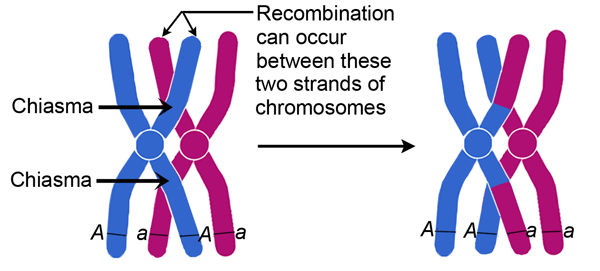
This image shows chromosomes during Prophase 1. Which of the following correctly describes the process shown?
1
segregation of sister chromatids
2
condensation and segregation of alleles
3
mutationin which the DNA content of the gene is altered
4
crossing - over in which alleles are exchanged

17

media

18

Multiple Choice

When does the independent assortment of chromosomes occur?

1

Telophase II

2

Metaphase I

3

Metaphase II

4

Prophase I

19

media

20

Multiple Choice

How does active transport differ from passive transport?

1

Uses energy

2

Does NOT use energy

21

There are two substances get into cells:

  • Passive Transport; does NOT require energy

  • Active Transport: DOES require energy

media

22

media

23

Examples of Active Transport Include:

  • Calcium Pump

  • Sodium-Potassium Pump

  • Secondary Active Transport

  • Endocytosis; Phagocytosis, Pinocytosis

  • Exocytosis

media

24

The Sodium-Potassium Pump:

  • Moves Na+ out

  • Moves K + in

  • Called an anti-porter

  • Uses ATP

  • How your nervous system works

media

25

Fill in the Blank

Question image

The image shows a _________ transport

26

Endocytosis:

  • Cell shifts the cell membrane in order to bring substances INTO the cell

  • Pinocytosis-cell drinking

  • Phagocytosis-cell-eating

  • Uses a lot of energy and is NOT always safe

media

27

Fill in the Blank

Question image

In the image, I observed that ______________ .

This helped me identify that the image is showing active transport.

28

Learning Goals

  • What is a virus?

  • How do viruses infect living organisms?

  • What happens after a virus infects a cell?

  • Why are viruses considered nonliving things?

29

media

30

media

31

media

32

media

33

Multiple Choice

All viruses will have either DNA or RNA as their genetic material.

1

True

2

False

34

​From DNA to Protein

​Genes: are sections of DNA that code for a Protein

Proteins perform lots of jobs with in the cell including determining our traits

Some text here about the topic of discussion

35

Multiple Choice

Which is Not a function of proteins?

1

Help protect the body

2

Contain the recipe to make proteins

3

They are key to cell structure and function

4

Catalyze chemical reactions

36

Translation: the Second step in Protein Synthesis

​The Process of Translation:

1) The mRNA goes to the ribosome in the cytoplasm ​

2) The Ribosome reads the mRNA one codon* at a time

media

​Codon* Three nucleotide sequence on mRNA that codes for a specific amino acid

37

Translation: the Second step in Protein Synthesis

​The Process of Translation:

3) The ribosome matches the codon on mRNA to the anti-codon on tRNA*

​4) The ribosome binds the amino acids in order into a protein chain

media

​tRNA* : has an anticodon and the specific amino acid for that anticodon

38

Multiple Choice

Where does Translation occur?

1

Nucleus

2

Ribosome

3

ER

4

Chloroplast

39

Multiple Choice

What is the end product of translation?

1

mRNA that can leave the nucleus

2

Amino acid chain

3

monosaccharide chain

4

Anticodon

40

media

41

media

42

media

43

media

44

media

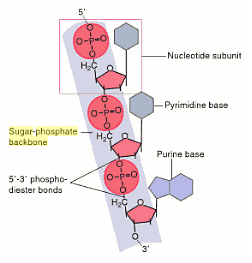
These alternate to form the ladder-like backbone of DNA​

What does the sugar and phosphate group do?

45

Multiple Select

What molecules are in nucleotides?

1

Phosphate group

2

Protein

3

Sugar

4

lipid

5

Nitrogenous base

46

media

Each nucleotide contains a Phosphate, sugar, and nitrogenous base.

Some text here about the topic of discussion.

What is a nucleotide?

47

media

48

Multiple Choice

What is the name of the sugar found in DNA?

1

adenine

2

ribose

3

deoxyribose

4

glucose

49

Multiple Select

What makes up a nucleotide? There is more than one answer.

1

sugar

2

RNA base

3

nitrogen base

4

phosphate group

media

Meiosis

Show answer

Auto Play

Slide 1 / 49

SLIDE