

sdsdd

Presentation
•
Social Studies
•
12th Grade
•
Practice Problem
•
Hard

Scott Savaiano
FREE Resource
10 Slides • 0 Questions
1

Unit 3 Lesson 2: Political & Behavioral Psychology
AIM: What are the sources of
political and social attitudes?
\Do Now: When you want to learn
more about a political or social
issue, where do you turn first for
information?
2


● In our last lesson in Unit 5 we talked about the
impact of attitudes on social and political behavior.
● For example, people may
○ vote for or against a candidate,
○ engage in protests or
○ advocate a specific opinion
● Question: What are the sources of these
attitudes?
Class Question 1
3


● Many sources come from everyday experience.
For example: your family.
● Work together as a group to come up with at
least one or two more sources, and let’s make a
class list.
● Copy down the ones that you hear during our
debrief that you didn’t already discuss as a
group.
Common sources
4


Identify one important attitude you hold about a social or political
issue from at least two of these sources:
● Family
● School
● Friends (including peer pressure)
● Social media
● Internet influencers, memes
● News media
● Religious texts
● Formative experiences (major life events, historical events)
Common sources - some
ideas, some attitudes?
5
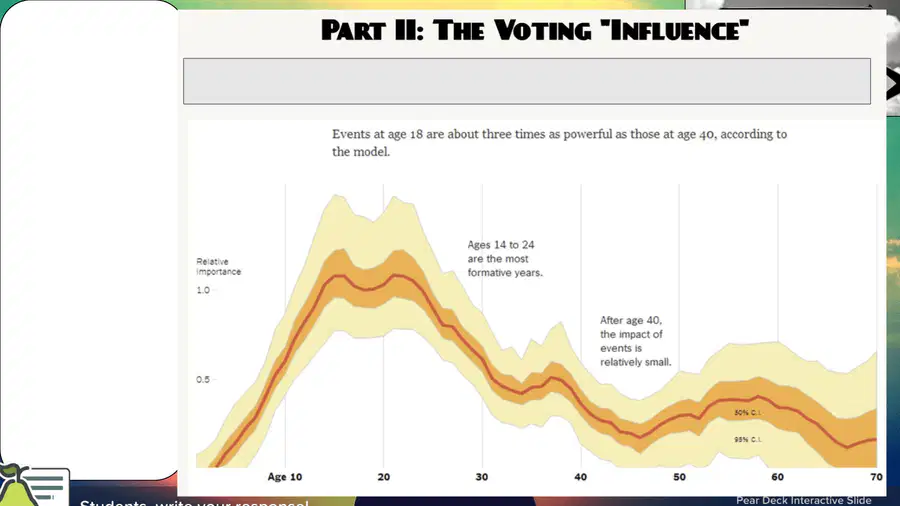
The impact
of
formative
ex-
periences
on voting
patterns:
what
are the
most
importa
nt
years?
Why?
6


● Based on the previous chart, “Formative Experience Theory”
explains socio-political attitude formation as a function of
“flashbulb” experiences (think of events like “The Great
Recession” or “the COVID Pandemic Shutdown).”
● Social identity theory OTOH argues it is not experiences but
group membership that determines attitudes, basically a
“System 1” decision that is made without our conscious control.
● Let’s use the Pew “National Public Opinion Reference Survey” (NOPRS)
to explore these theories. (Open the NOPRS SPSS file in SPSS)
The impact of experiences,
how strong is it?
7


1. Create frequency for the following variables:
a. PARTY, CRIMESAFE and GUNSTRICT
2. Copy and paste images of the tables into your presentation
3. Write one hypothesis based on “Formative Experience
Theory” about the expected relationship between
CRIMESAFE as an IV and GUNSTRICT as a DV.
4. Write one hypothesis based on Social Identity Theory about
the expected relationship between PARTY as an IV and
GUNSTRICT as a DV.
Group presentation: From
theory to hypothesis
8


What is Crosstabs
1. One of the most important and analytically powerful (useful)
functions in all of SPSS
2. Crosstabs = creating a table with two variables or
“crosstabulating” them.
3. Allows you to see how one variable changes across the
categories of another variable.
4. Limited to CATEGORY VARIABLES (includes ordinal though).
5. Not useful for continuous variables (interval and scale)
A new function in SPSS and
Data Analysis: Crosstabs!
9


1. Working along with me as the demonstrator, create the
Crosstabs in order
2. Paste the crosstabs output into your presentation.
3. Let’s work together to complete the “five steps” [see next page].
4. As pairs or in threes, create slides that “accept/reject” the
hypotheses, and discuss why.
Analyzing evidence for our
hypotheses (group)
10
5 Points to Discuss when
Analyzing results, assessing hypotheses
1. What are the results?
2. Does the “direction” of the results support the
hypothesis? For categorical variables, are the “Counts” +/-
the “Expected?” as hypothesized?
3. How big is the “effect”: How many Adjusted Residuals are
<= -2 or >= 2? How big is the chi-square?
4. Is the result “statistically significant?” What is the
p-value of the chi-square?
5. Should the hypothesis be accepted or rejected? Justify
why based on the previous evidence.
Unit 3 Lesson 2: Political & Behavioral Psychology
AIM: What are the sources of
political and social attitudes?
\Do Now: When you want to learn
more about a political or social
issue, where do you turn first for
information?
Show answer
Auto Play
Slide 1 / 10
SLIDE
Similar Resources on Wayground

8 questions
Sponge Bob
Presentation
•
University
7 questions
De la migración regulada a la mano de obra indocumentada
Presentation
•
12th Grade
8 questions
SSUSH6 Remediation
Presentation
•
12th Grade
7 questions
Mobilitas Sosial
Presentation
•
12th Grade
7 questions
Season of the year
Presentation
•
KG
6 questions
I'm Just a Bill
Presentation
•
12th Grade
6 questions
Branches of the Federal Government
Presentation
•
KG - 12th Grade
8 questions
BIMBINGAN KONSELING (SAJERAH, S.Pd :Training SLCC)
Presentation
•
12th Grade
Popular Resources on Wayground
19 questions
Naming Polygons

Quiz
•
3rd Grade
10 questions
Prime Factorization
Quiz
•
6th Grade
20 questions
Math Review
Quiz
•
3rd Grade
15 questions
Fast food
Quiz
•
7th Grade
20 questions
Main Idea and Details
Quiz
•
5th Grade
20 questions
Context Clues
Quiz
•
6th Grade
20 questions
Inferences
Quiz
•
4th Grade
19 questions
Classifying Quadrilaterals
Quiz
•
3rd Grade
Discover more resources for Social Studies
30 questions
AP Psychology Unit 4: Social Psychology and Personality
Quiz
•
12th Grade
48 questions
Civics EOC Practice Questions
Quiz
•
12th Grade
43 questions
U.S. History EOC Practice Questions
Quiz
•
12th Grade
50 questions
Economics Final Exam Review
Quiz
•
12th Grade
28 questions
Semester Review Part 1
Quiz
•
9th - 12th Grade
24 questions
Spring Semester Exam Part 2 Review
Quiz
•
9th - 12th Grade
10 questions
Exploring Financial Literacy and Personal Growth

Interactive video
•
9th - 12th Grade