

Development Planning

Presentation
•
•
Practice Problem
•
Easy

Katie Santala
Used 5+ times
FREE Resource
53 Slides • 12 Questions
1

Development Planning
Shaping the future now
2


3

Agenda
3
Employee journey
in today’s world
You in support of
employee
development
The toolkit and the
development
planning process
Constructing
development
items
Development
planning
conversations
4

Module 1
The Employee journey
4
5
Open Ended
What does being employee-centric mean for you both as an employee and as a leader of others?
6


Employee Value
Proposition (EVP)
– Focuses on what Sandvik offers to us,
the overall work experience, benefits,
and rewards.
– Supports creating employee-centric
“moments that matter” through entire
employee journey from attracting and
recruiting through off-boarding
Module 1
6
Employee Value Proposition

7

Our EVP enhances key
moments that matter
Module 1
7
Our integrated EVP delivers on our promise
to current and future employees
throughout the complete employee journey
Attract
Introduce
and onboard
Recruit
Engage
Perform
Reward
Develop in
new role
Leave as
a Sandvik
Ambassador
Develop
Grow
new roles at
Sandvik
Employee Value Proposition
8

Module 2
You in support of employee
development
8
9
Multiple Choice
What time of the year do Development Planning activities occur?
Q1
Q2
Q3
Q4
Throughout the year
10

Performance
Management
Cycle
– Individual development planning is
part of the overall Performance
Management cycle
– Conversations and collaboration are
ongoing!
9
Q1
Q2
Q3
Q4
Annual Salary
Review
Succession
and talent
reviews
QPulse
Mid-Year
Performance
Review
Performance Dialogues
Gather Feedback
Self-evaluation
Assess Potential
QPulse
QPulse
QPulse
Planning for 2024 Add
OKRs & Individual
Development Items
11
Open Ended
What is your role as a manger in supporting the development of your teams?
12


Roles and Responsibilities
Development Conversations
Employee
Manager
– Promote an inclusive culture of
continuous learning and
development
– Understand and communicate the
business vision and strategy
– Encourage and support employee’s
career development process
– Advise and coach employees on
appropriate development
opportunities, career moves, etc.
– Provide ongoing feedback on your
employee’s development
– Asks for progress updates from your
employees continuously
10
– Owner of their own career
development process
– Develop an understanding of the
competencies needed for success in
current role and future opportunities.
– Initiates ongoing career development
conversations with their manager
– Creates an action plan for own
development
– Asks for feedback from their manager
continuously
– Supports coworkers by sharing their
own knowledge and competences.
Human Resources
– Shares knowledge of the
process, steps and tools with the
management team and employees
– Coaches, supports and challenges
– Provides recommendations
about training opportunities
13
Poll
Sandvik Employee, Expert, and Leadership models
How many of you are familiar with Sandvi's Employee, Expert, and Leadership models that show the expectations of each type of employee?
I'm not familiar
I've heard they exist but don't know what is included
I am very familiar with them
I have a general idea
14

15

16

17

18


•Integral component of expectations
on all
•Shows awareness of personal
impact on others
•Stays curious, seeks feedback and
takes responsibility for own
development
•Is authentic and compassionate
•Acts with integrity and builds trust
Module 2
Self-awareness as a
leader and employee
16

19
Open Ended
What obstacles might be preventing you from building development plans?
20

Self awareness – Johari
Window
• 4 areas
• Traits and behaviors
• We are aware of, and others are as
well – “Open”
• We are aware of, but others are not –
“Hidden”
• We are not aware of, but others are –
“Blind spots”
• We are not aware of, and others are
not as well – “Unknown”
Module 2
17
Open area
Hidden
Unknown
Blind spot
Things I don’t know about me
Things others
know about me
Things I know about me
Things others
don’t know
about me
21
Multiple Select
Why should we use the Johari window as a tool to support the development efforts of others?
Build trust through sharing information about yourself.
Improve own self-awareness by discovering what other people think about you
Improve communication and team interpersonal relationships.
22

23

Self awareness
– Explore more about self awareness
– Strengthen Your Capabilities –
“Building Self-Awareness”
– Curated playlist
– LinkedIn Learning
Self Awareness courses, videos, collections
– SGL – Sandvik Global Leadership course
– Focus on importance of self-awareness
– Opportunities for reflection and growth as a
leader
Module 2
19
Photo credit: Vondrell Leadership
24

10 minute break
20
25

Module 3
The toolkit and development
planning
21
26
Multiple Choice
What are the components of the 70:20:10 approach to learning?
70% Job Experience
20% Collaboration
10% Formal Learning
70% Collaboration
20% Formal Learning
10% Collaboration
70% Formal Learning
20% Collaboration
10% Job Experience
27

The 70:20:10 Approach to Learning
•70% Job Experience
•20% Collaboration
•10% Formal Learning
Module 3
22
Learning on the job
Learning from
others
Participating in
Training
Classes
Intranet Page
28
Poll
Have you worked with your direct reports to establish on-the-job training as part of their development planning?
Yes
No
29

Employee Development Planning timeline snapshot
30
31
Multiple Choice
Whose responsibility is it ultimately to drive learning and development at Sandvik?
Managers
Employees
Senior Leaders
Human Resources
32
Multiple Choice
You have collaborated with your team, approved development plans and they have been added to Workday. As a manager are your responsibilities completed?
Yes
No
33


–Solo brainstorming session
–Starting point in any gap
analysis
– What skills am I good at in my role?
– What skills do I need to improve or
grow in my current role?
– What behaviors in the Sandvik
employee model do I need to work on
developing further?
–Template provided
Module 3
Step 1: Where am I right
now?
25

34

DEVELOPMENT PLANNING FOR EMPLOYEES - Dan Gauthier
STEP 1: Where am I right now?
Development Planning
STEP 1: Where am I right now?
Page 1 of 1
Skills I am good at in my current role
Skills I want/need to improve in my current role
and skills I need to have for roles I am interested in
Strategy Development
Negotiation
People Leadership/Performance Management
Holistic Business Approach - outside of ROTO
Communication
Knoweldge of Divisions outside of Rock Tools
Business forecasting and planning
Business Development
35

Use Step 1 of the template to document one or
two skills you are good at and one or two skills
you wish to improve.
26
36


–What do I enjoy doing?
–What am I doing when I feel
most excited or motivated at
Sandvik?
–Do I prefer leading a group,
working with peers or working
alone?
–What energizes me? What
drains my energy?
–What other roles at Sandvik
am I interested in?
–Step 2 template provided
Module 3
Step 2: Where do you want
to go?
27

37

DEVELOPMENT PLANNING FOR EMPLOYEES - Dan Gauthier
STEP 2: Where do I want to go?
Development Planning
STEP 2: Where do I want to go?
Page 1 of 1
Question
My input
What do I enjoy doing?
What am I doing when I feel most excited or
motivated working at Sandvik?
Do I prefer leading a group, working with peers or
working alone?
What energizes me at Sandvik?
What other roles at Sandvik am I interested in?
What are my career ambitions?
How does my current role fit with my career
vision/ambitions?
Connecting with people, helping others, learning about our business and our
customers
Developping ideas that can further our organization
I love them all equaly but in different situations
The sheer opportunities both internally and externally
SA Leadership, Division/Product Line Leadership
SA Leadership, Division/Product Line Leadership
It is a good starting point and provides opportunities to prepare myself these
roles.
38

Use Step 2 of the template to focus on
“Where do I want to go?”
28
39


Step 3: Identify the gaps
Module 3
29

40

41

Use Step 3 to input one or two skills and
complete the template for those one or two
skills.
30
42


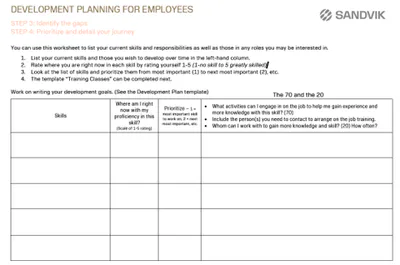
Step 4: Prioritize to start drafting your journey
Current responsibilities, tasks, future role interests
– Prioritize the list of skills
– Your choice – can be ones with biggest gap,
immediate need, biggest interest
– Answer questions in last column to focus on the
70 and 20
– What activities can I engage in on the job to increase
my skill with . . .?
– Whom do I need to contact?
– Whom can I work with?
Module 3
31
43


Step 4: Prioritize to start drafting your journey (cont’d.)
Current responsibilities, tasks, future role interests
– “The 10” - Training Courses, Certifications,
Degrees
– List any training courses you wish to complete.
– Should support development items
– Include activities you will engage in after the course
to apply your learning on the job.
– Explore existing platforms
– Workday Learning
– Strengthen Your Capabilities
– LinkedIn Learning
– Adobe Learning
Module 3
32

44

45

STEP 5 – The rest is up to you!
We can’t say “this is the final step” because
the next step begins the real process of
working to achieve your development goals.
Invest in yourself to make it happen!
Step 5 has a several components
33
46
Open Ended
Do you see any obstacles that might make it difficult to implement these toolkits with your employees?
47
Open Ended
Take a few minutes to reflect on your own development.
Will you do anything differently moving forward regarding your own development as a leader?
48

Module 4
Constructing development items
35
49


Objectives and Key Results (OKR)
Module 4
I will have 100% of my team’s development plans in
Workday by March 29 as measured by
•Conducting development planning training by
December 15,
•Completing development planning discussions
with each team member by March 1
•Approving development plans that have been
added to Workday by March 29
36
Example

50


Objectives and Key Results (OKR) samples
– I will increase my skills at facilitation by
end of Q1 2024, as measured by
– facilitating 3 upcoming project updates with
the team, getting feedback from them and my
facilitation coach
– facilitate a new hire training session by the
end of Q4 and gain feedback on
effectiveness.
– meet once per month with my facilitation
coach to discuss progress and areas of
growth.
– I will increase my technical skills with
BEV by end of 2024, as measured by
– successful completion of the SAE
International BEV course with a 90 or greater
score on assessment,
– participating in each monthly meeting with
the Control Systems team,
– attending 2 product launches
– participating in 2 product testing activities.

51

Practice
Write out one or two goals based on your own input
regarding skills development.
38
52

Module 5
Development Planning
Conversations
39
53


Roles and Responsibilities
Development Conversations
Employee
Manager
– Promote an inclusive culture of
continuous learning and
development
– Understand and communicate the
business vision and strategy
– Encourage and support employee’s
career development process
– Advise and coach employees on
appropriate development
opportunities, career moves, etc.
– Provide ongoing feedback on your
employee’s development
– Asks for progress updates from your
employees continuously
40
– Owner of their own career
development process
– Develop an understanding of the
competencies needed for success in
current role and future opportunities.
– Initiates ongoing career development
conversations with their manager
– Creates an action plan for own
development
– Asks for feedback from their manager
continuously
– Supports coworkers by sharing their
own knowledge and competences.
Human Resources
– Shares knowledge of the
process, steps and tools with the
management team and employees
– Coaches, supports and challenges
– Provides recommendations
about training opportunities

54


Preparation for
Development
Conversations
Employee Preparation
– One (+) month prior to
development conversation:
– Meet with and go through
development planning toolkit with
employees
– Give employees 3 weeks (approx.) to
complete prior to development
conversation
– 1-2 weeks prior to development
conversation:
– Review:
– Past IDP discussions and plans
– SMR strategic direction and
business needs
– Possible upskilling opportunities
– Your view of employee’s areas of
strength with specific examples and
growth opportunities
Manager Preparation
– One (+) month prior to
development conversation:
– Meet with manager to go through
development planning toolkit
– Set meeting date (3+ weeks out) for
development conversation
– 3+ weeks prior to development
conversation:
– Work on and complete development
planning toolkit
– Confirm meeting date, time and
location with manager to discuss
and finalize
– Plan to bring completed templates to
meeting.
Module 5
41

55


Think about:
– Have you allocated a decent amount of
time for the meeting?
– Is the surrounding environment
conducive to concentrating on the
discussion?
– What questions will you ask?
– Are they open-ended questions to
generate discussion with the employee?
– Are you focused on actively listening to
your employee to understand and not
to simply reply?
– Are you prepared to drill deeper into
discussions to get to the heart of any
matters?
Module 5
Development
Conversations – day of the
meeting
42

56


– Overview of meeting
– Manager welcomes employee, safety overview,
catches up and shares agenda,
– Discuss strengths (from Step 1 template)
– Employee goes first
– Manager goes next
– Discuss areas of growth (from Step 1 template)
– Employee goes first
– Manager goes next
– Manager and employee discuss any additional
opportunities not considered
– Employee drives discussion of current
proficiencies, priority skills and activities for
development and training classes (70 20 10)
– Manager and employee review final
development items –i.e. do they pass the “SMART” test, etc.?
– Manager gives verbal approval and next step
(employee to enter plans into Workday)
Module 5
Development
Conversations - Agenda
43

57


44

58


45

59


46

60

47
61


Best practices for
development
planning
conversations
Best practices
– Employee owns their
development and does the
“heavy lifting” when creating
their development plan draft
– Use the templates and instructions
– Collaboration with employee is
key
– Allow the employee to lead
discussion when offering areas
of strength and growth
– Ask open ended questions during
discussions
– Managers share ideas for
development opportunities, but
employees should have ultimate
say.
Avoid
– Manager doing the majority of
the work – this is employee’s
responsibility
– Manager “telling” as opposed to
asking
– Leads to not being heard
– Negatively affects employee
investment in self-development
– Adversely affects employee
engagement
– Waiting until the last minute to
plan for development
conversations
Module 5
48

62


What’s Next?
Module 5
–Study the toolkit to become
more familiar with the
content and process
–Set appointment(s) with your
direct reports
– at least one month before
scheduling development
conversation to go through the
toolkit.
– for development conversations
about 4-6 weeks after going
through the toolkit.
49

63

Resources
Articles, Courses, Podcasts on Employee Development
Module 5
50


64
Employee Development Planning timeline snapshot
65


Thank you!
52

Development Planning
Shaping the future now
Show answer
Auto Play
Slide 1 / 65
SLIDE
Similar Resources on Wayground

62 questions
The Periodic Table
Presentation
•
8th Grade
58 questions
Food and our Health
Presentation
•
8th Grade
58 questions
Theoretical and Experimental Probability
Presentation
•
7th Grade
60 questions
Israeli- Palestinian Conflict
Presentation
•
10th Grade
59 questions
Discrete and Continuous graphs
Presentation
•
7th - 10th Grade
60 questions
Bill of Rights
Presentation
•
9th Grade
61 questions
EOG Review | Local & Global Weather Patterns
Presentation
•
5th Grade
61 questions
Industrial Revolution
Presentation
•
6th - 8th Grade
Popular Resources on Wayground
10 questions
Safety Day 2026 – Student Review

Quiz
•
9th Grade
21 questions
Continents and Oceans
Quiz
•
6th Grade
20 questions
Parts of Speech
Quiz
•
5th Grade
16 questions
Subject & Predicate
Quiz
•
5th Grade
25 questions
Multiplication Facts
Quiz
•
5th Grade
12 questions
Map Skills
Quiz
•
3rd Grade
22 questions
Continents and Oceans
Quiz
•
5th Grade
15 questions
Rounding Decimals
Quiz
•
5th Grade
Discover more resources for
10 questions
Safety Day 2026 – Student Review
Quiz
•
9th Grade
21 questions
Continents and Oceans
Quiz
•
6th Grade
20 questions
Parts of Speech
Quiz
•
5th Grade
16 questions
Subject & Predicate
Quiz
•
5th Grade
25 questions
Multiplication Facts
Quiz
•
5th Grade
12 questions
Map Skills
Quiz
•
3rd Grade
22 questions
Continents and Oceans
Quiz
•
5th Grade
15 questions
Rounding Decimals
Quiz
•
5th Grade