Search Header Logo
8.11.1-The View from Earth

8.11.1-The View from Earth

Assessment

Presentation

•

Mathematics

•

8th Grade

•

Medium

•
CCSS
RL.1.10, RI.5.5, HSF-IF.C.7E

+7

Standards-aligned

Created by

Jessica Freeman

Used 3+ times

FREE Resource

65 Slides • 54 Questions

1

media

​

2

media

3

Chapter 11
Stars & Galaxies
Lesson 8.11.1-The View from Earth


Mrs. Freeman's Classroom (Notes to Print

4

media

​

5

media

6

8.10.1-The View from Earth

  • From Earth, objects in the sky APPEAR TO move from EAST to WEST.

  • The stars at night travel in a COUNTERCLOCKWISE CIRCLE around POLARIS, the NORTH STAR.

  • Earth's rotation gives the stars the appearance of motion.

  • The stars (with the exception of the sun) are in fixed positions and do not move with respect to one another.

​Topic; "Moving Stars"

7

media

Chapter 11-Stars & Galaxies
Lesson 8.11.1-The View from Earth

Let's take a look at the first question we will answer:

1. How do astronomers divide the night sky?

2. What can astronomers learn about stars from their light?

3. How do scientists measure distance and brightness of objects in the sky?

​1.

8

What Can You See in the Night Sky?

  • A star is a giant ball of hot gas, mainly composed of hydrogen and helium.

  • A constellation is a pattern or group of stars that people imagine to represent a figure, animal, or object.

  • A star chart can help you find constellations in the night sky.

9

How Do Objects in the Sky Appear to Move?

  • Stars, planets, and other objects move in space, but their actual motions and their apparent, or visible, motions may be very different.

  • The apparent motion of objects in the sky depends on the motions of Earth.

10

What Can You See in the Night Sky?

  • On a clear night, you may see stars, the moon, planets, meteors, and comets.

  • The moon is Earth’s only natural satellite.

  • A satellite is a body that orbits a planet.

11

Multiple Choice

The apparent motion of objects in the sky depends on what?

1

The movement of Earth

2

The movement of the galaxy

3

The movement of the planets

4

The movement of the sun

12

Multiple Select

If you look up in the sky on a clear night what could you all see?

1

Meteors

2

Planets

3

Moon

4

Stars

5

Comets

13

What Can You See in the Night Sky?

  • A planet is a object that orbits the sun, is large enough to to have become rounded by its own gravity, and has cleared the area of it orbit.

  • Five planets are visible from Earth without a telescope: Mercury, Venus, Mars, Jupiter, & Saturn.

14

What Can You See in the Night Sky?

  • A star is a giant ball of hot gas, mainly composed of hydrogen and helium.

  • A constellation is a pattern or group of stars that people imagine to represent a figure, animal, or object.

  • A star chart can help you find constellations in the night sky.

  • Our sky is divided into 88 constellations.

15

Multiple Choice

What is a pattern or group of stars that people imagine to represent a figure, animal, or object?

NOTE: Our sky is divided into 88 of these.

1

Planet

2

Constellation

3

Stars

4

Moon

16

Multiple Choice

What is a giant ball of hot gas, mainly composed of hydrogen and helium?

1

Comet

2

Meteor

3

Asteroid

4

Star

17

How Do Objects in the Sky Appear to Move?

  • Stars, planets, and other objects move in space, but their actual motions and their apparent, or visible, motions may be very different.

  • The apparent motion of objects in the sky depends on the motions of Earth.

18

Multiple Choice

The apparent motion of objects in the sky depends on what?

1

The movement of Earth

2

The movement of the galaxy

3

The movement of the planets

4

The movement of the sun

19

How Do Objects in the Sky Appear to Move?

  • Stars generally appear to move from east to west through the night.

  • This apparent motion is caused by Earth’s turning from west to east.

  • The sun’s apparent motion during the day is also caused by Earth’s motion.

20

Multiple Choice

It seems the stars move from what direction to what direction?

1

East to west

2

West to east

3

North to south

4

South to north

21

How Do Objects in the Sky Appear to Move?

  • Which constellations you can see varies from season to season.

  • These seasonal changes are caused by Earth’s orbit around the sun.

  • Each night, the position of most stars shifts slightly to the west.

22

Multiple Choice

Why do you see different constellations based on the season?

1

It’s based on Earth’s orbit around the sun

2

It’s based on the moon’s orbit around the Earth

3

It based on the sun’s orbit around the Earth

23

How Do Objects in the Sky Appear to Move?

  • Because the planets all orbit the sun in about the same plane, they appear to move through a narrow band in the sky.

  • This band is called the zodiac.

24

Multiple Choice

What is the narrow band the planets seem to move through in the sky called?

1

Zodiac

2

Constellations

3

Planets

25

Multiple Choice

What is a pattern or group of stars that people imagine to represent a figure, animal, or object?

1

Planet

2

Constellation

3

Stars

4

Moon

26

Multiple Choice

What is a giant ball of hot gas, mainly composed of hydrogen and helium?

1

Comet

2

Meteor

3

Asteroid

4

Star

27

Multiple Choice

The apparent motion of objects in the sky depends on what?

1

The movement of Earth

2

The movement of the galaxy

3

The movement of the planets

4

The movement of the sun

28

Multiple Choice

It seems the stars move from what direction to what direction?

1

East to west

2

West to east

3

North to south

4

South to north

29

Multiple Choice

Why do you see different constellations based on the season?

1

It’s based on Earth’s orbit around the sun

2

It’s based on the moon’s orbit around the Earth

3

It based on the sun’s orbit around the Earth

30

Multiple Choice

What is the narrow band the planets seem to move through in the sky called?

1

Zodiac

2

Constellations

3

Planets

31

Multiple Choice

Constellations and star patterns _________year after year, but which ones you can see varies seasonally.

1

change drastically

2

alternate positions

3

remain the same

4

are unreliable

32

Through the year

We see different constellations at different times of the year. For example, Orion is easy to see from November to February but it cannot be seen from May to July.

media

33

Through the year

It takes one year for the Earth to travel all the way round its orbit. The diagram shows the position of the Earth in January and in July.


To see the stars, you need to be on the dark side of the Earth. The diagram shows why you will see different stars in January and July.

media

34

8.10.1-The View from Earth

  • Stars emit much more than visible light.

  • Stars emit their energy as electromagnetic waves, of which visible light is only a narrow band.

  • Different telescopes can collect the various wavelengths of electromagnetic radiation emitted by the stars.

  • Spectroscopes spread starlight into its different wavelengths to show each star's unique spectrum.

​Topic: Star Light, Star Bright

35

media

Chapter 11-Stars & Galaxies
Lesson 8.11.1-The View from Earth

Let's take a look at the first question we will answer:

1. How do astronomers divide the night sky?

2. What can astronomers learn about stars from their light?

3. How do scientists measure the distance and brightness of objects in the sky?

​2.

36

media

37

38

media

39

40

media

41

media

42

media

43

Multiple Choice

Stars and galaxies release energy. We see this energy as ...

1

visible light (colors)

2

mechanical sound waves

3

heat

4

satellites

44

Multiple Choice

Question image

Which element(s) are found in the star's spectra below?

(Compare the first line to the bottom 3)

1

Hydrogen only

2

Hydrogen & Helium

3

Calcium only

4

Hydrogen & Calcium

45

Multiple Choice

Question image

A sample of gas is analyzed, producing the spectrograph in the image. Identify which element the sample is mostly made-up of?

Which of the 5 bottom images are most closely related to the top image?

1

Hydrogen

2

Helium

3

Neon

4

Mercury

46

Multiple Choice

Question image

What gases are in the unknown mixture?

Which images (a-d) are most closely related to "unknown mixture?"

1
Gas B & Gas D
2
Gas C & Gas B
3
Gas A & Gas D
4
Gas D & Gas C

47

Multiple Choice

Question image

Which of the following has the shortest wavelength?

1

microwaves

2

UV rays

3

Infrared

4

the color blue

48

Multiple Choice

Question image
High frequency waves have _________ wavelengths.
1
varying
2
long
3
short

49

media

50

Multiple Choice

Question image
Which has the SHORTEST wavelength and, therefore, the highest frequency/most energy
1
Radio waves
2
Ultraviolet Rays
3

Gamma (γ) Rays

4
X-rays

51

Multiple Choice

Question image

A ___ is used in astronomy to break down light like a prism.

1

telescope

2

spectroscope

3

stethoscope

4

microscope

52

Multiple Choice

Question image

Emission spectra emitted by an element (or compound) will produce ___ through a spectroscope.

1

bright lines

2

a continuous rainbow

3

dark lines

4

white light

53

Multiple Choice

Question image
The blue section of the wave is measuring _________________.
1
wavelength
2
crest
3
trough
4
amplitude 

54

Multiple Choice

What information does a spectrograph provide?

1

The age of a star.

2

What elements are in a star.

3

When the star was formed.

4

The density of stars

55

Electromagnetic Spectrum Review

media

56

media

57

Multiple Choice

Question image

What information about stars can be learned by using a spectroscope

1

chemical composition

2

distance from Earth

3

size

4

speed

58

media

59

8.10.1-The View from Earth

  • To measure distances within the solar system, astronomers use the astronomical unit (AU) or about 150,000,000 km.

  • For greater distances, such as Earth to other stars, scientists use the LIGHT-YEAR.

  • A LIGHT-YEAR is a distance that light will travel in 1 year, a distance of about 10 trillion km.

  • The nearest star, PROXIMA CENTAURI is about 4.2 light-years from Earth.

  • That is a distance of about 42 trillion km or 28 million AUs!

​Topic: Distances in Space

60

How do we MEASURE distances in space?

Astronomical Unit vs Light Year

media

61

Multiple Choice

A huge collection of stars , gas and dust

1

Universal

2

Universe

3

Galaxy

4

Solar system

5

Inner and Outer planets

62

Multiple Choice

Question image

Which of the following list the correct hierarchy in the Universe from biggest to smallest?


¿Cuál de las siguientes enumera la jerarquía correcta en el Universo de mayor a menor?

1

Universe, galaxies, solar system, stars and planets

2

Planets, stars, solar system, galaxies, universe

3

Solar system, galaxies, stars, planets, universe

4

Universe, solar system, galaxies, planets and stars

63

media

64

media

65

media

66

Multiple Choice

An astronomical unit is...

1

The average distance between the Earth and the Sun

2

The average distance between the Sun and Neptune

3

The diameter of the sun

4

The time it takes light to travel across our solar system

67

Multiple Choice

Astronomical units are used for....

1

Distances within a solar system

2

Distances between solar systems

3

Distances within galaxies

4

Distances between galaxies

68

Speed of light = Speed


Time = Years


Light Years = Distance

media

69

media

70

Multiple Choice

Light years are a measure of

1

time

2

speed

3

distance

4

light

71

Multiple Choice

A light year is...

1

The speed light travels

2

How long it takes light to get to you from the sun

3

The distance light can travel in a year

4

How many years it takes light to be emitted

72

Multiple Choice

A light-year is a measure of

1

time

2

speed

3

distance

4

brightness

73

Multiple Choice

What travels the FASTEST?

1

Light

2

Sound

3

You

74

Multiple Choice

How long does it take light from the Sun to reach us?

1

8 minutes

2

1 light year

3

5 milllion years

4

17 days

75

Multiple Choice

The distance light can travel in one year is ______________

1

15,000 kilometers

2

1 light-year

3

15 Astronomical Units

4

6,000 miles

76

Multiple Choice

Why do we use light years and astronomical units to measure distances in space?

1

Scientists want to sound smart.

2

Hubble discovered these units and wanted to use them.

3

Space is too small to use km, it wouldn't make sense.

4

Space is too big, vast, enormous to use traditional units, like miles.

77

media

78

media

79

media

80

media

81

media

82

media

Chapter 11-Stars & Galaxies
Lesson 8.11.1-The View from Earth

Let's take a look at the first question we will answer:

1. How do astronomers divide the night sky?

2. What can astronomers learn about stars from their light?

3. How do scientists measure the distance and brightness of objects in the sky?

​3.

83

8.10.1-The View from Earth

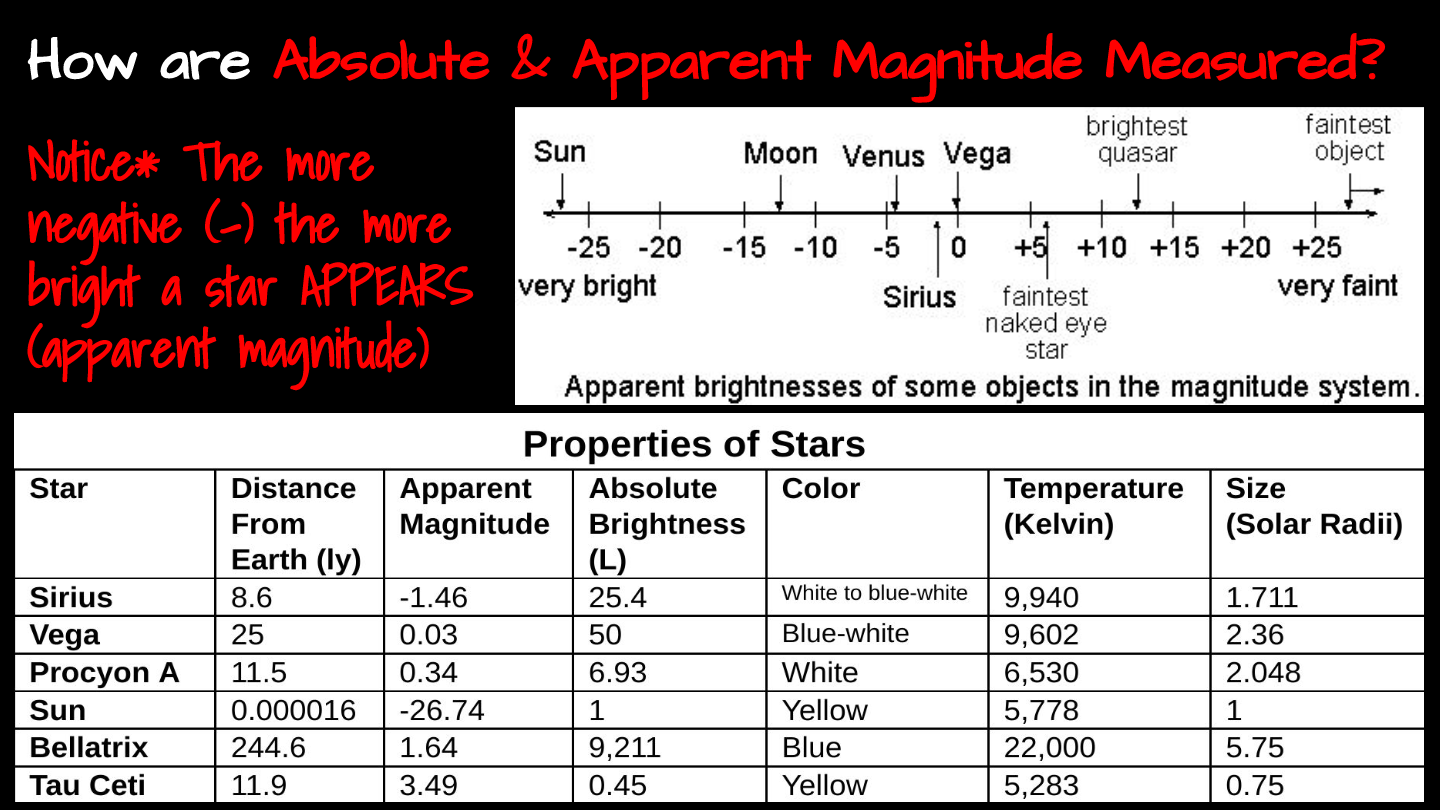
  • A star's brightness depends on its distance from Earth AND its luminosity, or true brightness.

  • Apparent Magnitude is a measure of how bright a star or other object looks from Earth.

  • Absolute Magnitude, also luminosity, is a measure of the star's actual brightness, which is dependent on its temperature AND size.

​Topic: Star Brightness

84

media

85

media

86

media

87

Multiple Choice

Question image

Most stars are made of which elements?

1

Hydrogen only

2

Hydrogen and Lithium

3

Hydrogen and Sodium

4

Hydrogen and Helium

88

media

89

media

90

91

media

92

media

93

Multiple Choice

Which might change, depending on the DISTANCE to a star?

1

Absolute Brightness

2

Apparent Magnitude

94

Multiple Choice

If a scientist needs to calculate the luminosity of a star, what information would they need?

1

Distance

2

Apparent Magnitude

3

Temperature

4

Distance and Apparent Magnitude

95

media

96

media

97

Multiple Choice

Question image

Which Star is the HOTTEST?

1

Blue

2

Red

3

Orange

4

Yellow

98

Multiple Choice

Question image
In the diagram given, what happens as we move to the left?
1
Stars Get Larger
2
Stars get Colder
3
Stars get hotter

99

Multiple Choice

Question image
Which star is the coldest?
1
Yellow Star
2
Red Star
3
Orange Star
4
Blue Star

100

Remember, when determining how HOT a star is, color matters!

RED stars are the coolest

Yellow and Orange stars are moderate

Blue and White stars burn the hottest

101

Multiple Choice

Which one physical property that all stars have?

1

They are made of gases.

2

They shine very brightly

3

They have a triangular shape

4

They contain iron in their cores

102

Multiple Choice

Which characteristic is used to measure the amount of llight radiated by a star?

1

size

2

color

3

luminosity

4

temperature

103

Multiple Choice

Which color are the hottest stars?

1

blue

2

orange

3

red

4

yellow

104

Multiple Choice

What is a large celestial body that is composed of gas and emits light?

1

Planet

2

Nebula

3

Moon

4

Star

105

Multiple Choice

All planets in our solar system orbit the sun because of the Sun's gravity.
1
True 
2
False 

106

Multiple Choice

________________ is the brightness of a star as seen from earth.

1

luminosity

2

apparent magnitude

3

absolute magnitude

4

star brightness

107

Multiple Choice

___________ is a measure of how bright a star would be if it were seen from a standard distance

1

luminosity

2

absolute magnitude

3

apparent magnitude

4

star brightness

108

Multiple Select

The closest star to earth is

1

Polaris

2

the North Star

3

the sun

4

Tatooine

109

Multiple Choice

Question image

What is the approximate surface temeprature of the sun according to the HR diagram?

1

5,500 K

2

6,000K

3

7,200 K

4

15,000K

110

media

111

Multiple Choice

Question image

Two stars are identified on the Hertzsprung-Russell diagram below.

Based on this diagram, how do the characteristics of Star 1 and Star 2 compare?

1

Star 1 is cooler and less bright than Star 2

2

Star 1 is hotter and brighter than Star 2

3

Star 1 is cooler and brighter than Star 2

4

Star 1 is hotter and less bright than Star 2

112

media

113

media

114

media

115

media

116

media

117

media

118

media

119

media
media

​

Show answer

Auto Play

Slide 1 / 119

SLIDE