

6.2 b: pH and pOH

Presentation
•
Science
•
12th Grade
•
Practice Problem
•
Easy

Erin Hannan
Used 5+ times
FREE Resource
15 Slides • 4 Questions
1
6.2 b: calculate pH, pOH, hydrogen ion concentration ([H+ ]) and hydroxide ion concentration ([OH– ]) for a range of solutions
d: write ionic equations to represent the dissociation of acids and bases in water, conjugate acid/base pairs in solution and amphiprotic nature of some salts, for example:
– sodium hydrogen carbonate
– potassium dihydrogen phosphate
2
What we will learn:
Recap - definitions of acids and bases
recap - types of equations
pH definition
Calculating pH given H+ concentration
pOH definition
Calculating pOH given OH- concentration
3
Types of equations
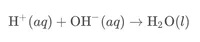
When we are dealing with neutralisation reactions, we can present them in several different equation types:
Neutral species - complete equation with all reactants and products fully formed into compounds
Complete ionic - complete equations with all reactants and products but split into ions
Net ionic - only presents the chemical species that are involved in the reaction (in neutralisation reactions, only the water, as all other species are ionised into it)


4
Definitions of acids and bases
Arrhenius and Bronsted-Lowry
Arrhenius:
- acids produce H+ in solutions
- bases produce OH- in solutions
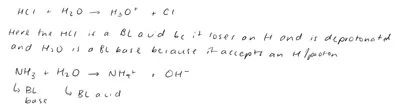
Bronsted-Lowry
- acids are proton donors
- bases are proton acceptors
- 'proton' essentially meaning a H molecule - makes sense with Arrhenius because when a H loses an electron, only a proton is left in the nucleus
5
Which is the 'better' theory?
Bronsted- Lowry
- explains the behaviour of acids and bases outside of water, but also useful in other solvents
- explains the behaviour of bases without an OH
- allows use of conjugate acids and bases
- limitations are explained by Lewis theory - describes them as electron pair donors and acceptors
6
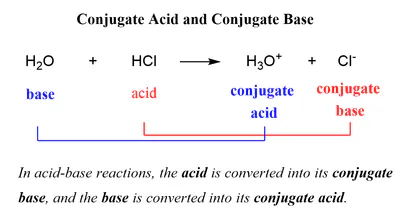
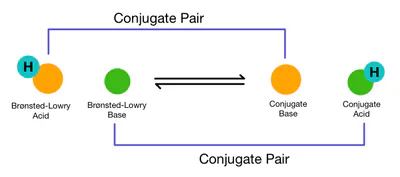
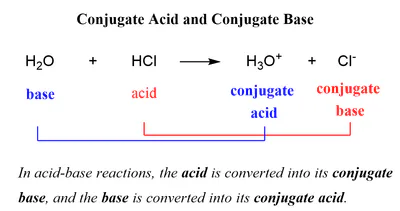
Conjugate acids and bases
7
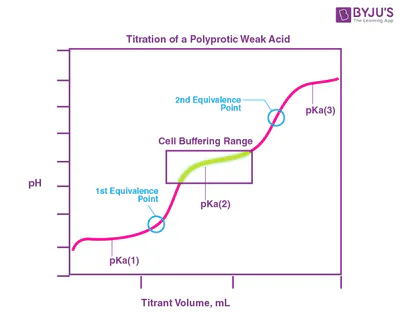
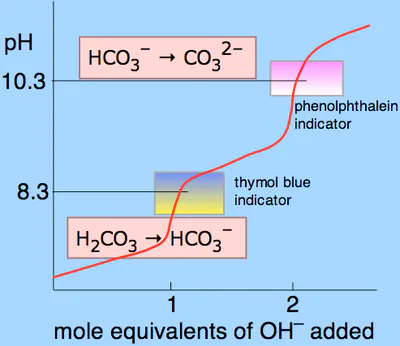
Amphiprotic and polyprotic acids
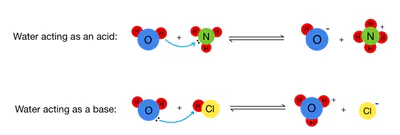
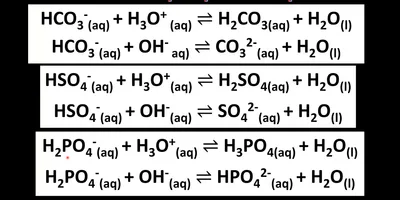
Amphiprotic substances are able to both donate and accept a proton - therefore, can act as either an acid or a base
It will act as an acid when it reacts with a stronger base, and will act as a base if it reacts with a stronger acid
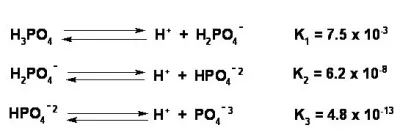
A polyprotic substance has the ability to donate more than one proton
Diprotic - can donate two. Triprotic - can donate three
8
Amphiprotic acids
9
Polyprotic acids
10
pH definition
log measurement of the amount of H+ in a solution
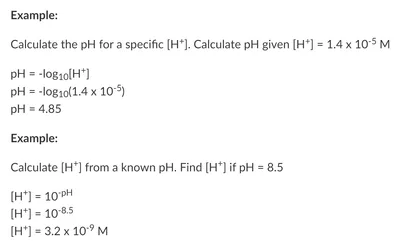
pH = -log10[H+]
pH is measured on a logarithmic scale, so a single digit change really means a 10-fold change
smaller pH value = higher concentration of H+ = more acidic

11
pH definition
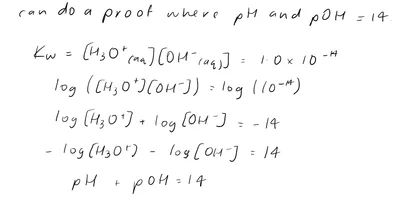
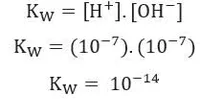
there is a quantitative relationship between the pH and pOH that becomes self-evident when describing the autoionisation of water and observing the mathematical proof of Kw
where Kw = [H+][OH-]
12
Calculating pH
13
Open Ended
Calculate the pH of a substance with a [H+] of 0.0010
14
Open Ended
Calculate the [H+] of a substance with a pH of 4.35
15
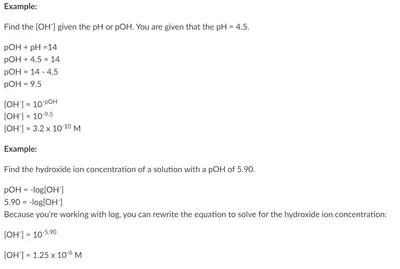
Calculating pOH
16
Open Ended
Calculate the pOH of a substance with a [OH-] of 6.3 x 10⁻⁸ M
17
Open Ended
Calculate the [OH-] of a substance with a pOH of 7.9
18
Self ionisation of water
mostly water is happy by itself, but sometimes it self-ionises and gives away a H+ --> meaning that it becomes OH- and the H+ will join with another water molecule to become H3O+
H2O⇌H3O++OH−
Kw=[H3O+][OH−]=1.0×10⁻¹⁴ at 25°C
because pH + pOH = 14
Can use this to calculate ion concentrations in solution when you know one unknown
19
Next up
strengths of acids and bases
6.2 b: calculate pH, pOH, hydrogen ion concentration ([H+ ]) and hydroxide ion concentration ([OH– ]) for a range of solutions
d: write ionic equations to represent the dissociation of acids and bases in water, conjugate acid/base pairs in solution and amphiprotic nature of some salts, for example:
– sodium hydrogen carbonate
– potassium dihydrogen phosphate
Show answer
Auto Play
Slide 1 / 19
SLIDE
Similar Resources on Wayground

16 questions
Adaptations for Gas Exchange
Presentation
•
12th Grade
14 questions
Foundations of A&P 1.3
Presentation
•
11th - 12th Grade
15 questions
ROTASI
Presentation
•
11th Grade
18 questions
Cellular respiration
Presentation
•
11th - 12th Grade
14 questions
La libertad 1. Qué es la Ilustración
Presentation
•
KG
14 questions
Geometry - Lesson ASA and AAS
Presentation
•
12th Grade
16 questions
Genetics Intorduction
Presentation
•
KG
15 questions
Chapter 6 - Water and Dietary Fibre
Presentation
•
12th Grade
Popular Resources on Wayground
10 questions
Safety Day 2026 – Student Review

Quiz
•
9th Grade
21 questions
Continents and Oceans
Quiz
•
6th Grade
20 questions
Parts of Speech
Quiz
•
5th Grade
16 questions
Subject & Predicate
Quiz
•
5th Grade
25 questions
Multiplication Facts
Quiz
•
5th Grade
12 questions
Map Skills
Quiz
•
3rd Grade
22 questions
Continents and Oceans
Quiz
•
5th Grade
15 questions
Rounding Decimals
Quiz
•
5th Grade
Discover more resources for Science
7 questions
Newton's Laws Video Quiz

Interactive video
•
9th - 12th Grade
35 questions
Cell Transport/Enzyme/Cell/Macro Review
Quiz
•
9th - 12th Grade
13 questions
Explore Enzyme Functions and Interactions
Quiz
•
9th - 12th Grade
10 questions
Fact or Fiction: Microbes
Quiz
•
9th - 12th Grade
10 questions
Understand Cell Functions and Organelles
Quiz
•
9th - 12th Grade
19 questions
Explore Macromolecules in Living Organisms
Quiz
•
9th - 12th Grade
15 questions
Layers of Atmosphere passage

Passage
•
9th - 12th Grade
22 questions
Quiz Review Day 5 Water and Macromolecules
Quiz
•
9th - 12th Grade