8.11.2-The Sun & Other Stars
Presentation
•
Mathematics
•
8th Grade
•
Medium
+9
Standards-aligned
Jessica Freeman
Used 2+ times
FREE Resource
79 Slides • 71 Questions
1
2
Chapter 11
Stars & Galaxies
Lesson 8.11.1-The View from Earth
Mrs. Freeman's Classroom (Notes to Print
3
Below, highlighted in GREEN, are the concepts we will discuss in this lesson. You should understand each of these concepts.
THINK
about
these
Concepts!
4
5
Be sure to use your textbook, Chapter 11, Lesson 2 to complete your vocabulary in your notes pages!
6
Follow the slides to complete your notes pages!
7
8
Chapter 11-Stars & Galaxies
Lesson 8.11.2-The Sun & Other Stars
Let's take a look at the first question we will answer:
1. How do stars shine?
2. How are stars layered?
3. How does the Sun change over short periods of time?
4. How do scientists classify stars?
1.
2.
9
8.11.2-The Sun & Other Stars
NUCLEAR FUSION in the core of a typical star FUSES hydrogen atoms.
THAT process PRODUCES helium and releases vast amounts of energy. THINK CHEMICAL REACTIONS PRODUCE LIGHT!
LIGHT ENERGY makes its way from the CORE to the star's atmosphere.
The SUN is a TYPICAL STAR, with a core, a radiative zone, and a convection zone in its interior AND photosphere, a chromosphere, and a corona in its atmosphere.
Topic: Energy Production and Movement
10
The Sun - Basic Facts (this is important)
The sun is a yellow dwarf star.
It is powered by nuclear fusion.
It takes 8 minutes for radiation from the sun to reach Earth.
11
Multiple Choice
Which planet is closest to the sun?
12
Burning implies combustion and fire. The sun isn't made of fire.
** The sun is made of super heated plasma (Hydrogen) that undergoes fusion.
The sun isn't burning!
13
Occurs on Earth in nuclear power plants and atomic bombs. Large unstable elements like uranium are broken apart to make smaller more stable elements like lead.
Nuclear Fission
Hydrogen (H+) atoms combine to form Helium (He) which releases a large amount of energy. Stars make heavier elements by further combining atoms.
Nuclear Fusion
Energy is produced through fusion
14
15
Multiple Choice
How long does it take for the light from the sun to reach the Earth?
8 minutes
8 seconds
8 days
8 years
16
Multiple Choice
How old is the Earth?
4.6 billion years
13.7 billion years
4.6 million years
13.7 million years
17
Parts of the sun
Inner layers
Core - Energy is produced from fusion.
Radiation zone - Tightly packed gas where electromagnetic radiation travels.
Convection zone - Hot gasses move to the outer portion, cold gasses fall back toward core.
18
Parts of the sun
Atmosphere
Photosphere - gives off visible light
Chromosphere - reddish layer only seen during an eclipse
Corona - outer portion - gives off solar wind (electrically charged particles)
19
20
Parts of the sun
Other terms
Sun spot - cooler portion of the photosphere
Prominence - loop that link sunspot areas
Solar flare - explosions of energy that increase the solar wind. Form when prominences connect.
21
The Sun - Basic Facts (this is important)
The sun is a yellow dwarf star.
It is powered by nuclear fusion.
It takes 8 minutes for radiation from the sun to reach Earth.
22
Let's learn . . . . something new!
23
THE SUN!
*When did our sun form?
*What are the layers of the sun?
*What is the composition of the sun?
*What happens in the center of the sun?
What are sunspots?
*How will our sun end it's life?
*What would happen if there was no sun?
24
25
Multiple Choice
When did the sun form?
4.6 billion years ago
2.6 billion years ago
46 years ago
5 million years ago
26
Multiple Select
Which of the following are parts of the sun?
convective zone
corona
hydrosphere
biosphere
photosphere
27
Multiple Select
What are some of the elements found in the sun? (choose ALL correct answers)
carbon
hydrogen
oxygen
nitrogen
helium
28
Fill in the Blank
Hydrogen atoms fuse together to make helium in a process called ______ _____ which releases lots of energy/radiation, electricity, and solar wind.
29
Fill in the Blank
______ are dark spots on the surface of the sun, where there are strong pockets of magnetism.
30
Multiple Choice
How will our sun end its life?
explode
black dwarf
white dwarf
cosmic dust
31
Open Ended
What would happen if there was NO sun? Give 2 facts.
32
WOW!
So, if the sun stopped shinning, how long would it take for us to know?
33
Interior of the Sun
The Sun's Interior is composed of three main sections:
Core
Radiation Zone
Convection Zone
34
The Core
The Sun produces an A LOT of energy in the core through nuclear fusion
Nuclear fusion occurs when HYDROGEN atoms combine to form HELIUM
This process requires extremely high temperatures and pressure
35
The Radiation Zone
The energy produced in the Sun's core moves outward through the radiation zone
This is a region of very tightly packed gas where energy moves mainly in the form of electromagnetic radiation
This zone is so dense that it can take over 100,000 years for the energy to move through it
36
The Convection Zone
This is the outermost layer of the Sun's interior
Hot gases rise from the bottom of the convection zone and slowly cool as they approach the top
Cooler gases sink, forming loops of gas that move energy toward the Sun's surface
37
38
Multiple Choice
What layer of the Sun's interior produces the energy?
Convection Zone
Core
Radiation Zone
Corona
39
Multiple Choice
In the convection zone, ______ gas rises and ______ gas sinks.
hotter, cooler
cooler, hotter
40
Multiple Choice
The sun produces energy through what process?
Fission
Fusion
Photovoltaic cells
Photosynthesis
41
The Sun's Atmosphere
The Sun's atmosphere is composed of three main sections:
Photosphere
Chromosphere
Corona
42
The Photosphere
Inner layer of the Sun's atmosphere
This layer of gas is thick enough to be visible and is considered the surface layer
When you look at an image of the Sun, you are looking at the photosphere
43
The Chromosphere
Middle layer of the Sun's atmosphere
This layer is seen as a reddish glow around the photosphere
Can only be seen at the start and end of a total eclipse
The Greek word chroma means "color" so the chromosphere is really the "color sphere"
44
The Corona
Outer layer of the Sun's atmosphere
Looks like a white halo around the sun
Only seen during an eclipse
Extends into space for millions of kilometers
Corona means "the crown" in Latin
45
Multiple Choice
Which layer of the Sun's atmosphere is only seen at the beginning and end of an eclipse?
Photosphere
Corona
Chromosphere
Radiation Zone
46
Fill in the Blank
What is the layer of the Sun that you can see?
47
Features of the Sun
Sunspots
Prominences
Solar flares
Solar wind
48
Fill in the Blank
The Sun's layers, from innermost to outermost, are the core, the ___________, and the convection zone.
49
Fill in the Blank
Hydrogen combines in the core of the sun to form _?
50
Open Ended
What is the star closest to us?
51
Match
Match the following
where fusion happens
light is released
sends out solar wind
cooler area on the surface
explosion of energy and gas
core
photosphere
corona
sun spot
solar flare
core
photosphere
corona
sun spot
solar flare
52
THE SUN!
*When did our sun form?
*What are the layers of the sun?
*What is the composition of the sun?
*What happens in the center of the sun?
What are sunspots?
*How will our sun end it's life?
*What would happen if there was no sun?
53
Let's watch the video and find out . . .
54
55
Multiple Choice
When did the sun form?
4.6 billion years ago
2.6 billion years ago
46 years ago
5 million years ago
56
Multiple Select
Which of the following are parts of the sun?
convective zone
corona
hydrosphere
biosphere
photosphere
57
Multiple Select
What are some of the elements found in the sun? (choose ALL correct answers)
carbon
hydrogen
oxygen
nitrogen
helium
58
Fill in the Blank
Hydrogen atoms fuse together to make helium in a process called ______ _____ which releases lots of energy/radiation, electricity, and solar wind.
59
Fill in the Blank
______ are dark spots on the surface of the sun, where there are strong pockets of magnetism.
60
Multiple Choice
How will our sun end its life?
explode
black dwarf
white dwarf
cosmic dust
61
Open Ended
What would happen if there was NO sun? Give 2 facts.
62
WOW!
So, if the sun stopped shinning, how long would it take for us to know?
63
Chapter 11-Stars & Galaxies
Lesson 8.11.2-The Sun & Other Stars
Let's take a look at the first question we will answer:
1. How do stars shine?
2. How are stars layered?
3. How does the Sun change over short periods of time?
4. How do scientists classify stars?
3.
64
8.11.2-The Sun & Other Stars
The Sun's interior remains stable for millions of years, BUT its atmosphere can change within minutes.
Sunspots, prominences, flares, coronal mass ejections (CMEs), and solar wind are all features of the Sun's atmosphere that change constantly.
THESE FEATURES (listed above) can interact with Earth's magnetic field.
Topic: The Changing Sun
65
Solar Prominence
A prominence is a bright, relatively dense, and relatively cool arched cloud of gas in the chromosphere and corona of the Sun. Looks like a Loop.
66
Solar Flares
A solar flare is a sudden, brief (typically lasting only a few minutes), and explosive release of solar magnetic energy that heats and accelerates the gas in the Sun's atmosphere.
Solar flares are brief explosions of solar magnetic energy.
67
What is happening in space
What we see
68
69
Multiple Choice
Prominences and sunspots are both:
Jets of burning gas
Patches on the Sun's surface
Caused by the Sun's electromagnetic field
Visible
70
71
Multiple Select
Which of the following correctly describes the rotation of the Sun?
All parts of the Sun rotate together.
The Sun rotates faster at its equator than at its pole.
The Sun rotates slower at its equator than at its pole.
The Sun does not rotate at all.
72
Sun Activity
Think about the different activities that occur on the sun.

73
Features of the Sun
Sunspots
Prominences
Solar flares
Solar wind
74
Sunspots
Areas of gas on the Sun's surface that are cooler than the gases around them
Cooler gases don't give off as much light
Can be larger than the Earth
The # of sunspots varies in a regular cycle, with the most appearing about once every 11 years
Affects on Earth: Auroras, disruptions in power, radio, and satellites
75
Prominences
Huge loops of gas that often link different parts of sunspot regions
These loops of gas are anchored to the photosphere and extend to the corona
Can last for months
Can disrupt navigation systems, surges/blackouts in electrical systems, damage/disrupt satellites
76
Solar Flare
A release of magnetic energy that heats gas in the Sun's atmosphere and causes an eruption into space
Typically lasts for a few minutes
Can cause the loss of power and satellite
77
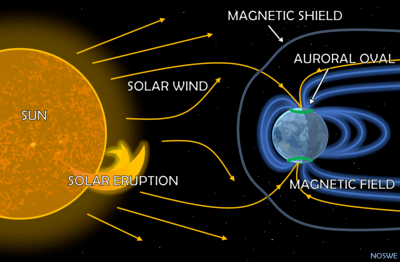
Solar Winds
Streams of electrical particles from the Sun
Solar flares can increase the amount of particles
Earth's magnetic field blocks the majority of solar winds except on the North and South Poles
At the poles, the particles create electric currents that cause gas in the atmosphere to glow (Northern Lights/Southern Lights)
Worst case scenarios: too many particles entering the atmosphere can cause magnetic storms and blackouts
78
79
Multiple Choice
Large eruptions of heated gas from the Sun's surface are called
Prominences
Solar winds
Sunspots
Solar flares
80
Multiple Choice
The corona sends out a stream electrical particles called the
Solar flares
Solar winds
Sunspots
Prominences
81
Fill in the Blank
The Sun's layers, from innermost to outermost, are the core, the ___________, and the convection zone.
82
Earth's energy budget allows us to track how much energy is coming in and going out. Incoming solar energy is either: Reflected or Radiated back to space, or Absorbed. About 71% of the total incoming solar energy is absorbed by the Earth system.
Where Does ALL the Sun's Energy Go?!
83
Multiple Choice
Earth's energy budget tracks how much energy flows in and out of Earth's climate.
True
False
84
Multiple Choice
Label part 1
#1 Core
#1 Radiation zone
#1 Convection zone
#1 Photosphere
85
Multiple Choice
Label part 6
#6 Prominences
#6 Corona
#6 Sunspots
#6 Photosphere
86
Multiple Choice
Label Part 3
#3 Chromosphere
#3 Radiation zone
#3 Convection zone
#3 Photosphere
87
Chapter 11-Stars & Galaxies
Lesson 8.11.2-The Sun & Other Stars
Let's take a look at the first question we will answer:
1. How do stars shine?
2. How are stars layered?
3. How does the Sun change over short periods of time?
4. How do scientists classify stars?
4.
88
8.11.2-The Sun & Other Stars
Scientists classify stars by temperature, color, and mass.
The Hertzprung-Russell Diagram organizes stars by surface temperature and luminosity.
The main sequence on the H-R diagram contains stars that are fusing hydrogen into helium in their cores.
90% of stars are found in the main sequence.
Stars move off of the main sequence when they have used up all of the hydrogen in their cores and begin FUSING helium or carbon.
Topic: Classifying Stars
89
Star Colors
The color of a star tells us the temperature of a star
Red stars are the coolest
Yellow stars are hotter than red stars.
White stars are hotter than red and yellow
Blue stars are the hottest stars of all.
90
Multiple Choice
91
Multiple Choice
92
93
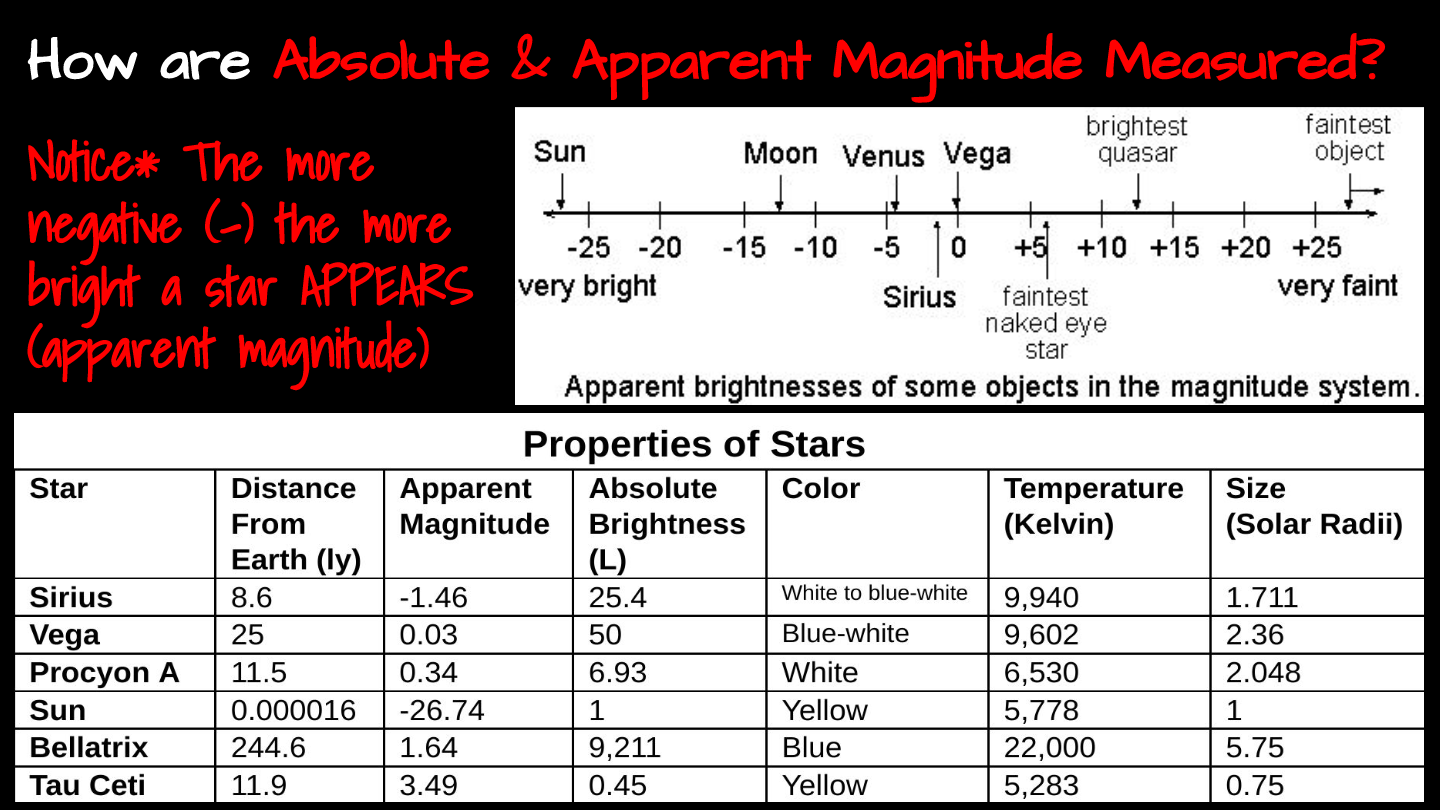
Why are some stars brighter than others?
One reason a star can seem brighter than another star is due to how much power a star has - which can also be explained as the amount of wattage it has (think of light bulbs!).
Stars with more power (or higher wattage) will shine brighter than those with less power (lower wattage).
94
Why are some stars brighter than others?
Another reason is the distance of the star from the Earth. Just because a star looks brighter, doesn’t mean it actually is brighter. The more distant an object is, the dimmer it appears. Therefore, if two stars have the same level of brightness, but one is farther away, the closer star will appear brighter than the more distant star - even though they are equally bright!
95
Multiple Select
What are two reasons that one star can appear brighter than another star?
power
size
distance
brightness
96
Multiple Choice
All stars are the same color and same size.
True
False
97
There are five main differences between planets and stars:
Planets always orbit around a star. Never the other way around.
Planets are made of rock, ice, gas or water. Stars are made of plasma.
Stars emit their own light. Planets don’t.
Planets are always colder than the stars in their system.
Difference between Stars and Planets
98
Multiple Choice
_________ are made of plasma.
Planets
Stars
99
Multiple Choice
Which is colder? Stars or Planet?
Planets
Stars
100
101
102
103
H-R Diagram
We classify/organize stars on the Hertzsprung-Russell diagram OR HR Diagram.
Astronomers sort stars by their:
Temperature
Size or Mass
Both temperature and size/mass of a star help us understand the ABSOLUTE BRIGHTNESS or how bright a star actually is.
104
105
106
107
108
Multiple Choice
Which Star is the HOTTEST?
Blue
Red
Orange
Yellow
109
Multiple Choice
Which Star is the COOLEST?
Blue
Red
Orange
Yellow
110
Multiple Choice
Which of the following words would describe a star that is BRIGHT
dim
dull
hot
luminous
111
112
Multiple Choice
The Hertzsprung-Russell Diagram is a tool that shows
the composition of the stars
all of the planets in our solar system
relationships & differences between stars
only 1 group of stars
113
Multiple Select
The position of a star on the HR Diagram can tell you
surface temperature
absolute magnitude (luminosity)
distance from earth
the galaxy that the star is in
114
Multiple Choice
Every star on the HR Diagram is compared to our star the Sun
true
false
115
Multiple Choice
What is the Hertzsprung-Russel Diagram?
A map which tells the approximate location of stars in the Milky Way galaxy and their distance from Earth.
A table that alphabetically lists stars by name and includes dates of when the star was first charted.
A chart which organizes stars into categories based on the amount of Hydrogen they burn.
A graph used to classify stars according to their luminosity, color, temperature, and stage.
116
117
Multiple Choice
What is found on the y axis of an H-R diagram?
Luminosity
(or brightness)
Temperature
Star Size
Distance
118
Multiple Choice
As you move from the bottom to the top of the HR diagram
Temperature increases
Luminosity increases
luminosity decreases
temperature decreases
119
Multiple Choice
The size of the star is related to its luminosity
false
true
120
Multiple Choice
The larger the star the greater the luminosity
false
true
121
Multiple Choice
Which star is brighter than the sun?
Sirius B
Procyon B
Van Maanan's Star
Aldebaran
122
123
124
Multiple Choice
125
Multiple Choice
126
Multiple Choice
127
128
129
Multiple Choice
What is found on the x axis of an H-R diagram?
Luminosity
(or brightness)
Temperature
Star Size
Distance
130
Multiple Choice
131
Multiple Choice
132
Multiple Choice
Which star is the hottest?
Yellow Star
Red Star
Orange Star
Blue Star
133
134
Multiple Select
The main groups of stars are (select all that apply)
giants
main sequence stars
red giants
white dwarfs
135
136
Multiple Choice
Compared to the rest of the stars, our sun is considered...
red Extremely Large and Cold
white Small with a medium temperature
yellow Medium size with medium temperature
137
Multiple Choice
138
Multiple Choice
139
140
141
142
143
144
Multiple Choice
145
Multiple Choice
True or False: White dwarfs are warmer and dimmer than giants.
True
False
146
Multiple Choice
Which star is considered a supergiant?
Sirius B
Sun
Betelgeuse
Van Maanan's Star
147
Multiple Choice
Which star is considered a giant star?
Mira
Zeta Arindani
Barnard's Star
Betelgeuse
148
Multiple Choice
Which star is considered a main sequence star?
Vega
Betelgeuse
Pollux
Van Maanan's Star
149
Multiple Choice
Which star is hotter than Deneb
Procyon
Sun
Regel
Banard's Star
150
Multiple Choice
Show answer
Auto Play
Slide 1 / 150
SLIDE

Similar Resources on Wayground
144 questions
Untitled Presentation
Lesson
•
9th Grade
138 questions
Evolution
Lesson
•
9th Grade
134 questions
Food webs and food chains
Lesson
•
7th Grade
144 questions
Medical Term- Nervous System
Lesson
•
10th Grade
143 questions
EOG Prep 2021
Lesson
•
8th Grade
151 questions
1st Quarter Review
Lesson
•
8th Grade
143 questions
Maksym and Kate - Speakout A2+
Lesson
•
8th Grade
147 questions
Chapter 17
Lesson
•
10th Grade
Popular Resources on Wayground
8 questions
Spartan Way - Classroom Responsible
Quiz
•
9th - 12th Grade
15 questions
Fractions on a Number Line
Quiz
•
3rd Grade
14 questions
Boundaries & Healthy Relationships
Lesson
•
6th - 8th Grade
20 questions
Equivalent Fractions
Quiz
•
3rd Grade
3 questions
Integrity and Your Health
Lesson
•
6th - 8th Grade
25 questions
Multiplication Facts
Quiz
•
5th Grade
9 questions
FOREST Perception
Lesson
•
KG
20 questions
Main Idea and Details
Quiz
•
5th Grade
Discover more resources for Mathematics
20 questions
Scatter Plots and Line of Best Fit
Quiz
•
8th Grade
12 questions
8th U6 L4 - Fitting a Line to Data
Quiz
•
8th Grade
25 questions
Scatter Plots and Line of Best Fit
Quiz
•
8th Grade
14 questions
finding slope from a graph
Quiz
•
8th Grade
20 questions
Graphing Inequalities on a Number Line
Quiz
•
6th - 9th Grade
20 questions
Pythagorean Theorem Review
Quiz
•
8th Grade
20 questions
Laws of Exponents
Quiz
•
8th Grade
20 questions
Slope from a Graph
Quiz
•
8th Grade