Search Header Logo
1st Quarter Review

1st Quarter Review

Assessment

Presentation

Science

8th Grade

Medium

NGSS
MS-PS1-4, MS-PS1-2, MS-PS1-1

+5

Standards-aligned

Created by

Sabrina Robinson

Used 37+ times

FREE Resource

39 Slides • 112 Questions

1

Pure Substances and Mixtures

media

2

media

3

media

4

media

5

Multiple Choice

A combination of rocks and water is an example of

1

A mixture

2

A solution

3

A solute

6

Multiple Choice

A substance that contains only one type of atom is a(n)
1
compound
2
element
3
heterogeneous mixture
4
homogeneous mixture

7

Multiple Choice

Question image

What type of mixture is this?

1

heterogeneous 

2

homogeneous

8

Multiple Choice

Question image

Consider the following samples.

Which model accurately classifies the samples?

1
2
3
4

9

media

10

Multiple Choice

Question image
1

Pure Substance

2

MIxture

11

Multiple Choice

Question image

What is it?

1

Pure Substance

2

Mixture

12

Multiple Choice

Question image

What is it?

1

Pure Substance

2

Mixture

13

Multiple Choice

Question image

What is it?

1

Pure Substance

2

Mixture

14

Multiple Choice

Question image

What is it?

1

Pure Substance

2

Mixture

15

Multiple Choice

Question image
1

Element

2

Compound

3

Homogeneous Mixture

4

Heterogeneous MIxture

16

Multiple Choice

Question image

What is this?

1

Element

2

Compound

3

Heterogeneous MIxture

4

Homogeneous Mixture

17

Multiple Choice

Question image

What is this?

1

Element

2

Compound

3

Homogeneous Mixture

4

Heterogeneous Mixture

18

Multiple Choice

Question image

What is this?

1

Element

2

Compound

3

Homogeneous Mixture

4

Heterogeneous MIxture

19

Multiple Choice

Question image

What type of substance is pictured?

1

element

2

compound

3

mixture

4

solution

20

Multiple Choice

Which is a mixture of compounds?

1
2
3
4

21

Multiple Choice

Question image

What type of substance is pictured?

1

element

2

compound

3

mixture

4

solution

22

Multiple Choice

Question image

What type of substance is pictured?

1

element

2

compound

3

mixture

23

Multiple Choice

Which is a mixture of compounds?

1
2
3
4

24

​Phase Changes

media

25

Open Ended

Question image

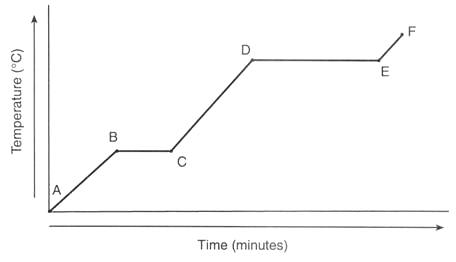
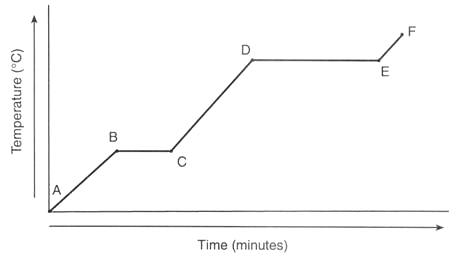
A phase change diagram is used to show the relationship between temperature, pressure and state of matter. Explain what is happening on the horizontal lines and why the lines are horizontal.

26

States of Matter

Remember that the state of matter is a Physical Property because the actual substance doesn't change, only the form changes.

media

27

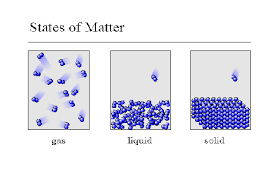
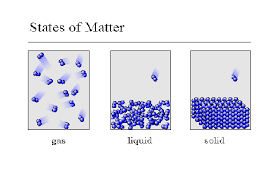
Each State of Matter is defined by how their particles behave.


1How close the particles are to one another, and 2how quickly they move determine what state of matter a substance is in.

28

There are 4 states of matter.

  1. solid
  2. liquid
  3. gas
  4. plasma
media

29

Multiple Choice

Question image

What line segment represents only the solid state? (Diagram F)

1

A-B

2

B-C

3

C-D

4

D-E

30

Multiple Choice

Question image

Between which points is the temperature of the substance remaining constant? (Diagram F)

1

A-B only.

2

A-B, C-D, E-F

3

B-C only.

4

B-C, D-E

31

Multiple Choice

True or false: melting and freezing occur at the same temperature!
1
True
2
False
3
I don't know

32

Multiple Choice

Question image

A substance's heating curve is shown in the graph. What is its boiling point? (Diagram B)

1

100 C

2

60 C

3

80 C

4

20 C

33

Multiple Choice

Question image

Are the particles moving faster or slower as time goes on? (Diagram F)

1

Faster

2

Slower

34

Multiple Choice

Question image

Which line segment demonstrates vaporization occurring? (Diagram E)

1

B-C

2

C-D

3

D-E

4

E-F

35

Multiple Choice

Question image

How long does it take this substance to change from a liquid to a gas? (Diagram E)

1

1 minute

2

2 minutes

3

10 minutes

4

15 minutes

36

Multiple Choice

Question image
What happens when thermal energy is taken away from particles?
1
They move faster and farther apart
2
They move slower and closer together

37

Multiple Choice

During a phase change, the temperature
1
increases
2
decreases
3
fluctuates
4
stays the same

38

Solid

In a solid, particles are packed tightly together so they don't move much, but are dense. The electrons of each atom are constantly in motion, giving the atoms a small vibration, but they are fixed in their position.


Solids have a definite shape, as well as mass and volume, and do not conform to the shape of the container in which they are placed. 

media

39

Multiple Choice

Question image

What state of matter is represented in this picture?

1

solid

2

liquid

3

gas

40

Liquid

In a liquid, the particles are more loosely packed than in a solid, but closely enough that it is not easily compressible.


The particles are able to flow around each other, giving the liquid an indefinite shape. Therefore, the liquid will conform to the shape of its container.

media

41

Multiple Choice

Which state of matter do the particles slip and slide past each other?

1

solid

2

liquid

3

gas

42

Gas

In a gas, the particles have a great deal of space between themso they move easily, and have high kinetic energy (energy of movement). When a gas is put under pressure by reducing the volume of the container, the space between particles is reduced and the gas is compressed.

media

43

Liquid on the other hand...

In a liquid, the particles are already close together, so it is not easily compressed.

media

44

Multiple Choice

Question image

What state of matter is represented in the picture above?

1

solid

2

liquid

3

gas

45

Multiple Select

Which type(s) of matter have a definite volume?

1

solid

2

liquid

3

gas

46

Multiple Choice

Which state of matter has the ability for its particles to be easily compressed?

1

Solid

2

Liquid

3

Gas

4

Plasma

47

Gas

A gas has no definite shape or volume. If unconfined, the particles of a gas will spread out indefinitely; if confined, the gas will expand to fill its container.

media

48

Multiple Select

Which type(s) of matter take on the shape of the container they are in?

1

solid

2

liquid

3

gas

49

Plasma

Plasma is not a common state of matter here on Earth, but it may be the most common state of matter in the universe. Stars are essentially superheated balls of plasma. 


Plasma consists of highly charged gas particles with extremely high kinetic energy (energy in motion).


Think of plasma as gas, with an electrical charge.

media

50

More on plasma.

The noble gases (helium, neon, argon, krypton, xenon and radon) are often used to make glowing signs by using electricity to ionize (an atom with a charge) them to the plasma state. 

media

51

Multiple Choice

Which state of matter is much like a gas, but with particles that are charged?

1

Solid

2

Liquid

3

Gas

4

Plasma

52

media

53

Multiple Choice

While an object is melting, what happens to the temperature?

1

increases

2

decreases

3

stays the same

54

Multiple Choice

In which state of matter are particles packed tightly together in fixed positions?

1

gas 

2

solid

3

liquid

4

plasma

55

Multiple Choice

Which has more energy?

1

Hot water

2

Room temperature water

3

Ice water

56

Multiple Choice

Which state of matter contains particles that flow freely past one another?

1

Solid

2

Liquid

3

Gas

4

Plasma

57

Multiple Choice

In which state of matter do particles spread apart and fill all the space available to them? 

1

crystal

2

liquid

3

gas

4

solid

58

Multiple Choice

Which state of matter has a fixed volume and mass?

1

Solid

2

Liquid

3

Gas

4

Plasma

59

Multiple Choice

In a(n) _______________________, the particles are packed closely together, but they can move past each other freely. 

1

solid 

2

liquid

3

gas

4

plasma

60

Multiple Choice

Which state of matter fills a container?

1

Solid

2

Liquid

3

Gas

4

Plasma

61

Multiple Choice

Question image

In which state of matter are the particles least able to move?

1

A

2

B

3

C

62

Multiple Choice

Which state of matter contains particles that slowly vibrate, but in a fixed position?

1

Solid

2

Liquid

3

Gas

4

Plasma

63

Multiple Choice

Particles in this state of matter are moving the fastest.

1

solid

2

liquid

3

gas

64

Multiple Choice

Question image

At higher temperatures

1

particles in an object have less energy

2

particles in an object move faster

3

a gas contracts

65

Multiple Choice

Question image

A gas

1

has a definite shape but no definite volume

2

has a definite volume but no definite shape

3

has fast-moving particles

66

Multiple Choice

Which state of matter has a definite shape?

1

Solid

2

Liquid

3

Gas

4

Plasma

67

Multiple Choice

Superheating gas so that it becomes ionized is one of the methods to form this state of matter.

1

Solid

2

Liquid

3

Gas

4

Plasma

68

Multiple Choice

Atoms or molecules in this phase of matter have the highest energy.

1

Solid

2

Liquid

3

Gas

4

Plasma

69

Multiple Choice

When water sits in the freezer and freezes into ice, it is because the water has...

1

gained mass

2

gained energy

3

lost mass

4

lost energy

70

Multiple Choice

When ice sits out on a counter and melts, it is because the ice has...

1

gained mass

2

gained energy

3

lost mass

4

lost energy

71

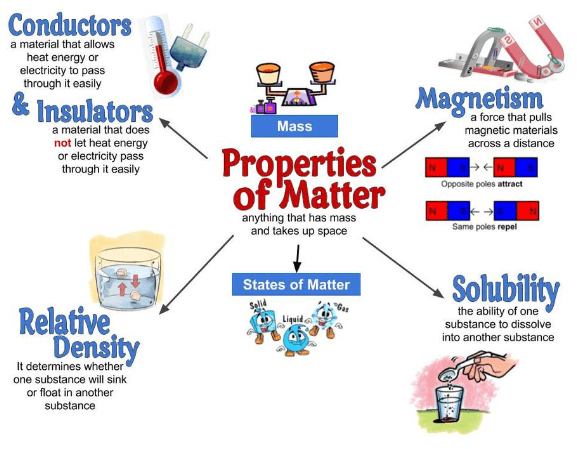
Physical and Chemical Properties

Properties of Matter

media

72

All substances have properties that we can use to identify them. There are TWO basic types of properties:

PHYSICAL properties and CHEMICAL properties

73

  • Does not change the identity or composition of matter

  • ​Observed with senses or measurements

PHASE CHANGES are physical, since only the speed, spacing, and attraction of particles are altered.

Physical Properties

media

74

​Examples of Physical Properties

  • magnetism​

  • boiling point and freezing point

  • density, mass, and volume

  • viscosity (how thick a liquid is)

  • size, shape, and color

  • texture

  • ​conducts electricity

75

  • Describes how the substances may change when it transforms through a chemical reaction​ (reacts with another substance)

  • Changes the identity of the original substance​

Chemical Properties

media

Chemical changes can't be "undone", since the substance has changed into something new!

76

​Examples of Chemical Properties

  • reactivity (reacting with other chemicals)

    • Signs of a chemical reaction to look for:

      • Release of heat or light

      • Color change

      • Formation of a gas

      • ​Formation of a precipitate (solid falling out of a liquid)

  • pH (measuring how acidic or basic a solution is)

  • flammability (how likely to burn)

77

media

78

Multiple Choice

Question image

You measure the DENSITY of a rock compared to water.

1

physical property

2

chemical property

79

Multiple Choice

Question image

A candle burning because the wick is flammable.

1

physical property

2

chemical property

80

Multiple Choice

Which of the following is NOT a physical property?

1

flammability

2

melting point

3

density

4

luster

81

Multiple Choice

A property that can only be observed when a substance reacts or does not react with another substance

1

chemical property

2

physical property

82

Multiple Choice

Which of the following is defined as the likelihood of a substance to undergo a chemical reaction?

1

oxidation

2

rusting

3

reactivity

4

flammability

83

Multiple Choice

Which of the following is NOT an example of a chemical reaction?

1

flammability

2

oxidation

3

reactivity

4

melting point

84

media

The different densities of objects determines if it will sink or float in water.

Higher density than water will SINK!

Lower density than water will FLOAT!

The density of water is defined as 1 gram / milliliter3

What makes objects sink or float?

85

Multiple Choice

If water has a density of 1 g/cm3, what would an object with a density of 1.5 g/cm3 do in water?

1

sink

2

float

3

I don't know

86

Multiple Choice

Question image

Which box has a higher density?

1

A

2

B

3

They are the same

87

Multiple Choice

Question image
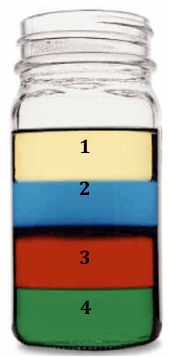
Put the liquids in order from most dense to least dense?
1
4, 3, 2, 1
2
1, 2, 3, 4
3
3, 4, 2, 1, 
4
4, 3, 1, 2

88

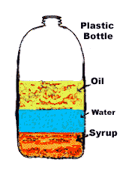
Multiple Choice

Question image
Which liquid is the least dense?
1
oil
2
water
3
syrup 
4
plastic bottle

89

Multiple Choice

Question image

In the picture, a can of Pepsi sunk and a can of Diet Pepsi are put into water. The Pepsi must be

1

more dense than water

2

less dense than water

3

it has no density

4

it has a density of 1 g/mL

90

Multiple Choice

Why does ice float

1

Liquid water is less dense than solid water.

2

Solid water is less dense than liquid water.

3

Gaseous water is less dense than solid water.

4

Liquid water is less dense than gaseous water.

91

Multiple Choice

Question image

Which of the following substances would float in water? (Hint: water has a density of 1g/cm3)

1

gold

2

rubber

3

water

4

cork

92

media

93

media

94

Multiple Choice

What is an example of a physical change?

1

baking brownies

2

explosion

3

cutting paper

4

rust on metal

95

media

96

media

97

Multiple Choice

Is baking a cake a physical or chemical change?

1

Physical

2

Chemical

98

media

99

media

100

media

101

media

102

media

103

Multiple Choice

Chopping wood

1

physical change

2

chemical change

104

Multiple Choice

Mixing different colored marbles

1

physical change

2

chemical change

105

Multiple Choice

Firework

1

physical change

2

chemical change

106

Multiple Choice

Making eggs for breakfast

1

physical change

2

chemical change

107

Multiple Choice

Burning wood

1

physical change

2

chemical change

108

Multiple Choice

Is a a rusting bicycle a chemical or physical change?
1
chemcial
2
physical

109

Multiple Choice

Is melting ice a chemical or physical change?
1
chemical
2
physical

110

Multiple Choice

Is spoiling food a physical or chemical change?
1
phyiscal
2
chemical

111

Multiple Choice

Salt dissolves in water
1
physical Change
2
chemical change

112

Multiple Choice

Which is a chemical change?
1
freezing fruit juice
2
slicing a potato
3
boiling water
4
copper metal turning green

113

Multiple Choice

what is the definition of physical change?
1
any change that results in the formation of new chemical substances. 
2
rusting
3

changes affecting the form of a chemical substance, but not its chemical identity.

4
any property that is measurable, whose value describes a state of a physical system

114

Multiple Choice

What is a chemical change?

1

How two chemicals react with one another when combined

2

A property that we can measure or observe with our 5 senses or other tools

3

When two chemicals react with one another to form a new substance

4

When a change occurs but it does not result in the formation of a new substance

115

Multiple Choice

A student mixes yellow powder with water. Which observation would prove a CHEMICAL change occurred?

1

The powder DISSOLVED in the water

2

The water turned the COLOR yellow

3

The water's TEMPERATURE changed

4

The STATE OF MATTER changed

116

Multiple Choice

Which of the following options provides evidence of a CHEMICAL change?

1

Wood is burned releasing ash and smoke

2

Rocks separate when soil is sifted

3

Boiling water bubbles when heated

4

Salt dissolves in water

117

Multiple Choice

Which of the following examples provides evidence of a PHYSICAL change?

1

Wood is burned and releases ash and smoke

2

Iron rusts over time

3

When mixed, baking soda and vinegar form gas bubbles

4

Boiling water bubbles when heated

118

Multiple Choice

When mixing milk and vinegar, a white, chunky, solid substance is formed. What has occurred?

1

Physical change: state of matter

2

Chemical change: precipitate

3

Physical change: freezing

4

Chemical change: new gas

119

Multiple Choice

You mix a yellow powder and a clear liquid. The liquid turns light yellow and the powder seems to disappear. This is a...

1

Endothermic Chemical Change

2

Exothermic Chemical Change

3

Physical Change

120

media

121

media

122

media

123

Multiple Choice

What is a group

1

Up and down row on the table

2

Up and down column on the table

3

Side to side row on table

4

Side to side column on the table

124

Multiple Choice

What is a period

1

Up and down row on the table

2

Up and down column on the table

3

Side to side row on table

4

Side to side column on the table

125

Multiple Choice

What group is carbon in?

1

1

2

2

3

13

4

14

5

15

126

Multiple Choice

Why are noble gases not reactive

1

Too few electrons

2

Too many electrons

3

They have a full set of electrons

4

They need more electrons

127

Multiple Choice

Question image
How are elements on the periodic table arranged by?
1
in alphabetic order
2
simular physical & chemical properties
3
their symbols
4
Just simular physical properties

128

Multiple Choice

Question image
Each column in the periodic table is called a _________ .
1
period
2
group
3
cluster
4
unit

129

Multiple Choice

Two elements chemically bonded form
1
element
2
compound
3
mixture
4
solutions

130

Multiple Choice

Question image
Periods on the periodic table are __________.
1
Horizontal Rows
2
Vertical Columns

131

Multiple Choice

The Atomic number is known as the _______

1

Number of electrons in an atom

2

Number of Protons in an atom

3

Number of neutrons in an atom

4

Number of Protons and electrons in an atom

132

Multiple Choice

What charge do protons have?

1

Positive

2

Negative

3

Neutral

133

Multiple Choice

What is Atomic Mass Number ?

1

Number of Protons

2

Number of Neutrons

3

Number of Protons and Neutrons

4

Number of Protons and Electrons

134

Multiple Choice

The number of electrons in an atom is equal to the...

1

Atomic number

2

Protons

3

Atomic Mass

4

Neutrons

135

Multiple Choice

The formula used to calculate the number of neutrons is:

1

Mass Number - Atomic Number

2

Protons + Electrons

3

Atomic Number - Mass Number

4

Protons x2

136

Multiple Choice

How many periods are on the periodic table?

1

5

2

6

3

7

4

8

137

Multiple Select

Elements in the same group have : (2 correct answers)

1

Similar chemical properties

2

Similar names

3

Same number of outer (valence) electrons)

4

The same number of protons

138

​Atoms

Atoms are made of protons, electrons, and neutrons

Protons are positive

Neutrons are neutral​

Electrons are negative ​

  • Protons and neutrons are in the nucleus

  • Electrons are on the outside

139

Multiple Choice

If an atom has 3 electrons, how many protons does it have?
1
1
2
2
3
4
4
3

140

Multiple Choice

Question image
What does the nucleus of an atom contain?
1
Electrons and neutrons
2
Protons and neutrons
3
Neutrinos and positrons
4
DNA and RN

141

Multiple Choice

How many atoms of Hydrogen are in H2O

1

1

2

2

3

3

4

more than 3

142

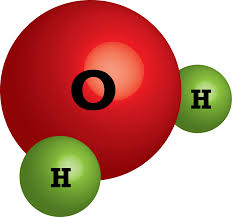
Multiple Choice

Question image

How many atoms of Hydrogen are in this compound?

1

1

2

2

3

3

4

4

143

media

144

Multiple Choice

Substances present at the start of a chemical reaction.

1

subscripts

2

reactants

3

coefficients

4

products

145

Multiple Choice

How many atoms of Carbon (C) are in C6H12O6?

1

3

2

6

3

12

4

24

146

Multiple Choice

In chemical reactions, what does the principle of conservation of mass mean?

1

Matter is not created or destroyed

2

The total mass of the reactants is greater than the total mass of the products

3

The total mass of the reactants is less than the total mass of the products

4

Matter is not changed

147

Multiple Choice

Is this equation balanced?

N2 + H2 --> NH3

1

Yes

2

No

148

Multiple Choice

Substances that form as the result of a chemical reaction
1
products
2
reactants
3
coefficients
4
subscripts

149

Multiple Choice

The Law of Conservation of Mass says that matter can neither be __________ or __________.

1

created; destroyed

2

recycled; renewed

3

subtracted; added

4

joined; separated

150

Multiple Choice

In a reaction A + B ----> C, reactant A has 5g and product C has 9g. How many grams does reactant B have?

1

4g

2

5g

3

9g

4

14g

151

Multiple Choice

If reaction starts with 20g of reactants it should produce 
1
a total of 40g of products
2
a total of 10g of products
3
a total of 80 g of products
4
a total of 20g of products

Pure Substances and Mixtures

media

Show answer

Auto Play

Slide 1 / 151

SLIDE