

MCS lecture

Presentation
•
Chemistry
•
12th Grade
•
Practice Problem
•
Medium

Stephanie Qiumei
Used 9+ times
FREE Resource
45 Slides • 4 Questions
1
2

Outline of content
1. Introduction
2. Relative masses of atoms and molecules
3. Molecular and Empirical* Formulae
4. Mole Relationships including calculations
based on reacting masses and volumes (of
solutions and gases)
PAGE 1-1
3

2.1 Definitions
You should be able to:
•
Define relative atomic, isotopic, molecular
and formula masses
PAGE 1-3
4


The relative molecular mass, Mr, of a
substance
RELATIVE MOLECULAR MASS, Mr
PAGE 1-3
5
Multiple Choice
Does Relative Molecular Mass have units?
Yes
No
6
Multiple Choice
Are relative molecular mass and molar mass the same?
Yes
No
7
The relative molecular mass, Mr, of a
substance
RELATIVE MOLECULAR MASS, Mr
PAGE 1-3
8

The relative isotopic mass, Ar, of a particular
isotope
PAGE 2-3
RELATIVE ISOTOPIC MASS, Ar
Note:
Not average mass!
PAGE 1-3

9

Why average mass?
Atoms of the same element may not have the same
mass – exist as isotopes.
Note: The average mass is the weighted average of
the relative isotopic masses of the isotopes according
to their abundances.
PAGE 1-3
10

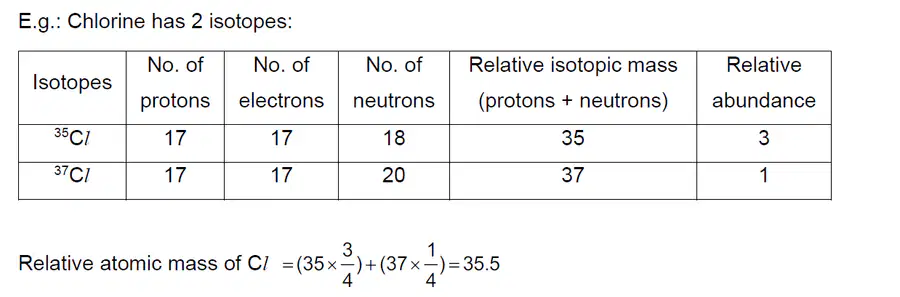
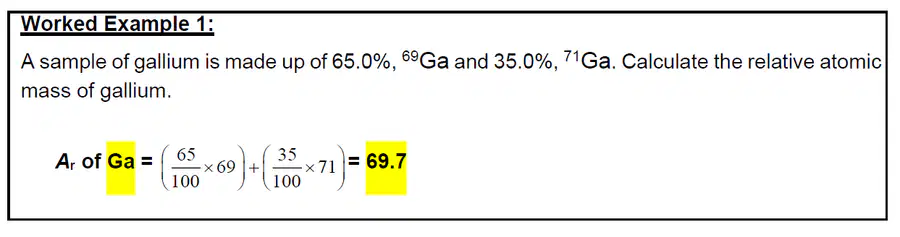
2.2 Calculate Ar from relative abundance of isotopes
You should be able to:
•
Calculate relative atomic mass, given
relative abundance of its isotopes
PAGE 1-4
11

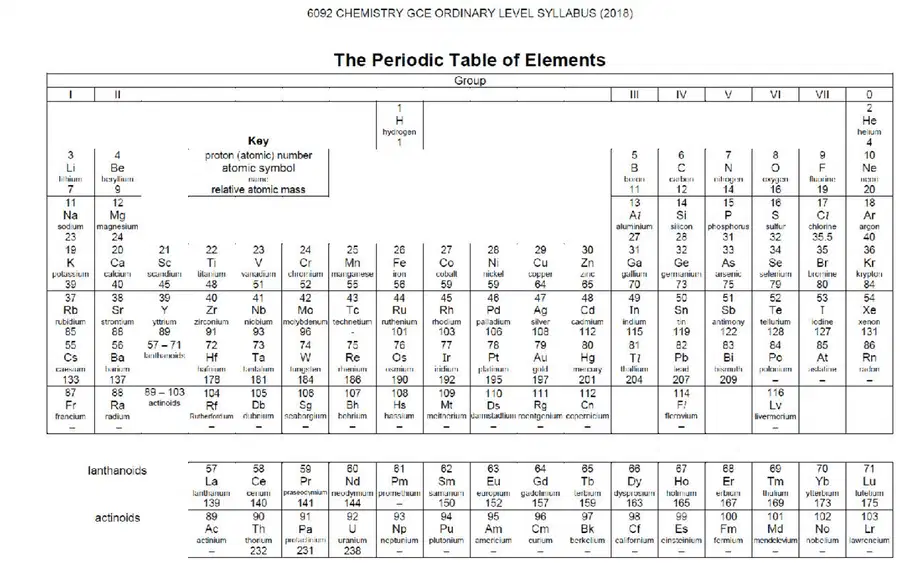
O level Periodic Table
12

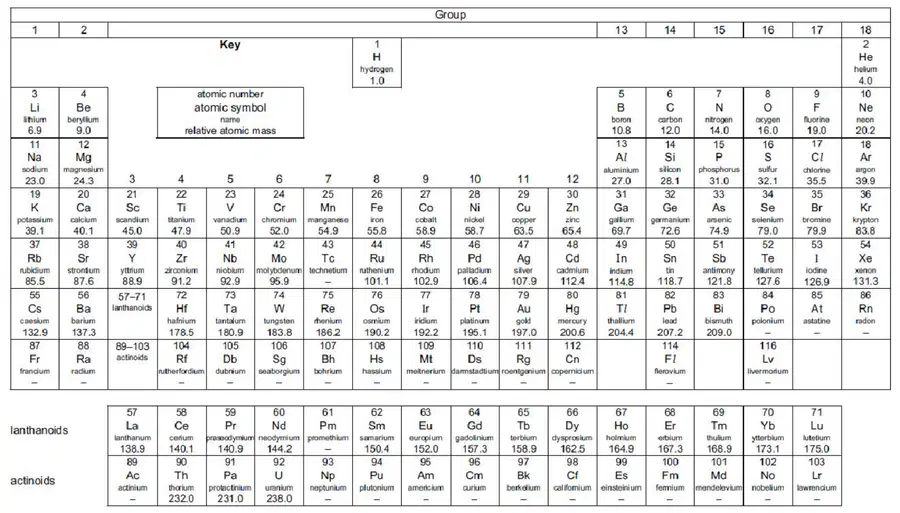
A level Periodic Table
13
14
15

3. Molecular and Empirical Formulae
You should be able to:
• Define empirical and molecular
formula
16


17

3. Molecular and Empirical Formulae
You should be able to:
• Calculate empirical* and molecular
formula, using composition by mass
Page 1-5
18

Worked Example 2:
Calculate the empirical formula of a compound that has the
Composition by mass: 12.8% carbon, 2.1% hydrogen and
85.1% bromine.
Information you need to solve this
problem:
Ar of C = 12.0
Ar of H = 1.0
Ar of Br = 79.9
Calculation: EF from Composition by mass
Page 1-5
19
Let the mass of a sample of compound be 100g.
C H Br
Mass / g 12.8 2.1 85.1
No. of mol 12.8 ÷ 12.0 2.1 ÷1.0 85.1 ÷ 79.9
= 1.067 = 2.1 =1.065
Simplest ratio 1 2 1
Worked Example 2:
Calculate the empirical formula of a compound that has the
Composition by mass: 12.8% carbon, 2.1% hydrogen and
85.1% bromine.
Solution:
Calculation: EF from Composition by mass
Page 1-5

20

21

22

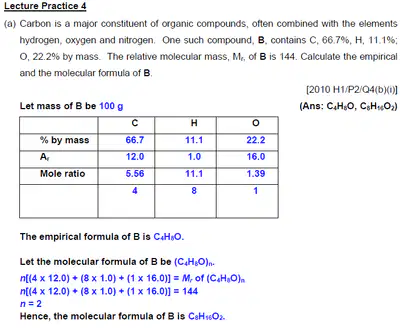
C H O
% by mass 66.7 11.1 22.2
No. of mol
66.7 ÷ 12.0 11.1 ÷1.0 22.1 ÷ 16.0
= 5.558 = 11.1 =1.388
Simplest ratio 4 8 1
(a) Carbon is a major constituent of organic compounds, often
combined with the elements hydrogen, oxygen and
nitrogen. One such compound, B, contains C, 66.7%, H,
11.1%; O, 22.2% by mass. The relative molecular mass, Mr,
of B is 72. Calculate the empirical and the molecular
formula of B.
Solution:
∴ Empirical formula of compound is C4H8O
Lecture Practice 4
Page 1-7
23
Fill in the Blanks

Lecture Practice 4(a) What is the molecular formula for B?
24
25

4.1 & 4.2 Molar Mass & Molar Volume
You should be able to:
• Perform calculations using mole
concept, involving:
• Reacting masses
• Volumes of gases
26
27
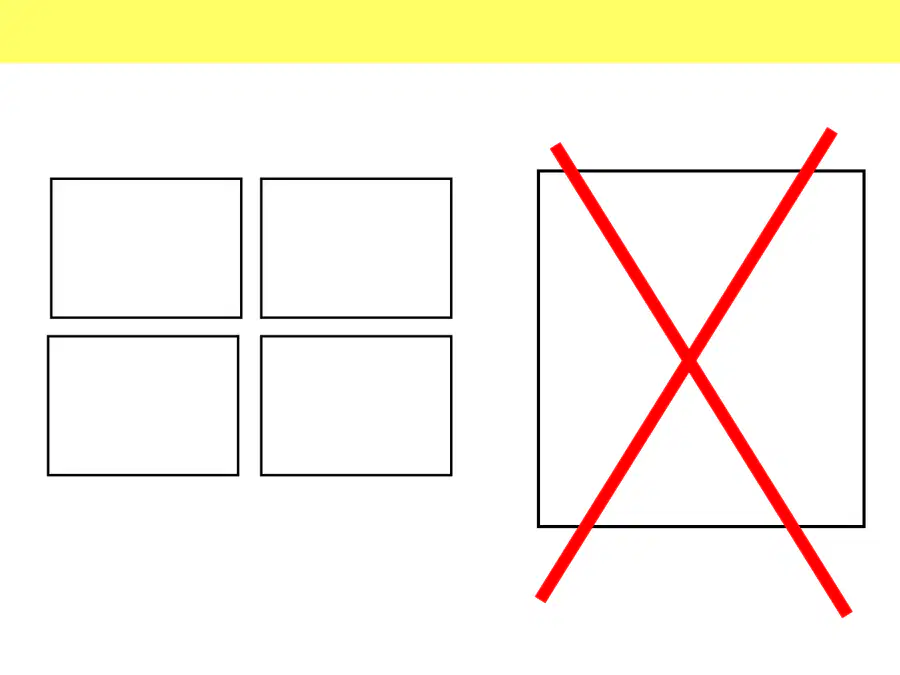
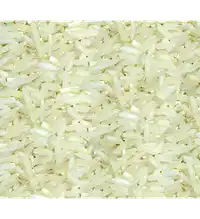


Learning to count effectively
4 bowls of rice
5 356 grains of
rice
vs
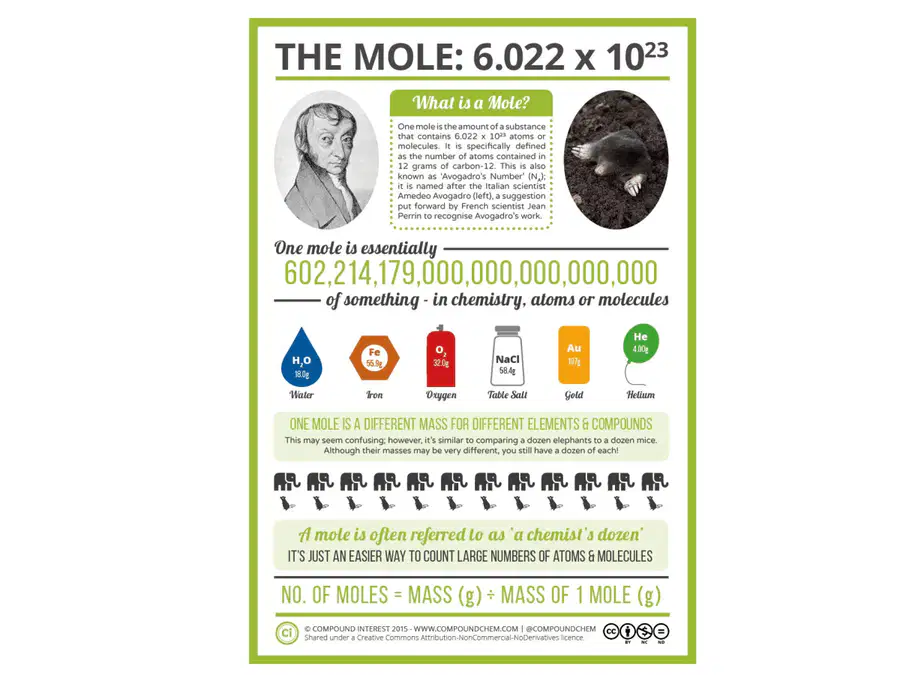
The Mole and Avogadro Constant
Page 1-8
28

• Equal volumes of gases,under the
same temperature and pressure,
contain equal number of atoms or
molecules.
• One mole of any gas will have the
same volume under the same
temperature and pressure.
• This Law applies strictly to Gases only.
• Do not confuse it with Volume of solutions!!!!
Molar Volume (for gases only)
The Mole and Avogadro Constant
Page 1-9
29
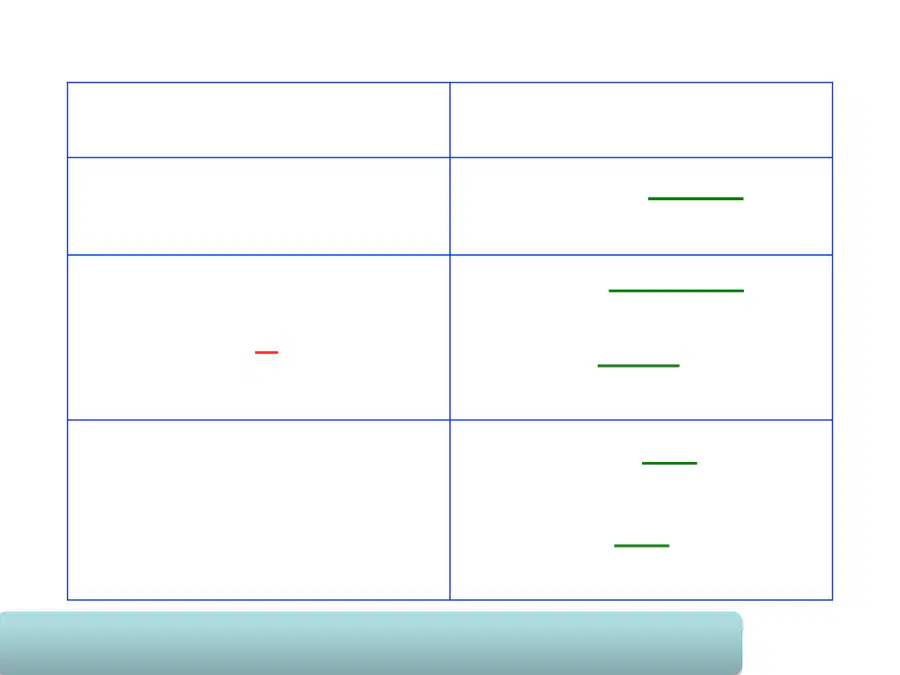
Take a minute to recap your mole
concept.
1 mole of substance
No. of particles
Na
No. of Na atoms =
1 x 6.02 x 1023
S8
No. of S8 molecules =
1 x 6.02 x 1023
No. of S atoms =
2 x 6.02 x 1023
8 x 6.02 x 1023
1 x 6.02 x 1023
MgCl2
No. of Cl- ions =
No. of Mg2+ ions =
Can also start doing self-practice 3.
Page 1-8
30

31


•
Calculation: Molar Volume
Page 1-10
32
Fill in the Blanks
Lecture Practice 6. What is the volume occupied by 10 g of helium at r.t.p?
33

34
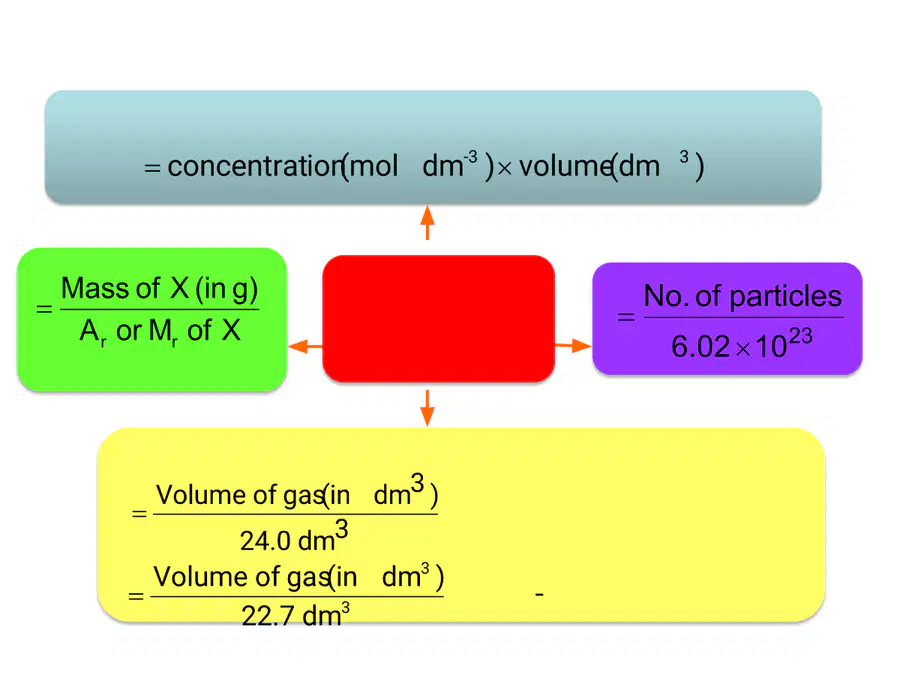
Important relationships involving “moles”:
No. of moles
of X
In aqueous solutions:
If X is a gas:
At r.t.p. (20°C and 1 atm)
At s.t.p. (0°C and 1 bar)
Page 1-11
35

REALITY
CHECK!
Page 1-17
5.3 Percentage Yield (actual yield)
36

4.3 Important relationships involving “moles”
You should be able to:
• Perform calculations using mole
concept, involving:
• Volumes and concentrations of
solutions
37

5.2 Limiting reagents
• In a reaction, 1 or more reagents may be present
in excess and not used up completely.
• The amount of product formed is determined by
the amount of reagent which is limited in the
reaction (hence it is completely used up).
• The reagent which is completely used up is
called the limiting reagent. The reaction stops
when the limiting reagent is consumed.
Use of mole concept in calculations
Page 1-15
38

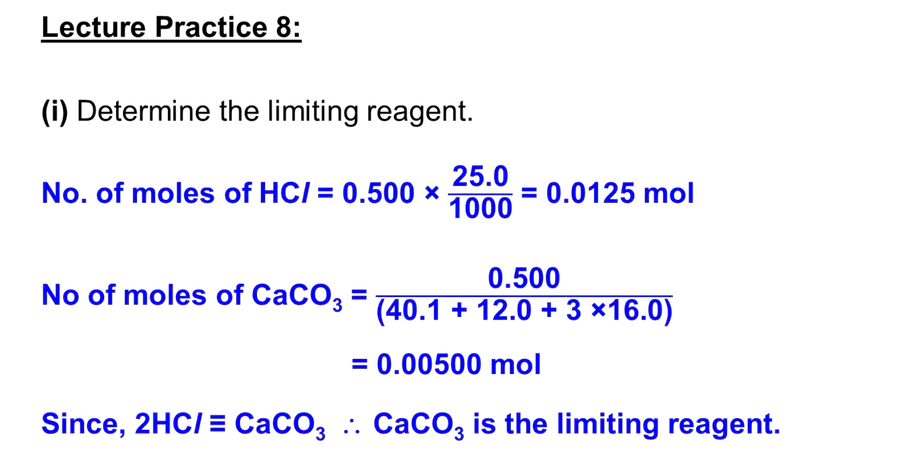
Lecture Practice 8:
25.0 cm3 of 0.500 moldm-3 of hydrochloric acid, HCl, is reacted
with 0.500 g of solid calcium carbonate, CaCO3, under room
conditions. The equation for the reaction is as follows.
2HCl(aq) + CaCO3(s) → CaCl2(aq) + CO2(g) + H2O(l)
(i) Determine the limiting reagent.
(ii) Calculate the total volume of the gas formed under room
conditions.
Calculation: Limiting Reagent
Page 1-16
39

• In real life, when chemical reactions are carried out,
it is usually impossible to ensure that 100% of
expected products are formed.
• Why?
• All stoichiometric calculations we have done thus far
have had one assumption in common: 100% of
products assumed to be formed!
REALITY CHECK!
Percentage yield
Page 1-17
40

• The formation of 100% of products is known as the
theoretical yield. It is the maximum amount of
products expected to be obtained if there was no
loss in chemicals at all. This can be calculated using
stoichiometric ratios.
• The experimental yield is the actual amount of
products formed in real life, usually measured in
terms of mass.
REALITY CHECK!
Percentage yield
Page 1-17
41

•
Calculation: Limiting Reagent
Page 1-16
42


Worked Example 7:
0.2 mole of ammonia gas is mixed with 0.30 mole of oxygen
gas. What is the limiting reactant, and how much excess
reactant remains after the reaction has stopped?
4NH3(g) + 5O2(g) 🡢 4NO(g) + 6H2O(g)
Calculation: Limiting Reagent
Page 1-16
43


• The percentage yield can be calculated by:
REALITY CHECK!
Percentage yield (pg 1-17)
Percentage purity (pg 1-18)
• The percentage purity can be calculated by:
Page 1-17 & 18
44


0.5 g of magnesium was added to sulfuric acid. The mass of the salt
obtained at the end of the reaction is 1.58 g.
Calculate the percentage yield for the above reaction.
(Ar of Mg = 24.3, Ar of S = 32.1, Ar of O = 16.0)
Worked Example 9:
Solution:
Mg(s) + H2SO4(aq)→ MgSO4 (aq) + H2 (g)
Since Mg ≡ MgSO4
No. of moles of MgSO4 (expected to form) = 0.02058 mol
Theoretical massof MgSO4 formed = 0.02058 x (24.3 + 32.1 + 4(16.0))
= 2.477 g
Page 1-18
Calculation: Percentage Yield
45


When excess tin is refluxed (heated) with iodine in an organic
solvent, tin(IV) iodide is formed.
Sn + 2I2 → SnI4
When 3.18 g of iodine were reacted with tin, 1.95 g of SnI4
crystals were formed. Calculate the percentage yield of this
reaction. [Ar: Sn, 118.7; I, 126.9]
Lecture Practice 9:
Solution:
Page 1-18
Calculation: Percentage Yield
46


Worked Example 10:
Solution:
Calculation: Percentage Purity
Page 1-19
An alloy sample of 11.54g is made up of 0.0998 mol of pure
copper, Cu.
Calculate the percentage by mass of pure copper in the alloy.
[Ar: Cu, 63.5]
47


Lecture Practice 10:
Solution:
Calculation: Percentage Purity
Page 1-19
Chalk is made up of mostly pure calcium carbonate. In a reaction, 10 g of chalk
was reacted with an excess of dilute hydrochloric acid. 2.28 dm3 of carbon dioxide
gas was collected at room temperature and pressure (r.t.p.). The equation for the
reaction is as follows.
CaCO3(s) + 2HCl(aq) → CaCl2(aq) + H2O(l) + CO2(g)
Calculate the percentage by mass of pure CaCO3 in chalk.
No. of moles of CO2 evolved =
= 0.0950 mol
Since CO2 ≡ CaCO3, no. of moles of CaCO3 = 0.0950 mol
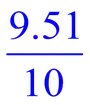
Mass of CaCO3 = 0.0950 x 100.1 = 9.51 g
% by mass of CaCO3 in chalk =
x 100 % = 95.1 %
48

Lecture Practice 12:
CxHy(g) + (x + y/4)O2 (g) → xCO2(g) + (y/2)H2O(l)
Since mole ratio of CO2 : CxHy is
∴ molecular formula of the hydrocarbon is
Calculation: Combustion of Hydrocarbon
Page 1-23
Initial (cm3)
20
150
0
Final (cm3)
0
50
60
Total vol is
110 cm3
Vol used/
involved
(cm3)
20
100
60
(vol of CO2 = vol
reacted with KOH)
Ratio
1
5
3
49

Lecture Practice 12:
(b) 20 cm3 of a hydrocarbon A were mixed with 80 cm3 of
oxygen. After cooling the apparatus to room temperature and
pressure, the 60 cm3 of gas that remained was shaken with an
excess of aqueous potassium hydroxide, KOH, 20 cm3 of gas
remained. Deduce the molecular formula of A.
Calculation: Combustion of Hydrocarbon
Page 1-23
Show answer
Auto Play
Slide 1 / 49
SLIDE
Similar Resources on Wayground

45 questions
Valence electrons and The Octet Rule
Presentation
•
12th Grade
42 questions
ÔN TẬP AMIN - AMINO AXIT - PEPTIT, PROTEIN VÀ POLIME
Presentation
•
12th Grade
43 questions
2.1: Perception Pt 2: Organization Slides
Presentation
•
12th Grade
47 questions
The Periodic Table
Presentation
•
10th - 12th Grade
44 questions
Simple Present Lesson
Presentation
•
KG
43 questions
Sampling Methods
Presentation
•
12th Grade
45 questions
Structure of Atom
Presentation
•
University
45 questions
BÀI TẬP VỀ PHỨC CHẤT
Presentation
•
12th Grade
Popular Resources on Wayground
10 questions
How much do you know about our Portrait of an Eagle?

Quiz
•
10th Grade
10 questions
Fast Food Slogans
Quiz
•
6th - 8th Grade
21 questions
Continents and Oceans
Quiz
•
6th Grade
20 questions
Parts of Speech
Quiz
•
5th Grade
16 questions
Subject & Predicate
Quiz
•
5th Grade
25 questions
Multiplication Facts
Quiz
•
5th Grade
12 questions
Map Skills
Quiz
•
3rd Grade
22 questions
Continents and Oceans
Quiz
•
5th Grade
Discover more resources for Chemistry
20 questions
electron configurations and orbital notation
Quiz
•
9th - 12th Grade
22 questions
KMT & Gas Variables
Quiz
•
10th - 12th Grade
30 questions
Atoms, Ions and Isotopes
Quiz
•
9th - 12th Grade
20 questions
Physical vs. Chemical Changes
Quiz
•
12th Grade
21 questions
Atomic Structure: Atoms, Isotopes & Ions...Oh, My!
Quiz
•
9th - 12th Grade
15 questions
Half-Life
Quiz
•
9th - 12th Grade
35 questions
Unit #4 Electron KAP Test Review
Quiz
•
10th - 12th Grade
12 questions
Periodic Trends
Quiz
•
10th - 12th Grade