

Plant structures

Presentation
•
Biology
•
12th Grade
•
Medium
+3
Standards-aligned
Ivana Grant
Used 7+ times
FREE Resource
13 Slides • 20 Questions
1
Bell Work 2/22
Organisms use food energy in the mitochondria to convert ADP to ATP. Which of the following statements describes how ADP is converted into ATP?
A. ADP loses a phosphate group which releases energy for use by the cell.
B. ADP gains a phosphate group which stores energy for use by the cell.
C. ADP loses a phosphate group which stores energy for use by the cell.
D. ADP gains a phosphate group which releases energy for use by the cell.
2
3
Multiple Choice
4
Multiple Choice
5
Multiple Choice

6
Multiple Choice
7
Multiple Choice
8
Multiple Select
Select all that are products of Photosynthesis.
Water
Carbon Dioxide
Oxygen
Sunlight (Light Energy)
Glucose (Sugar/food)
9
Multiple Choice
Which of the following is the correct equation for PHOTOSYNTHESIS?
light + carbon dioxide + water --> glucose + oxygen
carbon dioxide + sugar + water --> oxygen + light
oxygen + light + water --> carbon dioxide + sugar
carbon dioxide + oxygen + water --> Light+ Sugar
10
Multiple Choice
What is the correct chemical equation for Cellular Respiration?
C6H12O6 (Glucose) + H2O (Water) -----> CO2 (Carbon Dioxide) + H2O (Water) + ATP
C6H12O6 (Glucose) + O2 (Oxygen) -----> CO2 (Carbon Dioxide) + H2O (Water) + ATP
C6H12O6 (Glucose) + O2 (Oxygen) -----> CO2 (Carbon Dioxide) + H2O (Water) + ADP
11
Guiding Question
How are these plant organs related to photosynthesis and cellular respiration?
12
Plant Organs – Photosynthesis and Cellular Respiration
•Roots:
•Anchoring the plant to the soil
•Absorbing water and minerals and transporting them upwards
•Storing the products of photosynthesis (Glucose)
•Bulbous roots store starch.
•Aerial roots and prop roots are two forms of above-ground roots that provide additional support to anchor the plant.
•Some tap roots, such as carrots, turnips, and beets, are adapted for sugar/starch storage.
•Epiphytic roots enable a plant to grow on another plant
13
Multiple Choice
How do the roots of a plant contribute to the process of photosynthesis?
Roots do not participate in photosynthesis.
By producing glucose through the breakdown of carbon dioxide
By absorbing water and minerals necessary for photosynthesis.
By releasing oxygen into the atmosphere.
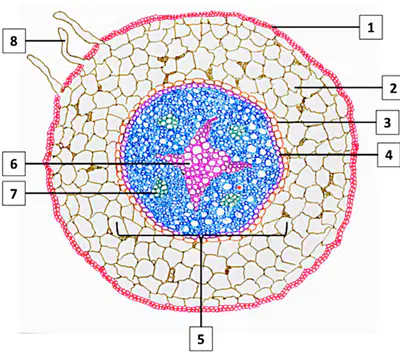
14
Plant Organs – Photosynthesis and Cellular Respiration
•1. Epidermis – absorption and protection
•2. Cortex – Thick area of storage parenchyma cells (Stores products of photosynthesis)
•5. Vascular Cylinder – Center portion of the root composed of xylem and phloem
•6. Xylem – Carries water up the plant
•7. Phloem – Tubes that transport glucose throughout the plant
•8. Root hairs – Increase surface area for the absorption of water
15
Plant Organs – Photosynthesis and Cellular Respiration
•Stems
•Support to the plant
•Holding leaves
•Flowers and buds
•Connect the roots to the leaves
•Transporting absorbed water and minerals from the roots to the rest of the plant
•Transporting sugars from the leaves to roots or mitochondria in other places throughout the plant
16
Multiple Choice
What reactant in photosynthesis do stem and roots bring to the chloroplast?
Carbon Dioxide
Glucose
Oxygen
Water
17
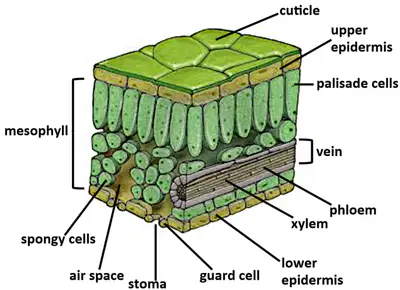
Plant Organs – Photosynthesis and Cellular Respiration
•Leaves
•Main site for photosynthesis
18
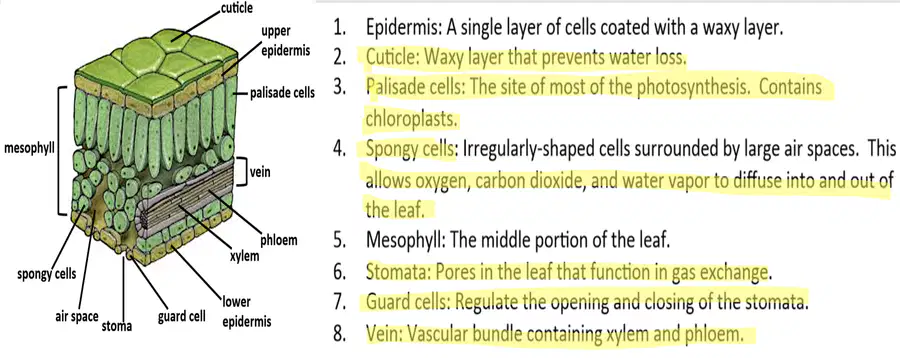
Plant Organs – Photosynthesis and Cellular Respiration
19
Multiple Choice
The function of stomata is
to carry out photosynthesis.
to transport dissolved sugars.
to allow for gas exchange.
to transport water and dissolved minerals.
20
Plant Tissues – Photosynthesis and Cellular Respiration
Dermal Tissue - covers and protects the plant to prevent water loss. It also allows for CO2 and O2 gas exchange.
Vascular Tissue – allows for the transport of water and glucose from the roots to the leaves of the plant.
Ground Tissue - main site for photosynthesis in the leaves, also provides support and structure.
21
Plant Cells – Photosynthesis and Cellular Respiration
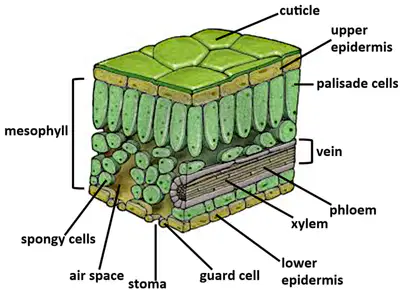
Cuticle – Prevent water loss
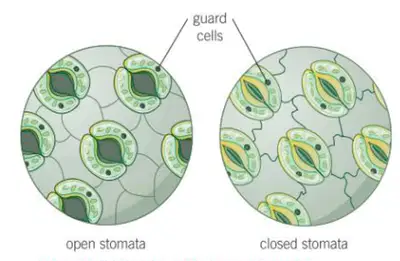
Stomata – Openings that allow gas exchange for photosynthesis and cellular respiration
Guard Cells – Surround each leaf stoma, controlling its opening and closing. Regulate the uptake of carbon dioxide and the release of oxygen and water vapor
22
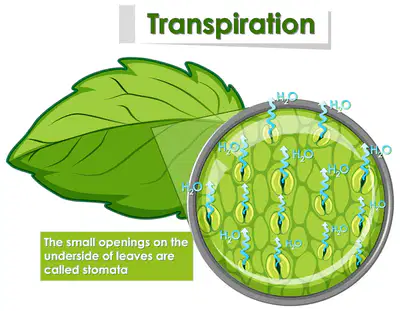
Transpiration
Transpiration is the loss of water from the leaves when the stomata are open.
23
Multiple Choice
The function of the cuticle is
to prevent water from evaporating from the leaf.
to allow for gas exchange at the top of the leaf.
to transport water and dissolved minerals.
to transport dissolved sugars.
24
Multiple Choice
Gas exchange in the leaf to do photosynthesis is done through the what?
stomata
chloroplasts
roots
phloem
25
Multiple Choice
What cells control water loss in a plant?
Stomata
Xylem
Guard
Epidermis
26
Plant Structures – Photosynthesis and Cellular Respiration
Parenchyma/ Palisade Cells (Ground Tissue) – Cells that have lots of chloroplasts, where photosynthesis happens in plants
Underneath the Cuticle and Epidermis
27
Plant Structures – Photosynthesis and Cellular Respiration
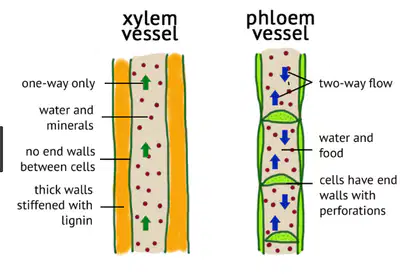
Phloem (Vascular Tissue)- moves sugar from the site of photosynthesis to other parts of the plant
Xylem (Vascular Tissue) – moves water + minerals from the roots to different parts of the plant
Xylem only flows from roots to leaves.
Phloem flows two ways, taking water and food back and forth in the plant.
28
Multiple Choice

What is the purpose of the XYLEM?
To bring food from the soil to the whole plant.
To carry water and nutrients from the roots to the whole plant.
To carry food from the chloroplasts around to all parts of the plant.
29
Multiple Choice
What does the Phloem transport?
Water and Minerals
Glucose
Blood
Chlorophyll
30
Multiple Choice
What structures let in the CO2 reactant for photosynthesis?
6CO2+6H2O+light energy→C6H12O6+6O2
Stomata
Stems
Roots
Root hairs
31
Multiple Choice
What structures let in the H2O reactant for photosynthesis?
6CO2+6H2O+light energy→C6H12O6+6O2
Stomata
Stems
Roots
Leaves
32
Multiple Select
What structures move or store the C6H12O6 product for photosynthesis?
6CO2+6H2O+light energy→C6H12O6+6O2
Stomata
Phloem
Roots
Guard Cells
33
Multiple Choice
What structures let out the O2 product for photosynthesis?
6CO2+6H2O+light energy→C6H12O6+6O2
Stomata
Phloem
Roots
Guard Cells
Bell Work 2/22
Organisms use food energy in the mitochondria to convert ADP to ATP. Which of the following statements describes how ADP is converted into ATP?
A. ADP loses a phosphate group which releases energy for use by the cell.
B. ADP gains a phosphate group which stores energy for use by the cell.
C. ADP loses a phosphate group which stores energy for use by the cell.
D. ADP gains a phosphate group which releases energy for use by the cell.
Show answer
Auto Play
Slide 1 / 33
SLIDE
Similar Resources on Wayground

25 questions
Reproductive Hormones
Presentation
•
12th Grade
25 questions
Enzymes L1
Presentation
•
12th Grade
25 questions
Macromolecules
Presentation
•
12th Grade
26 questions
Healthy diet and nutritional requirements during pregnancy
Presentation
•
12th Grade
25 questions
HW #3
Presentation
•
12th Grade
26 questions
Chi squared test and t test
Presentation
•
12th Grade
28 questions
Pregnancy, Growth and Development, Day 2
Presentation
•
12th Grade
25 questions
ECONOMICS TOPIC 2 LESSON 1
Presentation
•
12th Grade
Popular Resources on Wayground
20 questions
Math Review

Quiz
•
3rd Grade
15 questions
Fast food
Quiz
•
7th Grade
20 questions
Context Clues
Quiz
•
6th Grade
20 questions
Inferences
Quiz
•
4th Grade
19 questions
Classifying Quadrilaterals
Quiz
•
3rd Grade
20 questions
Figurative Language Review
Quiz
•
6th Grade
20 questions
Equivalent Fractions
Quiz
•
3rd Grade
10 questions
Identify Fractions, Mixed Numbers & Improper Fractions
Quiz
•
3rd - 4th Grade
Discover more resources for Biology
50 questions
NC EOC Biology Review part 1
Quiz
•
9th - 12th Grade
17 questions
Communicable and Chronic Diseases Slidedeck
Presentation
•
9th - 12th Grade
20 questions
NC EOC Biology Review part 1
Quiz
•
9th - 12th Grade
64 questions
Disease Unit- 2026
Quiz
•
9th - 12th Grade
55 questions
Mock EOC/ Interim 3 Review
Quiz
•
KG - University
44 questions
Biology EOC sem 2 review
Quiz
•
9th - 12th Grade
45 questions
Ecology Review
Quiz
•
9th - 12th Grade
131 questions
2026 Biology Final Review
Quiz
•
9th - 12th Grade