

Photosynthesis & NEURAL SINALLIN SL

Presentation
•
Biology
•
12th Grade
•
Easy

JOCELYN SIYANG
Used 4+ times
FREE Resource
35 Slides • 12 Questions
1
Multiple Choice

2
Multiple Choice
3
Multiple Choice

In which organelle does photosynthesis occur?
mitochondria
stomata
xylem
chloroplast
4
Multiple Choice
5
Multiple Choice
6
Multiple Choice

7
Multiple Choice
What is NOT the product of light dependent reaction?
ATP
NADPH
H2O
O2
8
Multiple Choice

9

10
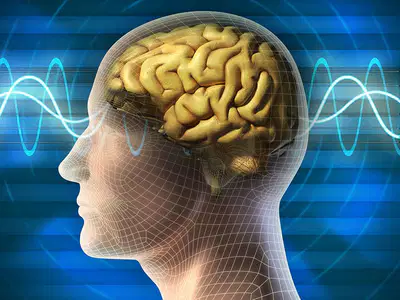
Interaction & Interdependence
Neural Signalling
11
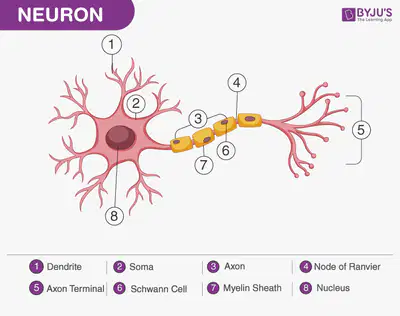
12
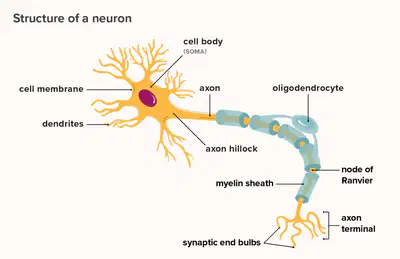
Basic Parts of the neuron:
1. cell body (soma)
- integrates incoming signals and
generates outgoing signals
2. nerve fibers
a. dendrites
- neuron to neuron
- conduct impulse to the soma
b. axon
- passes signals to other dendrites or effector cells
13
Other Parts of the neuron:
1. axon hillock
- where ACTION POTENTIAL is initiated
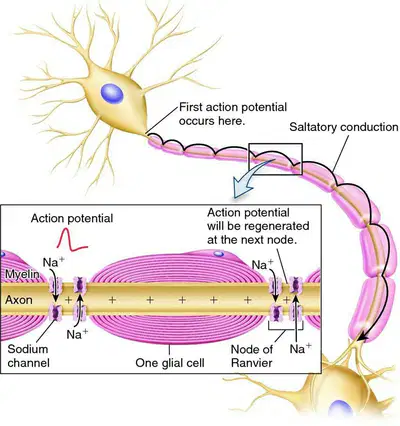
2. myelin sheath
- protective layer of fat and protein
produced by Schwann cells
- for efficient transmission of impulse
via SALTATORY CONDUCTION
14
Other Parts of the neuron:
3. node of Ranvier
- gaps in the myelin sheath for SALTATORY CONDUCTION
4. axon terminal
- releases neurotransmitters that relay signals across the synapse
15
What would the world be like if you could feel no pain?
16
Nerve impulses are action potentials propagated along axons of neurons
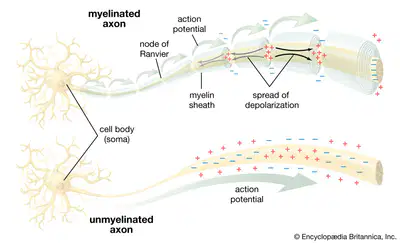
17
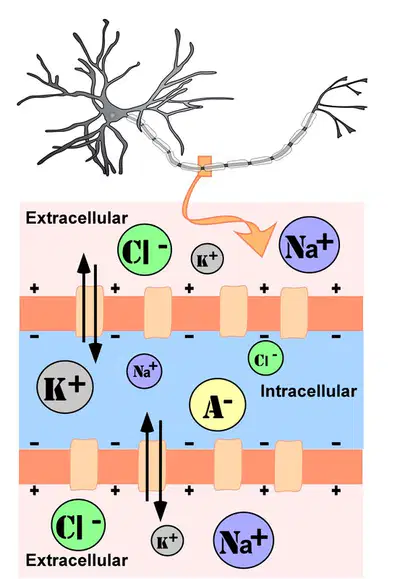
Nerve impulse is a result of a change in the concentration of sodium (Na+) and potassium (K+) ions across the membranes of the neuron.
18
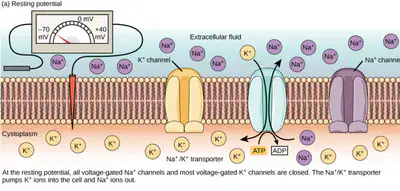
Na+ is pumped out, K+ is pumped in.
K+ ions leak out.
As a result, the outside of the cell is more positive, the inside of the cell is more negative
( - 70 mV)
19
Resting Potential
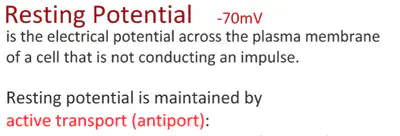
electrical potential
across the membrane when the cell is at rest
-70 mV
20
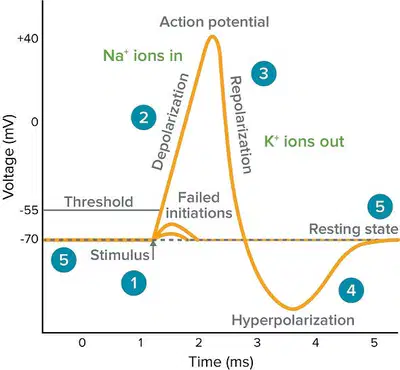
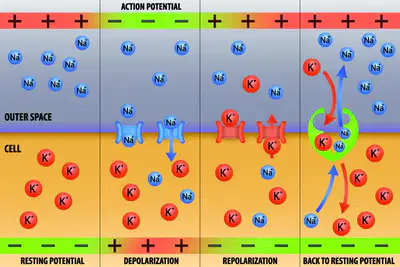
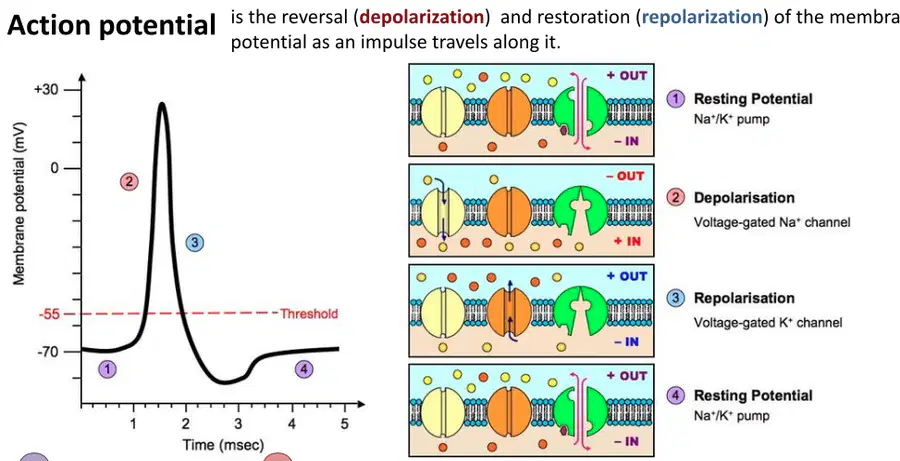
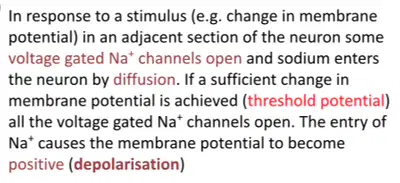
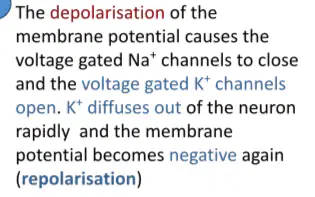
When a stimulus is received, voltage-gated channels open ( Na channels and then K channels) , an "action potential" occurs.
21
Action Potential
a. Depolarization
b. Repolarization
c. Hyperpolarization
22
23
24
25
26
Let's deepen our understanding further
Think - Write- Ask- Answer
Think of 3 questions about the topic.
Write these questions down.
Ask your partner to ask you the questions you've written.
Answer the questions verbally.
27
Understanding # 2: Myelination of nerve fibers allow for SALTATORY CONDUCTION
28
Basic Parts of the neuron:
1. cell body (soma)
- integrates incoming signals and
generates outgoing signals
2. nerve fibers
a. dendrites
- neuron to neuron
- conduct impulse to the soma
b. axon
- passes signals to other dendrites or effector cells
29
Impulse Conduction
Caused by an electrical current
Impulse transmission results from the flow of charged particles from one point to another.
In the body, whenever ions with opposite electrical charges are separated by a membrane, the potential exists for them to move toward one another. This is called membrane potential.
•A membrane that exhibits membrane potential (an excess of positive ions on one side of the membrane and an excess of negative ions on the other side) is said to be polarized.
30
Multiple Choice
Impulse transmission results from the flow of
membrane potential
charged particles
negative ions
31
Impulse Conduction: Step 1 Resting Potential
When a neuron is not conducting an electrical signal, the interior has a negative electrical charge and the exterior has a positive charge.
The outside of the cell is rich with sodium ions (Na+), whereas the inside contains an abundance of potassium ions (K+).

32
Impulse Conduction: Step 1 Resting Potential
The interior also contains other large, negatively-charged proteins and nucleic acids. These additional particles give the cell’s interior its overall negative charge.
33
Impulse Conduction: Step 1 Resting Potential
This state of being inactive and polarized is called resting potential. The neuron is resting, but it has the potential to react if a stimulus comes along.
34
Multiple Choice
The state of being inactive and polarized
Resting potential
Impulse conduction
35
Multiple Choice
When a neuron is not conducting an electrical signal, the interior has a negative electrical charge and the exterior has a positive charge.
True
False
36
Impulse Conduction: Step 2 Depolarization
A stimulus (such as chemicals, heat, or mechanical pressure) causes channels on the neuron’s membrane to open and Na+ from outside the membrane rushes into the cell.

37
Impulse Conduction: Step 2 Depolarization
•The addition of the positively charged ions changes the charge of a region of the cell’s interior from negative to positive. As the membrane becomes more positive, it is said to depolarize.
38
Multiple Choice
Depolarization is when the membrane becomes more ___________ charged
Negatively
positively
39
Impulse Conduction: Step 3 Action Potential
If the depolarization goes above the threshold level, adjacent channels also open, which allows more Na+ to enter. This creates an action potential, which means that the neuron has become active as it conducts an impulse along the axon. (Another term for action potential is nerve impulse.)

40
Step 4 Repolarization
The sudden influx of Na+ triggers other channels to open; this allows K+ to flow out of the cell.
Soon after K+ begins to exit, the Na+ channels shut to prevent any more Na+ from flowing into the cell.
This repolarizes the cell; however, Na+ and K+ are now flip-flopped, with the outside containing more K+ and the inside containing more Na+.

41
42
Synapses
As impulses move from one neuron to the next, they pass through a synapse:
1.When an action potential reaches a synaptic knob, the membrane depolarizes. Ion channels open and calcium ions enter the cell.

43
Synapses
2.The infusion of calcium causes vesicles to bind to the cell wall and release their store of a neurotransmitter into the synapse.
3.The neurotransmitter binds to receptors on the postsynaptic membrane. Each neurotransmitter has a specific receptor. (For example, the neurotransmitter epinephrine can only bind to receptors specific to epinephrine.)
44
Synapses
2.The infusion of calcium causes vesicles to bind to the cell wall and release their store of a neurotransmitter into the synapse.
3.The neurotransmitter binds to receptors on the postsynaptic membrane. Each neurotransmitter has a specific receptor. (For example, the neurotransmitter epinephrine can only bind to receptors specific to epinephrine.)
45
Synapses
5.The receptor releases the neurotransmitter, after which it is reabsorbed by the synaptic knobs and recycled or destroyed by enzymes (as shown here).
46
Synapses
4.The specific neurotransmitter determines whether the impulse continues (called excitation) or whether it is stopped (called inhibition). If the impulse is inhibitory, K+ channels open and the impulse stops. If the neurotransmitter is excitatory—as shown here—Na+ channels open, the membrane becomes depolarized, and the impulse continues.
47
Synapses
5.The receptor releases the neurotransmitter, after which it is reabsorbed by the synaptic knobs and recycled or destroyed by enzymes (as shown here).
Show answer
Auto Play
Slide 1 / 47
MULTIPLE CHOICE
Similar Resources on Wayground

40 questions
Cardiovascular System Recap
Presentation
•
12th Grade
41 questions
Kinematics Review
Presentation
•
11th - 12th Grade
44 questions
Primary Academic Refresher
Presentation
•
KG
41 questions
Energy flow in food chains
Presentation
•
11th Grade
41 questions
Le langage non verbal
Presentation
•
12th Grade
38 questions
Rhetorical Appeals and Strategies
Presentation
•
9th Grade
43 questions
Viruses
Presentation
•
11th Grade
43 questions
Water Unique Properties Lesson
Presentation
•
11th - 12th Grade
Popular Resources on Wayground
10 questions
Factors 4th grade

Quiz
•
4th Grade
10 questions
Cinco de Mayo Trivia Questions

Interactive video
•
3rd - 5th Grade
13 questions
Cinco de mayo
Interactive video
•
6th - 8th Grade
20 questions
Math Review
Quiz
•
3rd Grade
20 questions
Main Idea and Details
Quiz
•
5th Grade
20 questions
Context Clues
Quiz
•
6th Grade
20 questions
Inferences
Quiz
•
4th Grade
19 questions
Classifying Quadrilaterals
Quiz
•
3rd Grade
Discover more resources for Biology
20 questions
Food Chains and Food Webs
Quiz
•
7th - 12th Grade
18 questions
Population Dynamics
Quiz
•
7th - 12th Grade
50 questions
NC EOC Biology Review part 1
Quiz
•
9th - 12th Grade
10 questions
Ameoba Sisters: Introduction to cells
Interactive video
•
9th - 12th Grade
15 questions
Evidence of Evolution
Quiz
•
8th - 12th Grade
50 questions
Biology Keystone Mixed Review
Quiz
•
9th - 12th Grade
20 questions
NC EOC Biology Review part 1
Quiz
•
9th - 12th Grade
100 questions
Virginia Biology SOL Review
Quiz
•
9th - 12th Grade