Search Header Logo
  1. Resource Library
  2. Science
  3. Biology
  4. Ecological Relationships
  5. Interdependence Of Organisms In Their Environment
Interdependence of Organisms in Their Environment

Interdependence of Organisms in Their Environment

Assessment

Presentation

Science

9th - 12th Grade

Medium

NGSS
MS-ESS1-1, MS-ESS2-5, MS-ESS2-4

+21

Standards-aligned

Created by

Macaylah Britt

Used 11+ times

FREE Resource

78 Slides • 34 Questions

1

media

2

media

3

media

4

media

5

media

6

media

7

media

8

media

9

media

10

media

11

Multiple Choice

Which is an example of an ecosystem?

1

An area of cold climate and communities of different species

2

one elk

3

a group of elks living together in the same area

4

elks, snow rabbits, and owls living in the same area

12

Multiple Choice

What is ecology?

1

the study of interactions between organisms and their environments

2

the study of animals

3

the study of how genes are passed down from generation to generation

4

the study of rocks

13

Match

Match the following levels of classification to the pictures:

Organism

Population

Community

Ecosystem

14

Match

Match the following levels of classification to their definitions:

1 individual

All the same species

All the different living things

All the biotic and abiotic things

Organism

Population

Community

Ecosystem

15

media

16

media

17

media

18

media

19

media

20

media

21

media

22

media

23

media

24

media

25

media

26

media

27

media

28

media

29

media

30

media

31

Multiple Choice

What are the four most important materials needed by living organisms?
1
water, carbon, oxygen, nitrogen
2
water, food, oxygen, carbon
3
water, carbon, nitrogen, phosphorous
4
water, carbon, food, phosphorous

32

Multiple Choice

What converts nitrogen into a useable form for plants and animals?
1
bacteria
2
fungi
3
rain

33

Multiple Choice

Carbon dioxide is added to the atmosphere by
1
Burning fossil fuels 
2
Cellular respiration
3
Decomposing organic matter
4
All answers are correct

34

Multiple Choice

Question image
What is it called when plants give off water vapor as a waste product?
1
condensation
2
evaporation
3
sublimation
4
transpiration

35

media

36

media

37

media

38

media

39

media

40

media

41

Multiple Choice

All the following is classified as a renewable resource, BUT...

1

oil

2

solar

3

water

4

wind

42

Multiple Choice

All the following is classified as a nonrenewable resource, BUT...

1

oil

2

natural gas

3

water

4

coal

43

Multiple Select

A resource is renewable because...

1

it cannot be replaced as fast as people use it.

2

it can be recycled.

3

it can easily be replaced as it is used.

4

it is available in limited supplies.

44

Multiple Select

A resource is nonrenewable because...

1

it cannot be replaced as fast as people use it.

2

it can be recycled.

3

it can easily be replaced as it is used.

4

it is available in limited supplies.

45

media

46

media

47

media

48

media

49

media

50

media

51

media

52

media

53

media

54

media

55

media

56

Multiple Choice

Autotrophic organisms that undergo photosynthesis

1

Producers

2

Consumers

3

Detritivores

4

Decomposers

57

Multiple Choice

Heterotrophic organisms that must consume other organisms for survival

1

Consumer

2

Decomposer

3

Producer

4

Organism

58

Multiple Choice

Question image
An organism that needs to eat other organisms to obtain energy is known as a:
1
Autotroph
2
Producer
3
Consumer
4
Mutualist

59

Multiple Choice

Question image

In this food chain, what is the producer?

1

Plants

2

Freshwater Shrimp

3

Minnow

4

Perch

5

Pike

60

Multiple Choice

Question image

In this food chain, what is the primary consumer?

1

Plants

2

Freshwater Shrimp

3

Minnow

4

Perch

5

Pike

61

Multiple Choice

Question image

In this food chain, what is the secondary consumer?

1

Plants

2

Freshwater Shrimp

3

Minnow

4

Perch

5

Pike

62

Multiple Choice

Question image

If the hawk population decreases, what will happen to the snakes and rabbits?

1

Snakes and rabbits will increase

2

Snakes and rabbits will decrease

3

Snakes will decrease, rabbits will increase

4

Snakes will increase, rabbits will decrease

63

media

64

media

65

media

66

media

67

media

68

media

69

media

70

media

71

media

72

media

73

media

74

media

75

media

76

media

77

Multiple Choice

Question image
Barnacles create home sites by attaching themselves to whales. This relationship neither harms nor benefits the whales. 
1
parasitism
2
commensalism
3
mutualism

78

Multiple Choice

Question image
Yucca flowers are pollinated by yucca moths. The moths lay their eggs in the flowers where the larvae hatch and eat some of the developing seeds. Both species benefit. 
1
parasitism
2
commensalism
3
mutualism

79

Multiple Choice

Question image
Mistletoe extracts water and nutrients from a spruce tree. The spruce tree is harmed. 
1
parasitism
2
commensalism
3
mutualism

80

Multiple Choice

Question image

Which of the following shows the symbiotic relationship between the Rodent and the Bird?

1

Mutualism

2

Commensalism

3

Competition

81

Multiple Choice

Question image
1.  A bee and a flower work together to benefit each other. This is an example of _________________. The bee helps the flower by pollinating it and the flower helps the bee by providing it with nectar. 
1
commensal relationship 
2
parasitic relationship 
3
mutual relationship 

82

Multiple Choice

Question image
Using this picture, what defense is this Hawk Moth displaying?
1
camouflage
2
emitting smells
3
mimicry
4
panting

83

media

84

media

85

media

86

media

87

media

88

media

89

media

90

media

91

media

92

Multiple Choice

Question image

The largest number of individuals that an environment can support long term is...

1

carrying capacity

2

emigration

3

immigration

4

population density

93

Multiple Choice

Question image

What happens if a population grows past its carrying capacity?

1

The population keeps growing

2

The population starts to die off

3

The entire species will go extinct

4

The carrying capacity just increases

94

Multiple Choice

Question image

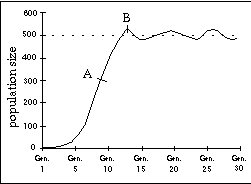
What is the carrying capacity of the graph?

1

1000

2

8000

3

800

4

600

95

Multiple Choice

Question image

What is the carrying capacity of the graph?

1

around 500

2

more than 800

3

less than 300

4

around 700

96

media

97

media

98

media

99

media

100

media

101

media

102

media

103

media

104

media

105

media

106

media

107

media

108

Multiple Choice

What is the main difference between primary and secondary ecological succession?

1

Primary begins WITHOUT soil; Secondary begins WITH soil

2

Primary is the first state and secondary is the second stage

3

Primary builds plant community; secondary builds animal community.

4

Primary begins WITH soil; Secondary begins WITHOUT soil

109

Multiple Choice

Question image
What are examples of pioneer species in a primary succession?
1
Bushes and Shrubs
2
Oak trees
3
Mossess and Lichens 
4
A rose Bush

110

Multiple Choice

Question image

Primary or secondary ecological succession?

1
2

111

Multiple Choice

Which catastrophic event will most likely have the effect of returning an ecosystem to primary succession?
1
A tornado
2
A volcanic eruption
3
A flood
4
A drought

112

Multiple Choice

Question image
After a forest fire, an ecosystem would start regrowth through -
1
primary succession
2
secondary succession
3
climax community
4
limiting factors
media

Show answer

Auto Play

Slide 1 / 112

SLIDE