Search Header Logo
  1. Resource Library
  2. Science
  3. Biology
  4. Ecological Succession
  5. Unit 3: Ecosystems
Unit 3: Ecosystems

Unit 3: Ecosystems

Assessment

Presentation

Science

9th - 12th Grade

Easy

NGSS
MS-LS2-4, MS-LS2-1, MS-LS2-5

+22

Standards-aligned

Created by

Amanda Duncan

Used 7+ times

FREE Resource

10 Slides • 90 Questions

1

media

LS2-1 Carrying Capacity
LS2-5 Carbon Cycle
LS2-7 Human Impacts

Ecosystems

2

Abiotic vs Biotic Factors

3

  • Organism

  • Population

  • Community

  • Ecosystem

​Levels of an Ecosystem

4

  • Keystone species

  • Ecological value

  • Economic value

  • Factors that affect biodiversity

Biodiversity

5

  • Density-dependent

  • Density-independent

  • Population growth

    • Exponential

    • Logistic

    • Carrying capacity

​Limiting factors

6

  • Competition

  • Predation

  • Symbiosis

    • Commensalism

    • Parasitism

    • Mutualism

​Relationships Between Populations

7

  • Primary succession

    • Pioneer species

    • Lichens

  • Secondary succession

​Ecological Succession

8

Carbon Cycle

9

Human Impact

10

Multiple Choice

Biotic factors are

1

Living

2

nonliving

11

Multiple Choice

Abiotic factors

1

living

2

nonliving

12

Multiple Choice

Water would be an example of:

1

Biotic

2

abiotic

13

Multiple Choice

A biotic factor that limits the size of a population would be:

1

food

2

space

3

water

14

Multiple Choice

What abiotic factor would plants compete for?

1

Food

2

Sunlight

3

Parasites

4

predators

15

Multiple Choice

What is a example of a abiotic factor?

1

Panda

2

Bacteria

3

Butterfly

4

Weather

16

Multiple Choice

Temperature, light, air, water, and soil are all  _____  parts of the environment
1
alive
2
biotic 
3
abiotic
4
living

17

Multiple Choice

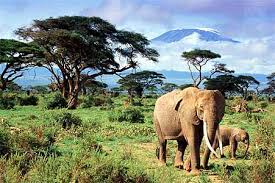
Question image
What are the biotic factors in this image?
1
sunlight, elephants, and grasses
2
sunlight, water,  and air
3
elephants, plants, trees 

18

Draw

Circle the BIOTIC factors

19

Multiple Choice

Question image

The sun is a _______factor

1

Biotic

2

Abiotic

20

Multiple Choice

A group of only one type of organism is a

1

Population

2

Community

3

Ecosystem

4

Niche

21

Labelling

Label the picture.

Drag labels to their correct position on the image

Population

Organism

Community

Biosphere

Ecosystem

22

Dropdown

​ ​
- Organisms that have similar features and can reproduce.

- A group of the same species that live in a certain area.

-  A combination of all the different populations that live and interact in the same environment

- All the living and non-living things that interact in one specific part of the environment.

23

Multiple Choice

Question image

What level of ecological organization do the organisms represent?

1

Species

2

Population

3

Community

4

Ecosystem

24

Multiple Choice

Question image

What level of ecological organization does the bird represent?

1

Organism

2

Population

3

Community

4

Ecosystem

25

Multiple Choice

Question image

What level of ecological organization does this entire picture represent?

1

Organism

2

Population

3

Community

4

Ecosystem

26

Reorder

Reorder the following from least to greatest (from left to right).

organism

population

community

ecosystem

biome

1
2
3
4
5

27

Multiple Choice

What does the root "diversity" mean...

1

living

2

nonliving

3

toxic

4

variety

28

Fill in the Blank

Type answer...

29

Multiple Choice

Question image

How do biodiversity and stability work together?

1

The lower the biodiversity the greater the stability of an ecosystem.

2

The higher the biodiversity, the less stable the ecosystem

3

The higher the biodiversity, the greater the stability of the ecosystem.

4

Biodiversity has nothing to do with ecosystem stability.

30

Multiple Choice

Question image
High biodiversity is 
1
having a lot of the same organism.
2
having a few of the same organism.
3
having a lot of variety of different organisms.
4
only having one of each organism. 

31

Multiple Choice

Question image

Which ecosystem is more likely to survive a change in the environment?

1

One with High biodiversity

2

One with Low biodiversity

32

Multiple Choice

Question image

Which shows more biodiversity Image A or Image B. Why?

1

Image B is more biodiverse, because shows more different species than image A.

2

Image A is more biodiverse, because shows a greater number of organisms that image B

3

Both images show the same biodiversity

33

Multiple Choice

Question image

In this food web example you can see that rain forests have many producers consumer and predators. How would you describe the rain forest biome?

1

It has high biodiversity

2

It has low biodiversity.

34

Multiple Choice

Question image
Which habitat exhibits the greatest biodiversity?
1
A habitat with 15 different species with about 300 individuals each
2
A habitat with 10 different species with about 75 individuals each
3
A habitat with 4 different species with about 150 individuals each
4
A habitat with only one species with about 2000 individual

35

Multiple Choice

Define genetic diversity

1

a variety of genes and traits within a species

2

a variety of ecosystems in a given area

3

system made up of all the living and nonliving things in a given area

4

a variety of species in an ecosystem

36

Multiple Choice

Which statement best describes an example of high biodiversity?

1

A pond ecosystem is populated by a single species of frogs

2

A state park that includes multiple forest and freshwater ecosystems with many different species of fish, birds and frogs in a variety of colors

3

A desert ecosystem is populated by organ pipe cacti, camels, and armadillo lizards

37

Multiple Choice

Why is biodiversity important to ecosystems?

1

It helps populations adapt to ecological changes.

2

It increases at each level of the food chain.

38

Multiple Choice

Which ecosystem below has the HIGHEST biodiversity?

1
2
3

39

Multiple Choice

The more different types of organisms and the more relationships that can occur between organisms the greater the...

1

Species Diversity

2

Genetic Diversity

3

Ecosystem Diversity

40

Multiple Choice

Greater ____________________ means there are more habitats to support different types of organisms.

1

Ecosystem Diversity

2

Species Diversity

3

Genetic Diversity

41

Multiple Choice

The greater the ____________________, the more likely a species is to survive changes to their environment

1

Genetic Diversity

2

Species Diversity

3

Ecosystem Diversity

42

Match

Match the following

population

species

ecosystem

community

biome

43

Multiple Choice

Question image

Which describes symbiosis?

1

the interaction between organisms and abiotic factors in an ecosystem

2

the interaction between two different organisms that are living in close physical association

3

the effects of changing abiotic factors on organisms in their ecosystem

4

the study of interactions between abiotic factors and living organisms

44

Multiple Choice

Question image

Identify the interaction described in the scenario.

Sea Anemones will hitchhike on the backs of hermit crabs, while getting a ride, the anemones use their tentacles to grab leftovers from the hermit crabs’ meals. The sea anemone protects the hermit crab from hungry octopuses.

1

mutualism

2

commensalism

3

parasitism

4

competition

45

Multiple Choice

Question image

Identify the interaction described in the scenario.

Barnacles are crustaceans that are unable to move on their own. During the larval stage, they stick to other organisms such as whales or attach to shells, ships, and rocks. They grow and develop on these surfaces without negatively affecting them.

1

mutualism

2

commensalism

3

parasitism

4

competition

46

Multiple Choice

Question image

The flock of seagulls that are fighting over a single food source (Nemo & Dory) depicts which ecological relationship?

1

Competition

2

Mutualism

3

Cooperation

4

Commensalism

47

Multiple Choice

When there is a lack of resources such as food, water, sunlight, shelter, and space this is often called __________.
1
limiting factors
2
wet
3
messy
4
found in rocks

48

Multiple Choice

Which describes carrying capacity?

1

the number of organisms in an environment

2

factors that limit population size

3

the smallest population an environment can support

4

the largest population an environment can support

49

Multiple Choice

Question image

In the graph to the right, what is the population of deer at the carrying capacity of the environment?

1

3

2

7

3

70

4

40

50

Fill in the Blank

Type answer...

51

Multiple Choice

If the population of a species is greater than its carrying capacity for a long time, what can that do to available resources in its ecosystem?

1

Deplete them completely.

2

Double the amount that was there.

3

Nothing, as there is no causal relation.

4

Triple the amount that was there.

52

Multiple Choice

By which activity can humans change the carrying capacity of the population of a species?

1

Studying the niches (the role an organism plays in a community) of particular species.

2

Compiling a list of habitats in an ecosystem.

3

Manipulating resources in its natural environment.

4

Convincing it to reduce its carbon footprint.

53

Multiple Choice

If a natural disaster devastates an ecosystem, what will this do to the carrying capacity of the population of a species within that ecosystem?

1

Increase it.

2

Will not affect it, so it will stay the same.

3

Always reduce it down to zero.

4

Decrease it.

54

Multiple Choice

What can destroy the amount of resources in an ecosystem?

1

Natural disasters.

2

Tornados only.

3

Hurricanes only.

4

Tsunamis only.

55

Multiple Choice

What happens to the population of a species after it reaches its carrying capacity?

1

Increases linearly (in a straight line) over time.

2

Increases exponentially (line is curved) over time.

3

Decreases to zero in a very short amount of time.

4

Remains relatively the same.

56

Explanation Slide...

57

Match

Match the following

Primary succession

pioneer species

abiotic factor

secondary sucession

climax community

58

Multiple Choice

___ are the first organisms to colonize an area and begin the process of ecological succession.

1

foundational organisms

2

introductory organisms

3

primary organisms

4

pioneer species

59

Multiple Choice

Primary succession occurs in an area that has:

1

Has Soil

2

Has No Soil

3

Has Some Soil

4

none of these

60

Multiple Choice

What is the main difference between primary and secondary ecological succession?

1

Primary begins WITHOUT soil; Secondary begins WITH soil

2

Primary is the first state and secondary is the second stage

3

Primary builds plant community; secondary builds animal community.

4

Primary begins WITH soil; Secondary begins WITHOUT soil

61

Multiple Choice

What is an example of an area that is likely to undergo primary succession?

1

Glaciers melt and leave exposed rock

2

Plants die from drought and decompose

3

Land is bulldozed and soil remains

62

Multiple Choice

Question image
What is ecological succession?
1
A slow change in an environment
2
A change that takes days in an environment
3
No change
4
Abiotic change

63

Multiple Choice

Question image
What are examples of pioneer species in a primary succession?
1
Bushes and Shrubs
2
Oak trees
3
Mossess and Lichens 
4
A rose Bush

64

Multiple Choice

After a volcanic eruption, volcanic rock is present (but no soil). Which of the following states the most likely order of succession that would be seen?

1

Lichens → Shrubs → Grasses → Trees

2

Lichens → tree → shrubs→Grasses

3

Grasses → Lichens → Shrubs → Trees

4

Lichens → Grasses → Shrubs → Trees

65

Multiple Choice

Question image

Primary or secondary ecological succession?

1
2

66

Multiple Choice

Question image
What is the order of succession shown in this figure?
1
A, B, C, D
2
B, A, D, C
3
C, D, A, B
4
D, A, B, C

67

Multiple Choice

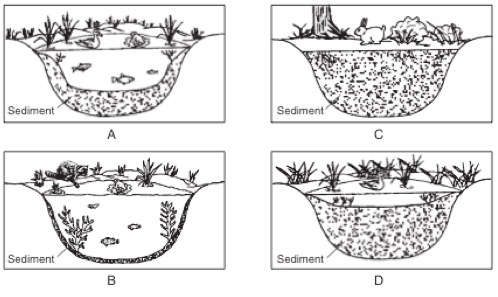
Question image
What is the correct order from oldest (happened first) to youngest (happened last) in this pond succession?
1
A, B, C, D
2
D, C, B, A
3
B, A, D, C
4
C, D, A, B

68

Multiple Choice

Question image

Where does SOIL get its carbon from?

1

The sky

2

The sun

3

Dead animals and plants

4

Worms

69

Multiple Choice

Question image

Where does a TREE get its carbon from?

1

The sky

2

The sun

3

Dead animals and plants

4

Worms

70

Multiple Choice

Question image

Where does the SKY get its carbon from?

1

The sun

2

Animals breathing

3

Water

4

The sun

71

Multiple Choice

Question image

Where do ANIMALS get their carbon from?

1

The sun

2

Other animals breathing

3

The dirt

4

Their food

72

Labelling

Label the following Carbon cycle.

Drag labels to their correct position on the image

sunlight

photosynthesis

animals breathing (respiration)

fossil fuels

73

Dropdown

Carbon ​
is a greenhouse gas. That means that it traps ​
.

74

Multiple Select

*Choose all that apply* What are benefits of photosynthesis?

1

It makes food that plants and animals can use for energy

2

It changes light energy from the sun into a form that can be used by living things

3

It changes carbon into a form that can be used by living things

75

Multiple Choice

How are cellular respiration and photosynthesis related?

1

They are the same reaction, which means that their reactants (starting substances) and their products (ending substances) are exactly the same

2

They are opposite reactions, which means the products (ending substances) of photosynthesis become the reactants (starting substances) of cellular respiration and vice versa

3

Photosynthesis and cellular respiration are not related

76

Multiple Choice

Which of the following removes carbon from the atmosphere?
1
Combustion
2
Respiration
3
Photosynthesis
4
Death

77

Multiple Choice

Organisms that do not decompose can be buried and become what?
1
water
2
nutrients
3
air
4
fossil fuels

78

Multiple Select

Question image

What are two (2) ways to reduce the carbon emissions from passenger cars?

1

Use less expensive gas

2

Carpooling

3

Public Transportation

4

Driving only passenger cars

79

Multiple Choice

Which process removes carbon dioxide from the atmosphere?

1

deforestation

2

tree farms

3

burning fossil fuels

4

cellular respiration

80

Multiple Choice

Which process contributes carbon dioxide to the atmosphere?

1

respiration

2

photosynthesis

3

tree farms

81

Multiple Choice

With the help of the Sun, through the process of photosynthesis, carbon dioxide is pulled from the air to make plant________

1

leaves

2

food

3

roots

4

nutrients

82

Multiple Choice

The average temperature of the surface of Earth has increased approximately 1°C in the past century. Which reason best explains this increase in temperature?
1
lower levels of ozone in the atmosphere
2
lower levels of nitrogen in the atmosphere
3
higher levels of carbon dioxide and other greenhouse gases in the atmosphere
4
higher levels of oxygen in the atmosphere

83

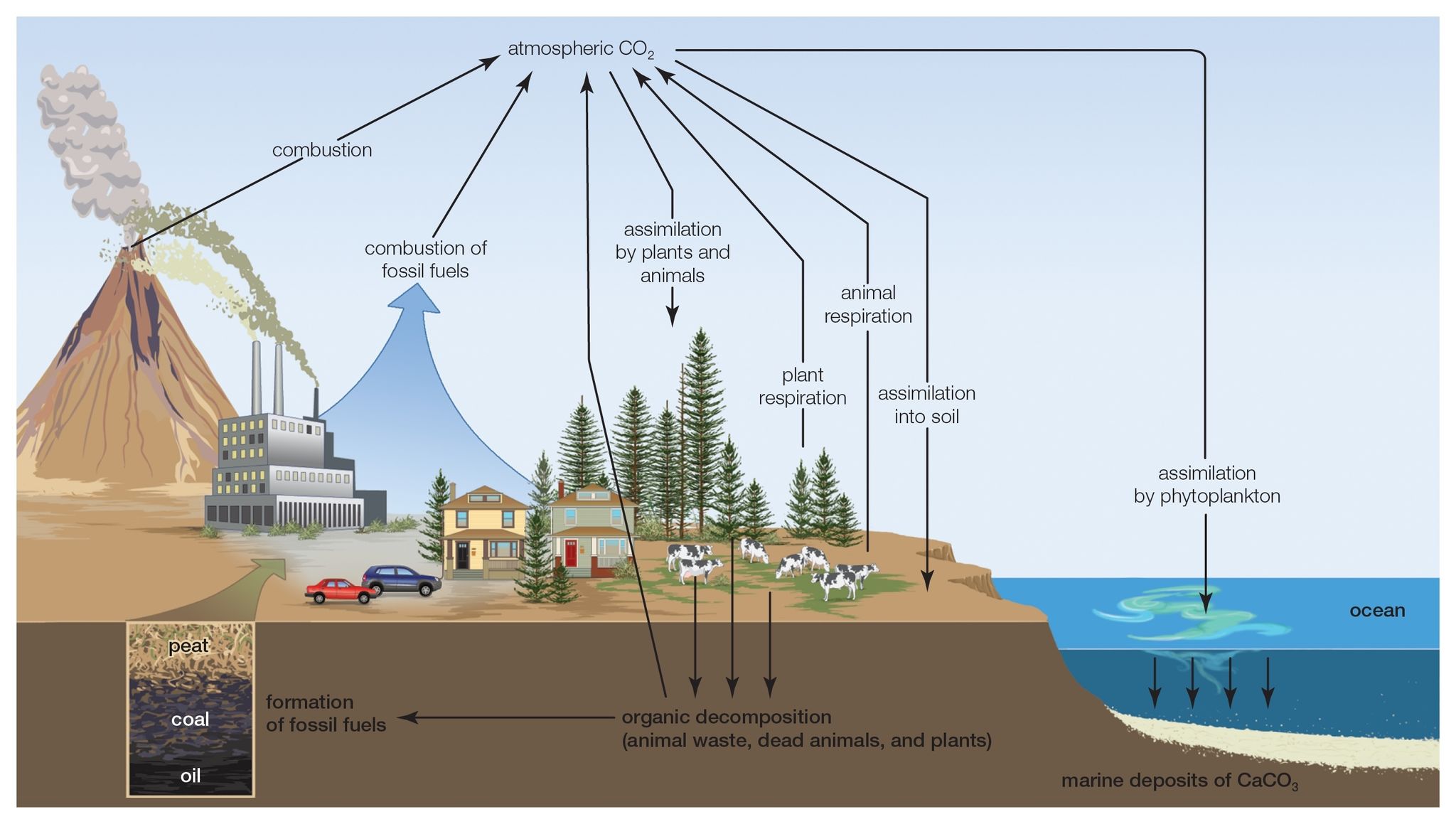
Multiple Choice

Question image
Which of the following add carbon dioxide to the atmosphere?
1
volcanoes
2
combustion of fossil fuels
3
animal and plant respiration
4
all of these

84

Multiple Choice

When humans burn fossil fuels, most of the carbon quickly enters the                       as carbon dioxide.
1
Water
2
Atmosphere
3
Sun
4
Air

85

Multiple Choice

How do living organisms return carbon to the atmosphere in the carbon cycle?
1
respiration and photosynthesis
2
 decomposition and respiration

86

Multiple Choice

Deforestation means...

1

removing the forest

2

adding to the forest

3

mapping the forest

4

polluting the forest

87

Multiple Choice

Burning fossil fuels creates air pollution.

1

True

2

False

88

Multiple Select

What are the consequences of deforestation? Check 2.

1

Decreased biodiversity

2

Increased soil erosion

3

Decreased sunlight

4

Increased oxygen

89

Multiple Choice

How do humans increase erosion?

1

building groynes

2

protecting beach dunes

3

removing plants/trees

90

Multiple Choice

Process that moves sediments and rocks from one place to another.

1

Erosion

2

Deposition

3

Weathering

4

Pollution

91

Multiple Choice

What is the main greenhouse gas?

1

carbon dioxide

2

oxygen

3

nitrogen

4

methan

92

Multiple Choice

Which human activity is correctly paired with its likely future consequence?
1
overfishing in the Atlantic — increase in supply of flounder and salmon as food for people 
2
development of electric cars or hybrid vehicles — increased rate of global warming 
3
use of fossil fuels — depletion of underground coal, oil, and natural gas supplies 
4
genetically engineering animals — less food available to feed the world’s population

93

Multiple Choice

Increased industrialization will most likely
1
decrease available habitats 
2
increase environmental carrying capacity 
3
increase the stability of ecosystems 
4
decrease global warming

94

Multiple Choice

1. Which of the following is not a renewable resource?

1

coal

2

wind energy

3

solar energy

4

water

95

Multiple Choice

1. Why is firewood considered to be a renewable resource?

1

It can be replenished over time.

2

It is used up faster than it can form.

3

It is made from coal.

4

It can be made synthetically.

96

Multiple Choice

1. Which biome has the highest biodiversity and is the most threatened?

1

Temperate forests

2

grasslands

3

tropical rain forests

4

deserts

97

Multiple Choice

Question image

According to the graph, what material’s recycling would reduce the largest portion of America’s trash?

1

Metals

2

paper

3

plastics

4

Yard trimmings

98

Multiple Choice

How do invasive plants damage the environment?
1
Compete with native species
2
Change plant community
3
Alter diversity
4
All of these

99

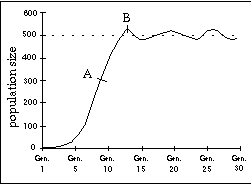
Multiple Choice

Question image

What is the carrying capacity of the graph?

1

around 500

2

more than 800

3

less than 300

4

around 700

100

Multiple Choice

Question image
Which of the following would INCREASE the carrying capacity of an ecosystem?
1
increase in predators
2
disease
3
increase in available food
4
drought
media

LS2-1 Carrying Capacity
LS2-5 Carbon Cycle
LS2-7 Human Impacts

Ecosystems

Show answer

Auto Play

Slide 1 / 100

SLIDE