STAAR Prep 4
Presentation
•
Science
•
9th Grade
•
Medium
+4
Standards-aligned
Jane Claussen
Used 26+ times
FREE Resource
15 Slides • 24 Questions
1
STAAR Prep 4
Evolution and Taxonomy
2
Mock Questions
36, 27, 38, 20, 40, 34, 15, 43, 13
3
Know how evidence of evolution shows common ancestry and that taxonomy shows evolutionary relationships.
I Will...
Review Evolution and Taxonomy
We Will...
Win for the Day...
4
the process of biological change by which descendants come to
differ from their ancestors.
Evolution
5
- Biological Evolution by Natural Selection
- defined evolution as "descent with modification"
- the idea that species change over time, give rise to new species, and share a common ancestor
Charles Darwin
6
Variation: difference in the physical traits of an individual from those of other individuals in the group to which it belongs.
Adaptation: a feature that allows an organism to better survive and reproduce in its environment.
Darwin's Observations
7
Biogeography
Fossils
Homologous Structures
Embryology
Molecular Biology
Evidence of Evolution
8
Multiple Choice
The pictures below show the forelimbs of six different organisms.
Using this picture, which statement is correct?
These forelimbs have similar bones, indicating that the organisms share a common ancestor.
These forelimbs have similar bones, indicating that the organisms all live in the same habitat.
These forelimbs have similar bones, indicating that the organisms all have the same diet.
These forelimbs have similar bones, indicating that the organisms' evolution happened quickly.
9
Multiple Choice
The table below shows information about four organisms with very different looking forelimbs.
What does the table prove about the organisms?
All evolved from different ancestors.
All live in the same environment.
All use their forelimbs to walk.
All share a common ancestry.
10
Multiple Choice
The study of the early stages of development that is one evidence of evolution is:
Homologous Structures
Comparative Embryology
Vestigial Organs
Analagous Structures
11
Match
embryology
homologous
structures
analogous
structures
vestigial
structures
molecular
biology
embryology
homologous
structures
analogous
structures
vestigial
structures
molecular
biology
12
Multiple Choice
Q36: During early stages of development, dolphin embryos begin to develop hind limbs. By the time the dolphin fetuses are fully developed, the hind limbs have disappeared.
Which statement best explains the early development and then disappearance of hind limbs in dolphins?
Dolphin fetuses change their development to adapt to an aquatic environment.
The genes that control the development of hind limbs are destroyed as the fetus develops.
The early ancestors of dolphins had hind limbs.
Dolphins are evolving to become terrestrial animals.
13
Know how evidence of evolution shows common ancestry and that taxonomy shows evolutionary relationships.
I Will...
Review Evolution and Taxonomy
We Will...
Win for the Day...
14
Mechanisms of Evolution
What causes change over time?
Natural Selection: ability to survive and reproduce
Gene Flow: transfer of genetic material from one population to the next
Genetic Drift: change in the frequency of an existing gene variant in a population due to random chance
15
Types of Evolution
Gradualism: evolution that suggests that changes occur slowly and constantly overtime.
Punctuated Equilibrium: evolution that suggests very short, rapid periods of change followed by long periods of stability
16
Match
Match the following
The survive and reproduce
caused by chance events, decreasing genetic variation
Organism of one population moving to another population adding genetic variation
Change over time
Causes of Change over time
Natural Selection
Genetic Drfit
Gene Flow
Evolution
Mechanisms of Evolution
Natural Selection
Genetic Drfit
Gene Flow
Evolution
Mechanisms of Evolution
17
Multiple Choice
Evolution that is characterized by long periods of stability in the characteristics of an organism and short periods of rapid change such as what is occurring in the image above is called ________________.
punctuated equilibrium
gradualism
no evolution
rapid and gradual
18
Multiple Choice
Evolution that occurred slowly and gradually such as what is occurring in the image above is called ______________.
punctuated equilibrium
gradualism
no evolution
rapid and gradual
19
Multiple Choice
Due to normal migration patterns of the butterfly, a yellow butterfly moved to the orange butterfly population increasing the new populations genetic variation. Which mechanism of evolution caused this occurance?
Gene Flow
Genetic Drift
Natural Selection
20
Multiple Choice
The American Bison was once hunted to the brink of extinction. Due to limited genetics from the small population, researchers and conservationists have added cattle genes to help create genetic variation.
Which type of mechanism of evolution caused the decreased genetic variation in the bison?
Genetic Drift
Natural Selection
Gene Flow
21
Multiple Choice
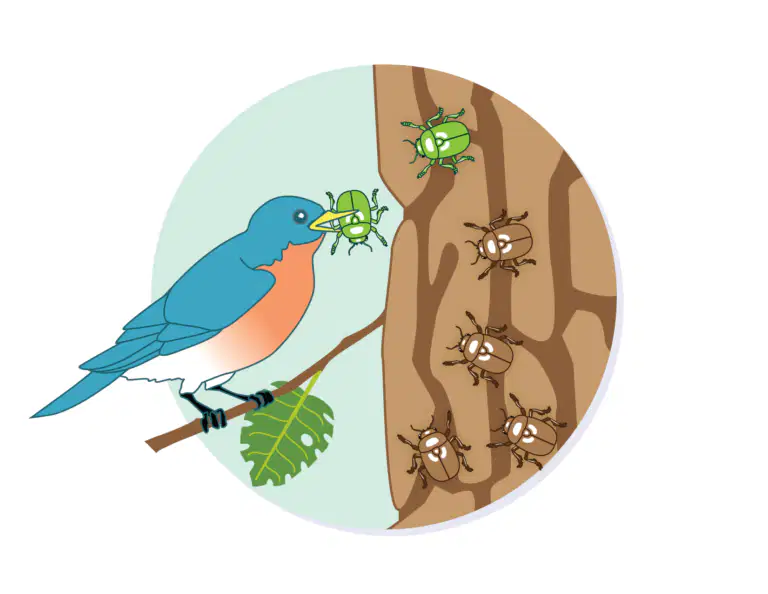
The biological fitness of the brown beetle allows it to blend in with its habitat so that it can continue to survive and reproduce. This is an example of which type of mechanism of evolution?
Natural Selection
Gene Flow
Genetic Drift
22
Multiple Choice
Q27: Certain species of the coral-like sea organisms called bryozoans first appeared about 140 million years ago. They remained unchanged for the first 40 million years and then suddenly experienced rapid genetic change.
Which process would BEST account for the pattern of evolution in bryozoans?
Convergent evolution
differentiation
punctuated equilibrium
gradualism
23
Multiple Choice
Q38: The figure shows fossilized and living stalk-eyed flies from the family Diopsidae. In fossils, the eye spans of the flies are much smaller than those of living flies.
Which question would BEST help determine whether the change in eye span in stalk-eyed flies was influenced by natural selection?
Is the eye span of male stalk-eyed flies similar to that of female flies?
What is the relationship between the body length and eye span of stalk-eyed flies?
How does the eye span of stalk-eyed flies compare from one generation to the next?
Do fossilized stalk-eyed flies have a shorter body length than living flies?
24
Multiple Choice
Q20: The salamanders of the genus Ambystoma in northeastern North America are an entirely female population that reproduces asexually through the process of cloning. However, they have developed a way of inserting DNA from other species of salamanders into their own DNA.
How has DNA from other salamander species helped these Ambystoma salamanders survive environmental changes over the past 6 million years?
By decreasing the mutations that occur in the DNA
By increasing genetic diversity in the population
By making the DNA more similar across the population
By creating many genetically identical individuals
25
Multiple Choice
Q40: The Florida panther (Puma concolor coryi) population had declined to approximately 20 to 30 individuals as a result of habitat loss and hunting. Many of the panthers had genetic mutations due to inbreeding that affected their ability to reproduce and survive. Female Texas pumas (Puma concolor stanleyana) were introduced into Florida to mate with the endangered population of panthers. Hybrid panthers had more genetic variation and reproductive success than the Florida panthers.
Which table best represents the mechanism of evolution and the effect on the gene pool of the Florida panther population?
Mechanism of Evolution: Gene Flow
Event: Texas Puma Introduction
Effect on Genetic Variation: Increased
Mechanism of Evolution: Gene Flow
Event: Hunting and Habitat loss
Effect on Genetic Variation: decreased
Mechanism of Evolution: artificial selection
Event: Texas Puma Introduction
Effect on Genetic Variation: Decreased
Mechanism of Evolution: artificial selection
Event: Hunting and Habitat loss
Effect on Genetic Variation: Increased
26
Know how evidence of evolution shows common ancestry and that taxonomy shows evolutionary relationships.
I Will...
Review Evolution and Taxonomy
We Will...
Win for the Day...
27
Taxonomy
Levels of Classification
(Domain) Kingdom, Phylum, Class, Order, Family, Genus, and Species
Broad/Least Closely Related to Narrow/More closely related
Purpose of Levels of Classification: determine closest relationships/common ancestors
The use of standardized taxonomy (levels of classification): less confusion for those that study it.
Taxonomy Importance:
I.D. organisms
Find evolutionary relationships
28
Multiple Choice
Q34: There are approximately 113 species and subspecies of snakes in Texas. Why would it be important for scientists to use a standardized taxonomic system when naming species of snake?
To ensure that all species of snakes are located in the fossil record
To avoid confusion in the identification of a variety of snake species
To place snakes in various groups based on their habitats in the ecosystem
29
Know how evidence of evolution shows common ancestry and that taxonomy shows evolutionary relationships.
I Will...
Review Evolution and Taxonomy
We Will...
Win for the Day...
30
Levels of Classification
31
Multiple Choice
Q15: Blue whales and narwhals are both marine mammals in Order Cetacea. Which other classification group must these whales share?
family
phylum
genus
species
32
3 Domains:
Bacteria
Archaea
Eukarya
6 Kingdoms:
Eubacteria
Archaebacteria
Protista
Fungi
Plantae
Animalia
33
Multiple Choice
The table was created to describe four organisms.
Organism A is in the kingdom ____________.
Archaeabacteria
Plantae
Protista
Fungi
34
Multiple Choice
The table was created to describe four organisms.
Organism C is in the kingdom ____________.
Archaeabacteria
Plantae
Protista
Fungi
35
Multiple Choice
The table was created to describe four organisms.
Organism D is in the kingdom ____________.
Archaeabacteria
Plantae
Protista
Fungi
36
Match
Prokaryotic
Autotrophic
Heterotrophic
Eukaryotic
Organisms that lack a nucleus
organisms that make their own food
organisms that get their own food
Organisms that have a nucleus
Organisms that lack a nucleus
organisms that make their own food
organisms that get their own food
Organisms that have a nucleus
37
Match
Match the following kingdoms to the make up of their cell walls:
cell wall made of peptidoglycan
no cell wall
cell wall made of cellulose, some have chloroplasts
cell wall made of chitin
Cell wall made of cellulose, all have chloroplasts
Eubacteria
Animalia
Protista
Fungi
Plantae
Eubacteria
Animalia
Protista
Fungi
Plantae
38
Multiple Select
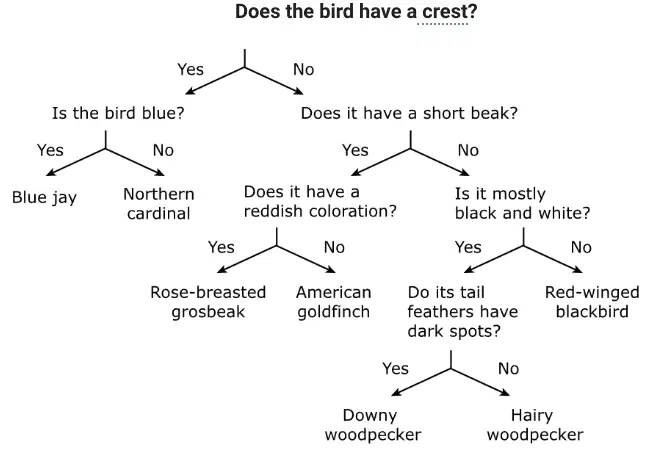
Q43: A student creates a dichotomous key to identify birds.
Based on the key, which two characteristics are shared by the red-winged blackbird and the hairy woodpecker?
Select TWO correct answers.
does not have a crest
is not blue
does not have a short beak
does not have reddish coloration
is not mostly black and white
39
Multiple Choice
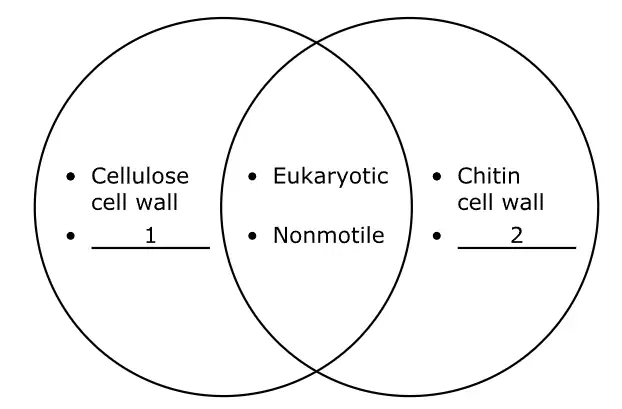
Q12: The Venn diagram compares two kingdoms. Which labels could be used to fill in the blanks?
1. Multicellular
2. Unicellular
1. Unicellular
2. Multicellular
1. Heterotroph
2. Autotroph
1. Autotroph
2. Heterotroph
STAAR Prep 4
Evolution and Taxonomy
Show answer
Auto Play
Slide 1 / 39
SLIDE

Similar Resources on Wayground
33 questions
Chemical Bonding
Presentation
•
8th Grade
34 questions
The central and peripheral nervous system
Presentation
•
9th Grade
36 questions
Distance vs Time Graphs
Presentation
•
9th Grade
31 questions
Determining Half-Life Lesson
Presentation
•
9th Grade
36 questions
Levels of Organization - Cells to Biome
Presentation
•
KG
36 questions
Regulation of Gene Expression
Presentation
•
9th - 10th Grade
34 questions
Carbon, Nitrogen, and Oxygen Cycles
Presentation
•
8th Grade
33 questions
Atoms and the periodic table
Presentation
•
8th Grade
Popular Resources on Wayground
6 questions
Secondary Safety Quiz
Presentation
•
9th - 12th Grade
10 questions
Afterschool Activities & Sports
Quiz
•
6th - 8th Grade
19 questions
ROAR Week 2026
Quiz
•
9th - 12th Grade
20 questions
Lab Safety Quiz
Quiz
•
6th Grade
15 questions
Cool Tool:Chromebook
Quiz
•
6th - 8th Grade
22 questions
would you rather
Quiz
•
3rd - 11th Grade
21 questions
Continents and Oceans
Quiz
•
6th Grade
20 questions
Parts of Speech
Quiz
•
5th Grade
Discover more resources for Science
10 questions
Scientific Method (The scientific method)
Interactive video
•
9th Grade
9 questions
Scientific method
Interactive video
•
9th - 12th Grade
10 questions
Lab Safety Essentials
Interactive video
•
6th - 10th Grade
10 questions
Essential Guidelines for Science Lab Safety
Interactive video
•
6th - 10th Grade
20 questions
States of Matter Quick Check
Quiz
•
9th Grade
14 questions
Flinn Lab Safety
Quiz
•
9th - 12th Grade
10 questions
Exploring the Steps of the Scientific Method for Kids
Interactive video
•
6th - 10th Grade
38 questions
Lab Safety
Quiz
•
9th - 12th Grade