Search Header Logo
Weather Review Grade 8

Weather Review Grade 8

Assessment

Presentation

Science

8th Grade

Hard

NGSS
MS-ESS2-5, MS-ESS2-6, MS-ESS1-1

+12

Standards-aligned

Created by

A. Bleecher

FREE Resource

27 Slides • 36 Questions

1

media
media
media

How’s the Weather Up There?

2

Multiple Choice

Question image

Measures air temperature.

1

Thermometer

2

Barometer

3

Hygrometer

4

Compass

3

Multiple Choice

Question image

Measures air pressure.

1

Thermometer

2

Barometer

3

Hygrometer

4

Compass

4

Multiple Choice

Question image

Measures relative humidity, using the cooling effect of evaporation.

1

Thermometer

2

Barometer

3

Sling Psychrometer

4

Anemometer

5

Multiple Choice

Question image

Measures the amount of rain that has fallen over a specific time period.

1

Wind Vane

2

Hygrometer

3

Rain Gauge

4

Weather Satellite

6

Multiple Choice

Question image

Measures the water vapor content of air or the humidity.

1

Compass

2

Hygrometer

3

Weather Balloon

4

Anemometer

7

Multiple Select

Question image

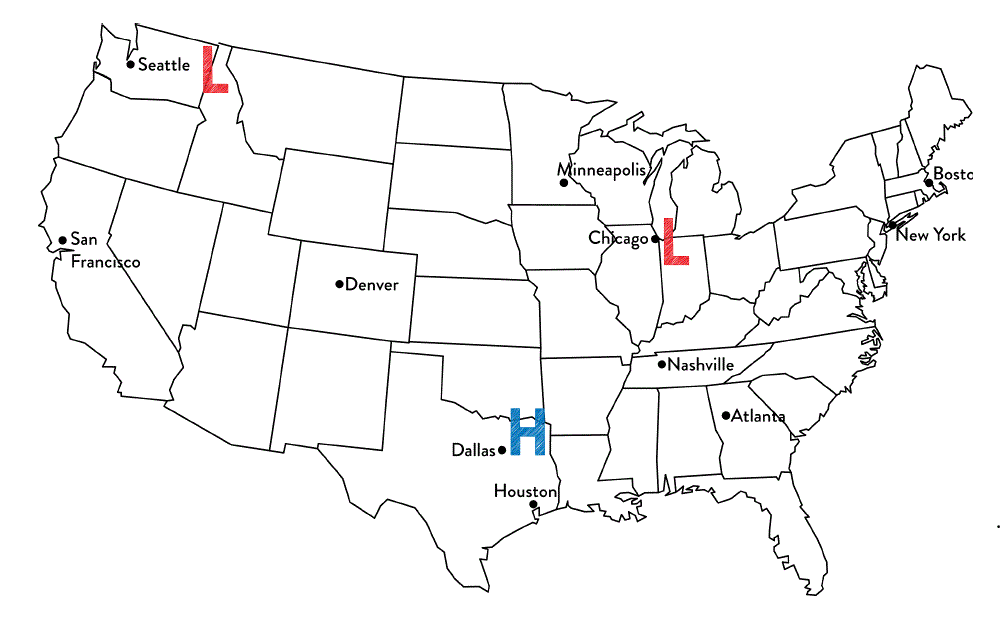
Why do you see precipitation near the L? (select 2 answers)

1

because that is low pressure and that is where air rises, forming clouds

2

because that is where air is falling and it brings rain with it

3

because southern Ohio is always rainy this time of year

4

because the cold front is meeting the warm front which forces warm air to rise rapidly forming clouds

8

Multiple Choice

Question image

You would expect to see clouds forming and possible precipitation

1

in Utah (the H)

2

in Florida

3

in Nebraska (between the H and the L)

4

in Indiana

9

Multiple Choice

Question image

Tim said that Chicago is most likely to experience rainy weather. Jennifer thinks that Dallas is most likely to experience rainy weather.

Which student is correct?

1

Tim because Chicago is the closest to a low pressure system and they produce precipitation.

2

Jennifer because high pressure systems produce precipitation

3

Both students are correct because all systems produce precipitation

4

Neither of the students are correct because the cities are not close enough to the system.

10

Multiple Choice

Question image

What type of weather is Minneapolis most likely experiencing?

1

light/drizzly rain

2

severe thunderstorms

3

sunny skies

4

cloudy skies, light precipitation

11

Multiple Choice

Question image

What type of weather is Denver most likely experiencing? Notice the type of front that has just passed through.

1

High humidity, cooler temperatures

2

Low humidity, cooler temperatures

3

Rainy, cold weather

4

Rainy, humid weather

12

Multiple Choice

Question image

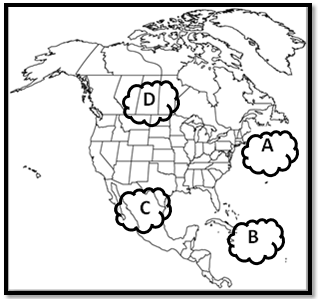
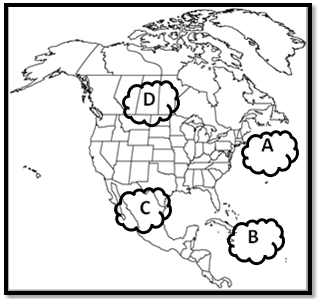
Which location is most likely experiencing warmer temperatures and higher humidity?

1

Location A

2

Location B

3

Location C

4

Location D

13

Multiple Choice

Question image

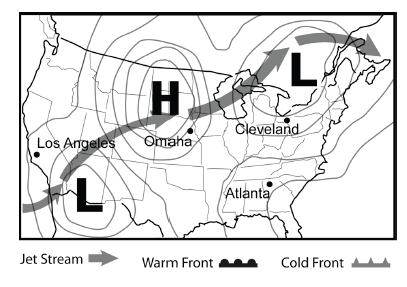
The Jet Stream is a global pattern of atmospheric movement that influences patterns in local weather. Rain and even severe thunderstorms are often associated with the passage of a cold front. Based on this information, and that provided in the weather map, which city shown will most likely experience precipitation in the next few days?

1

Albany

2

Bismarck

3

Nashville

4

San Diego

14

Multiple Choice

Question image

The Jet Stream is a global pattern of atmospheric movement that influences patterns in local weather. In general, one can expect clear skies with a high pressure area and cloudier conditions in areas of low pressure. Based on this information, and that provided in the weather map, which city shown most likely is currently experiencing clouds but will see clearer skies in the near future?

1

Atlanta

2

Cleveland

3

Omaha

4

Los Angeles

15

Multiple Choice

Warm air is ______ dense than cool air. Warm air rises and cool air sinks.

1

less

2

more

16

media
media
media
media
media
media
media
media
media
media

Student Answer Packet 1: To be completed with a partner

1. The included weather maps were created by meteorologists using scientific instruments. Several weather variables are commonly
used to describe weather conditions. If you were making observations and collecting this data in order to determine the relationship
between air mass movements and changes in weather, which three scientific weather instruments would you use to collect this data?
Include the three weather variables being measured in your responses.

Acceptable responses include, but are not limited to:
air pressure is measured with a barometer

air temperature is measured with a thermometer

humidity is measured with a sling psychrometer/ hygrometer

precipitation is measured with a rain
gauge

17

Multiple Choice

rapidly moving cold air  mass runs into a warm air mass the cold air slides under the warm air. This is called a  .....
1
cold front
2
warm front
3
stationary front

18

media
media
media

2. Using the Weather Map Packet, complete the table entitled Weather Data for
Albany below, indicating the weather conditions in Albany, NY at 7:00 a.m. for
January 14 through January 18, 2022.
Criteria to be used for completing the data table:

Air temperature – record numerical value in degrees Fahrenheit
(°F).
Air pressure – record numerical value in millibars (mb).
Precipitation – circle Yes if precipitation is occurring, circle No if precipitation is

not occurring.

Type of precipitation – if precipitation is occurring (Yes is circled), identify the

most likely type of precipitation occurring.

19

Multiple Choice

When a warm air mass gently slides on top of a cold air mass, and you have drizzly rain and then warmer weather, what type of front is it?
1
warm front
2
cold front
3
occluded front
4
stationary front

20

media
media
media
media

Temperature

Air Pressure

21

Multiple Choice

Question image
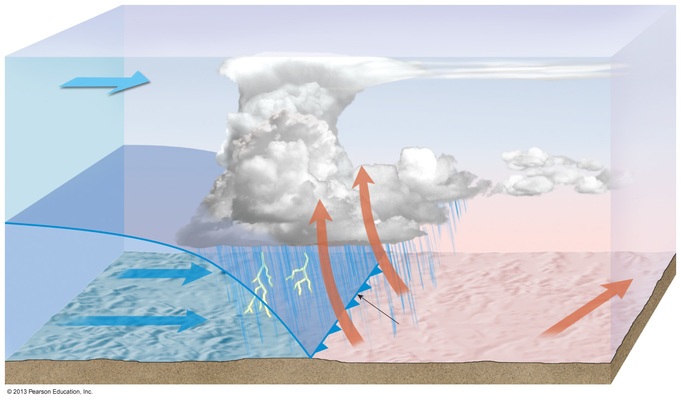
What type of storm front is this? 
1
warm front
2
cold front
3
stationary front
4
occluded front

22

media
media
media

23

Multiple Choice

A front is
1
where warm air is cooling at earth's surface
2
a line where hot and cold air are separating
3
a line where two different air masses meet
4
where cold air is rising and forming rain clouds

24

media
media

25

Multiple Choice

Question image
Which type of air would you find at air mass D?
1
cold, dry
2
warm, humid
3
warm, dry
4
cold, humid

26

media
media
media

2. Using the Weather Map Packet, complete the table entitled Weather Data for
Albany below, indicating the weather conditions in Albany, NY at 7:00 a.m. for January
14 through January 18, 2022.
Criteria to be used for completing the data table:

Air temperature – record numerical value in degrees Fahrenheit (°
F).
Air pressure – record numerical value in millibars (mb).
Precipitation – circle Yes if precipitation is occurring, circle No if precipitation is

not occurring.

Type of precipitation – if precipitation is occurring (Yes is circled), identify the

most likely type of precipitation occurring.

23

-2

-3

18

20

1012 mb
(1012 - 1016)

1028 mb
(1024 - 1032)

1032
(1028 - 1036)
988 mb
(984 - 992)
1006 mb
(1004 - 1008)

Snow

Snow

—-
___

____

27

Multiple Choice

Question image
This is the symbol for a... 
1
Cold Front
2
Warm Front
3
Stationary Front
4
Occluded Front 

28

media
media
media

< 20

1008-1016
Snow

A cold front from the north travels through
Albany, decreasing the air temperature.

A high-pressure system moves in from the
north, increasing the air pressure.

The precipitation along the cold front will pass through
Albany. (There is a shaded area just west of Albany on 1/18.)

The air temperature is below the freezing point (32 ),
causing the precipitation to be snow.

29

Multiple Choice

Question image
This is the symbol for a... 
1
Stationary Front
2
Occluded Front
3
Cold Front
4
Warm Front

30

media
media
media
media

As latitude increases, air temperature generally
decreases.

31

Multiple Choice

Question image
This is the symbol for a... 
1
Stationary Front
2
Occluded Front
3
Cold Front
4
Warm Front 

32

media
media
media
media
media

Rocky
Mountains

The Rocky Mountains have a higher elevation and
colder temperatures are found at higher altitudes.

High Pressure

(Hint: Cold air is more dense!)

33

Multiple Choice

Question image
Identify the type of front that is shown in the image.
1
Occluded Front
2
Cold Front
3
Stationary Front
4
Warm Front

34

media
media

There are many different weather variables that interact and are
constantly changing.
Meteorologists do not know exactly how weather variables will interact
in the future, but make a guess based on available data.
The characteristics of air masses change as the air masses move
across the United States.
There is not enough information/data to make a more accurate
prediction.

35

Multiple Choice

A dry and cold air mass would be...
1
Maritime polar
2
Continental polar
3
Maritime tropical
4
Continental tropical

36

media
media
media
media
media

Low Pressure

Saturday, 1/15

Monday, 1/17

Sunday, 1/16

Missouri & surrounding states

northeast

southeast

Shows a large area of
precipitation around the L.

Shows a large area of
precipitation around the L.

Shows a large area of
precipitation around two L’s.

(Choose 1 Date/ Location/ Evidence)

37

Multiple Choice

A wet and hot air mass would be a...
1
Maritime tropical
2
Maritime polar
3
Continental polar
4
Continental tropical

38

media
media
media

Since warm air is less dense than cold air, it
rises over the cold air when they meet. The water
vapor in the air condenses as the air rises, forming
a cloud that can produce precipitation.
Precipitation falling from a cloud is formed by
warm air rising above cold air because warm air is
less dense. The water vapor in the rising air
condenses, forming a cloud.

39

Multiple Choice

Question image

Which type of air would you find at air mass B?

1

cold, dry

2

warm, humid

3

warm, dry

4

cold, humid

40

media
media
media
media

On Friday, New York City was in a warm air mass and on Saturday, the city
was in a cold air mass.
A cold front passed over New York City between Friday and Saturday, bringing
in cold air behind it.
A cold air mass moved eastward, decreasing the temperature.

41

Multiple Choice

Question image
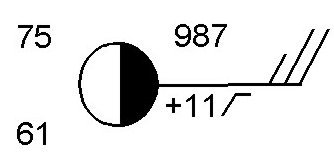
What is the temperature at this station
1
75 degrees
2
61 degrees
3
987 degrees
4
11 degrees

42

media
media
media
media
media
media

The center of a high-pressure system is
located near Ontario, Oregon, and the
center of a low-pressure system is located near
Spokane, Washington. Wind blows from high to
low.

In “Weather
Map Packet”/
Reference
Packet

43

Multiple Choice

Question image
What is the wind speed at this station
1
3 knots
2
15 knots
3
25 knots
4
30 knots

44

media
media
media
media
media
media

The center of the low-pressure system moved from
the Georgia region to the northeast US.
The low moved from Georgia to Pennsylvania.
The area of the precipitation moved up the east
coast.

Northeast OR North

45

Multiple Choice

Should bring nice weather

1

Low pressure

2

Cold front

3

Warm front

4

High pressure

46

media
media
media
media
media

The air mass was formed over the Gulf of Mexico, which is a body of
water close to the equator.
The air mass formed over water and close to the equator.

The temperature is warmer on Sunday than
Saturday.
The temperature increased from Saturday to
Sunday. Precipitation is occurring on Sunday, but not on
Saturday.
It is now raining on Sunday after this air mass moved
over Jacksonville.

47

Multiple Choice

Which of the following best describes the surface wind circulation around the center of a Low pressure system (as seen from above)?

1

counterclockwise and spiraling outward

2

counterclockwise and spiraling inward

3

clockwise and spiraling outward

4

clockwise and spiraling inward

48

media
media

Areas that receive more direct rays heat Earth’s surface, causing
warm air to rise, that eventually cools and falls toward Earth’s surface
at areas that receive less direct rays from the Sun.
Differences in air density are caused by unequal heating of Earth’s
surface. Warmer, less dense air rises (low pressure) and cooler, more
dense air sinks (high pressure).

49

Multiple Choice

The density of the air ______ as you go up in the atmosphere.

1

increases

2

decreases

3

stays the same

50

media
media
media
media
media

The paths of winds on Earth’s surface are
curved because Earth rotates on its axis.
Earth is rotating, causing winds to curve.

Air masses flow in the same direction as the
wind belts/prevailing winds. If you
are located between 30° North and 60° North,
the air masses move from southwest to
northeast.

51

Multiple Choice

In the morning, Carlos noticed that the air pressure reading on the barometer was beginning to drop. What kind of weather can he most likely expect in the evening?
1
The weather will be cloudy with a chance of rain.
2
The weather will be warmer with clear skies.
3
The weather will be clear and windy.
4
The weather will be sunny and cool.

52

media
media
media

53

Multiple Choice

High humidity means the air is unsaturated.

1

True

2

False

54

media
media
media
media

Low air pressures are located in Colorado and precipitation usually
occurs around low-pressure systems, while New York State is next to
a high-pressure system, where precipitation usually does not occur.

The isobars in Colorado are much closer together
than the isobars in New York State.
There is a larger pressure difference in Colorado than
in New York State.

55

Multiple Choice

Overcast skies & steady precipitation (snow or rain) is weather you'd see at what type of front?

1

warm

2

cold

56

media
media
media

Air temperature will increase because a
warm front will move into NY state.

It will decrease because warm air has lower air pressure
than cool air.
It will decrease because warm air from the warm front is less
dense and has lower pressure.
Warm air from the warm front will rise, causing a decrease in
air pressure.

Cloud cover will increase because clouds are presently
behind the warm front. When the front moves over NY State,
it will get cloudy.

An increase in clouds causes an increase in humidity.
Humidity will increase because clouds from the warm front
will enter New York State.

57

Multiple Choice

What type of weather will you see along a cold front?

1

Thunderstorms

2

Sunny skies

3

Gentle rain

4

No weather

58

media
media
media

Temperatures are cooler/lower on the coasts
than in the middle of the country.

59

Multiple Choice

Question image

The table shows the air temperature and dewpoint at each of four locations, A, B, C, and D. Based on these measurements, which location has the greatest chance of precipitation?

1

A

2

B

3

C

4

D

60

media
media
media

Temperatures are warmer/higher on the coasts
than in the middle of the country.

61

media
media
media

Oceans cause coastal climates to be generally
warmer in the winter than climates in the middle of
the United States, and coastal climates to be
generally cooler in the summer than climates in
the middle of the United States.
Oceans cause temperature changes to be not
as great along the coasts as inland locations from
one season to another.

62

media
media

63

media
media
media
media
media

How’s the Weather Up There?

Show answer

Auto Play

Slide 1 / 63

SLIDE